Compare ductless vs central hvac for home additions in Lubbock to find the most efficient cooling solution for your West Texas expansion.
The Definitive Guide to Ductless vs Central HVAC
Why the Right HVAC Choice for Your Home Addition Matters
When it comes to ductless vs central HVAC for home additions, the right system depends on a few key factors: whether your existing system has spare capacity, how your addition is connected to the main house, and how much disruption you're willing to accept during installation.
Here's a quick comparison to help you decide:
| Factor | Ductless Mini-Split | Central HVAC Extension |
|---|---|---|
| Best for | Detached additions, ADUs, sunrooms, garages | Attached additions with accessible ductwork |
| Installation time | 1-2 days | 3-7 days |
| Energy efficiency | Up to 35 SEER2 | Up to 26 SEER2 |
| Duct energy loss | None | Up to 30% |
| Zoned control | Yes, independent per room | Limited without upgrades |
| Disruption level | Minimal (3-inch wall hole) | Moderate to high |
| Works when existing system is maxed out | Yes | No |
| Lifespan | ~20 years | 15-20 years |
Adding square footage to your Lubbock home is exciting. But keeping that new space comfortable when West Texas summers routinely push temperatures past 100°F? That's where many homeowners get stuck — and where the wrong HVAC decision can cause headaches for years to come. Duct energy losses, an overtaxed central system, or a poorly sized mini-split can all leave your new addition too hot in summer and too cold in winter.
The good news is that both systems can work beautifully — when matched to the right situation.
I'm Ronda Rushing Brown, a third-generation leader at Joe Rushing Plumbing, Heating & Air Conditioning with decades of hands-on experience helping Lubbock homeowners navigate decisions exactly like ductless vs central HVAC for home additions. In this guide, I'll walk you through everything you need to know to make a confident, informed choice for your specific situation.
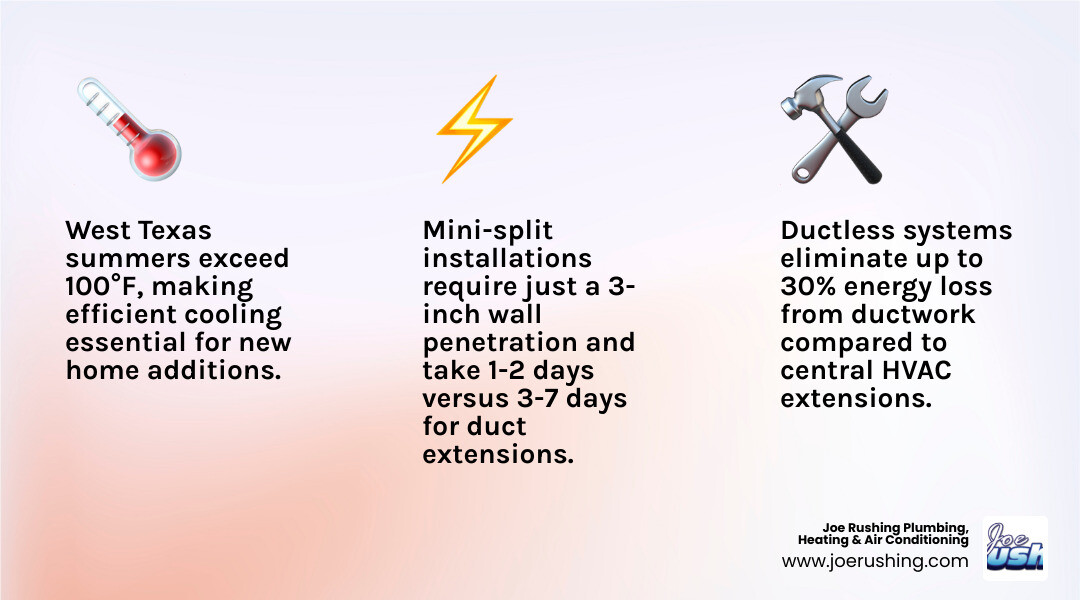
Comparing Ductless vs Central HVAC for Home Additions

When we look at ductless vs central HVAC for home additions, we are essentially comparing two different philosophies of air distribution. A central HVAC system is a "whole-home" solution. It relies on a single, powerful outdoor condenser and an indoor air handler (usually in a closet or attic) to push air through a network of ducts.
On the other hand, a ductless mini-split is a "point-of-use" system. It still has an outdoor condenser, but instead of bulky ductwork, it uses small refrigerant lines to connect directly to one or more indoor air handlers mounted on the wall or ceiling of your new room.
The choice often comes down to the architecture of your addition. If you are building a detached Accessory Dwelling Unit (ADU) or a "casita" in the backyard, running ductwork underground from your main house is not only incredibly difficult but also results in massive energy loss. In these scenarios, a ductless system is almost always the superior choice.
However, if your addition is a simple bedroom extension sharing a wall with your existing HVAC closet, extending your current ductwork might seem like the path of least resistance. But before you make that call, you have to ask: Is a Mini Split Better Than Central Air for Your Home? Often, the answer depends on your existing system's "reserve capacity."
Understanding Ductless Mini-Split Systems
Ductless systems are marvels of modern engineering. Most of these units utilize "inverter technology." Think of a traditional central AC like a light switch—it’s either 100% on or 100% off. This leads to those annoying temperature swings where you're freezing one minute and sweating the next.
Inverter technology works more like a dimmer switch. The system can ramp up or down to maintain a perfectly consistent temperature. This is especially helpful in West Texas, where the afternoon sun can turn a sunroom into an oven in minutes.
With a mini-split, you get true zoned comfort. If your new addition is a home office, you can keep it a crisp 72 degrees during the day while leaving the rest of the house at 78 to save on energy. Ductless AC Replacement in Lubbock Made Simple is a common request we see because homeowners love the ability to control their comfort room-by-room.
Extending Central HVAC for Home Additions
If you decide to extend your central system, we have to look closely at "static pressure." Your existing blower motor was designed to push air through a specific amount of ductwork. When you add a new room and more ducts, you increase the resistance (static pressure).
If your blower isn't powerful enough, you won't just have a hot addition—you’ll actually reduce the airflow to the rest of your house. It’s like trying to water a larger garden by just adding a longer hose to the same weak faucet; eventually, the water barely trickles out of the nozzle.
Before we recommend Air Conditioning Installation Replacement Lubbock TX for an extension, we perform a Manual J load calculation. This ensures your current unit has the "muscle" to handle the extra square footage without burning out the compressor or blower motor prematurely.
Efficiency and Performance in the West Texas Climate
In May 2026, energy efficiency isn't just a buzzword; it’s a necessity for managing Lubbock utility bills. The primary metric we use is SEER2 (Seasonal Energy Efficiency Ratio). Modern ductless systems are the heavyweights here, with some units reaching up to 35 SEER2. In comparison, high-efficiency central systems typically top out around 26 SEER2.
Why the big gap? It mostly comes down to duct leakage and heat gain. In West Texas, many of our ducts run through attics that can reach 150°F. Even well-insulated ducts lose a significant amount of cooling to that heat. Research shows that up to 30% of conditioned air can be lost through leaks or poor insulation in central ducted systems.
Ductless systems eliminate this problem entirely. The cooled air is delivered directly into the room. This is one of the biggest reasons Why Lubbock Homeowners Are Splitting Up with Traditional AC when they add on to their homes.
Energy Savings with Ductless vs Central HVAC for Home Additions
When comparing ductless vs central HVAC for home additions, the energy savings can be staggering. Because ductless systems avoid duct losses and use variable-speed inverter technology, they can reduce energy consumption by up to 40% compared to a conventional ducted system.
For a homeowner in Lubbock or Levelland, this means your new master suite or sunroom won't cause your electric bill to skyrocket. You're only cooling the space when you're actually using it. If you’re interested in these benefits, our team specializes in Ductless Mini Split Installation Replacement Lubbock TX.
Comparing Efficiency and Comfort Features
To help visualize the performance differences, consider these key benefits of ductless systems:
- Zoned Temperature Control: Each room has its own thermostat.
- Superior Dehumidification: The variable-speed operation is excellent at removing moisture from the air, which is vital during our humid late-summer "monsoon" days.
- Independent Operation: If your main house system fails, your addition stays comfortable (and vice versa).
- No "Pinging" Sounds: You won't hear the metal expansion and contraction noises common in ductwork.
Installation Timelines and Home Disruption
One of the most overlooked factors in the ductless vs central HVAC for home additions debate is the "mess factor."
Installing a ductless mini-split is remarkably non-invasive. We only need to drill a small, 3-inch hole through the exterior wall to run the refrigerant lines and power. There's no need to tear into drywall, move load-bearing studs, or lose closet space to new duct runs. Most single-zone installations are completed in just 1 to 2 days.
Extending central HVAC is a much larger project. It often involves cutting into ceilings or walls, rerouting existing electrical or plumbing, and potentially several days of construction dust. For many, Central Air vs Mini Split for Older West Texas Homes comes down to preserving the structural integrity and aesthetics of the home without a week of major construction.
Choosing Ductless vs Central HVAC for Home Additions Based on Space
Certain spaces are "natural" fits for one system over the other:
- ADUs and Casitas: Ductless is the gold standard here. Running ducts between separate buildings is inefficient and expensive.
- Sunrooms: These rooms have high "heat gain" due to all the glass. A dedicated ductless unit can react quickly to the sun coming out, whereas a central system might struggle to keep up.
- Garage Conversions: Garages often have poor insulation and large doors. A mini-split provides the localized power needed to turn a concrete box into a comfortable gym or workshop.
- Attic Suites: Space is at a premium in attics. Not having to find room for bulky ducts allows for higher ceilings and more living space.
Whether you're doing a small remodel or a massive expansion, we provide General Air Conditioning Lubbock TX services to ensure your new space is handled with professional care.
Maintenance and Long-Term Comfort Considerations
Both systems require regular maintenance to survive the West Texas dust. For central systems, this means changing your 1-inch filters every 30 to 90 days and having us inspect the ductwork for leaks or mold every few years.
Ductless systems have permanent filters that you should rinse out every 2 to 4 weeks. It’s a simple task that takes five minutes but makes a huge difference in indoor air quality. Because there are no ducts to collect dust and allergens, many homeowners find that mini-splits actually improve the air quality in their new additions.
Noise is another major comfort factor. Modern mini-splits are "whisper-quiet," often operating at levels as low as 19 to 26 decibels. To put that in perspective, a quiet library is about 40 decibels. You’ll barely hear it running, which is a major win for bedroom additions. The Great AC Debate: Central Air vs Mini Splits for Texas Living often highlights this quiet operation as a top reason for choosing ductless.
Frequently Asked Questions about HVAC for Additions
Can I use a hybrid setup with both systems?
Absolutely! This is one of our favorite solutions. You can keep your reliable central HVAC for the main part of the house and use a ductless mini-split for the "problem zones" or the new addition. This provides a level of redundancy; if one system needs a repair, you still have a comfortable "refuge" in the other part of the house.
Will extending my ducts strain my current AC?
It’s a very real possibility. Most HVAC systems in Lubbock are sized precisely for the original square footage of the home. Adding even 300 or 400 square feet can push a system over the edge. An overtaxed system will run constantly, leading to higher bills and a much shorter lifespan for the compressor. We always recommend a professional capacity check before adding any new vents.
Which system is quieter for a bedroom addition?
Ductless systems win the noise battle every time. Because the noisy part (the compressor) is outside and there is no air rushing through metal vents, the indoor units are nearly silent. If you’re a light sleeper, a mini-split is the way to go.
Conclusion
Choosing between ductless vs central HVAC for home additions doesn't have to be a stressful decision. Whether you're looking for the high-efficiency, zoned comfort of a mini-split or the seamless integration of a central system extension, the key is professional sizing and installation.
At Joe Rushing Plumbing, Heating & Air Conditioning, we’ve been serving the Lubbock community since 1948. As the city's second-oldest plumbing and HVAC company, we bring 77 years of West Texas experience to every job. We are a family-owned, third-generation business dedicated to protecting your home and family.
From our BBB A+ rating and Nextdoor Neighborhood Favorite status to our 24/7 emergency availability, we are here when you need us. Our technicians are fully licensed and insured (TACLA024534C & M-12583) and equipped with the latest technology—including advanced camera inspections and Perma-Liner trenchless pipe repair—to provide non-invasive solutions for your home.
If you’re ready to bring world-class comfort to your new home addition, explore our Ductless Mini Split Solutions or give us a call today. We’ll help you find the perfect fit for your home, your budget, and your lifestyle.
Need HVAC Help?
Our certified technicians are ready to help with all your heating and cooling needs.
Get Free EstimateMore Articles
View All PostsRelated Articles
Ready to Get Started?
Whether you need a repair, maintenance, or a new system installation, our expert team is here to help.