The Great AC Debate: Central Air vs Mini Splits for Texas Living
Joe Rushing
Discover central air vs mini split for south plains homes: efficiency, installation & performance in West Texas heat. Find your ideal cooling solution!
The Great AC Debate: Central Air vs Mini Splits for Texas Living
Central Air vs Mini Split for South Plains Homes: Which One Actually Works Here?
Central air vs mini split for south plains homes is one of the most common questions we hear from homeowners in Lubbock and Levelland — and for good reason. When summer temps regularly push past 100°F and your attic is baking at 140°F, the wrong cooling system doesn't just mean discomfort. It means sky-high energy bills and a system working twice as hard as it should.
Here's a quick answer to help you decide:
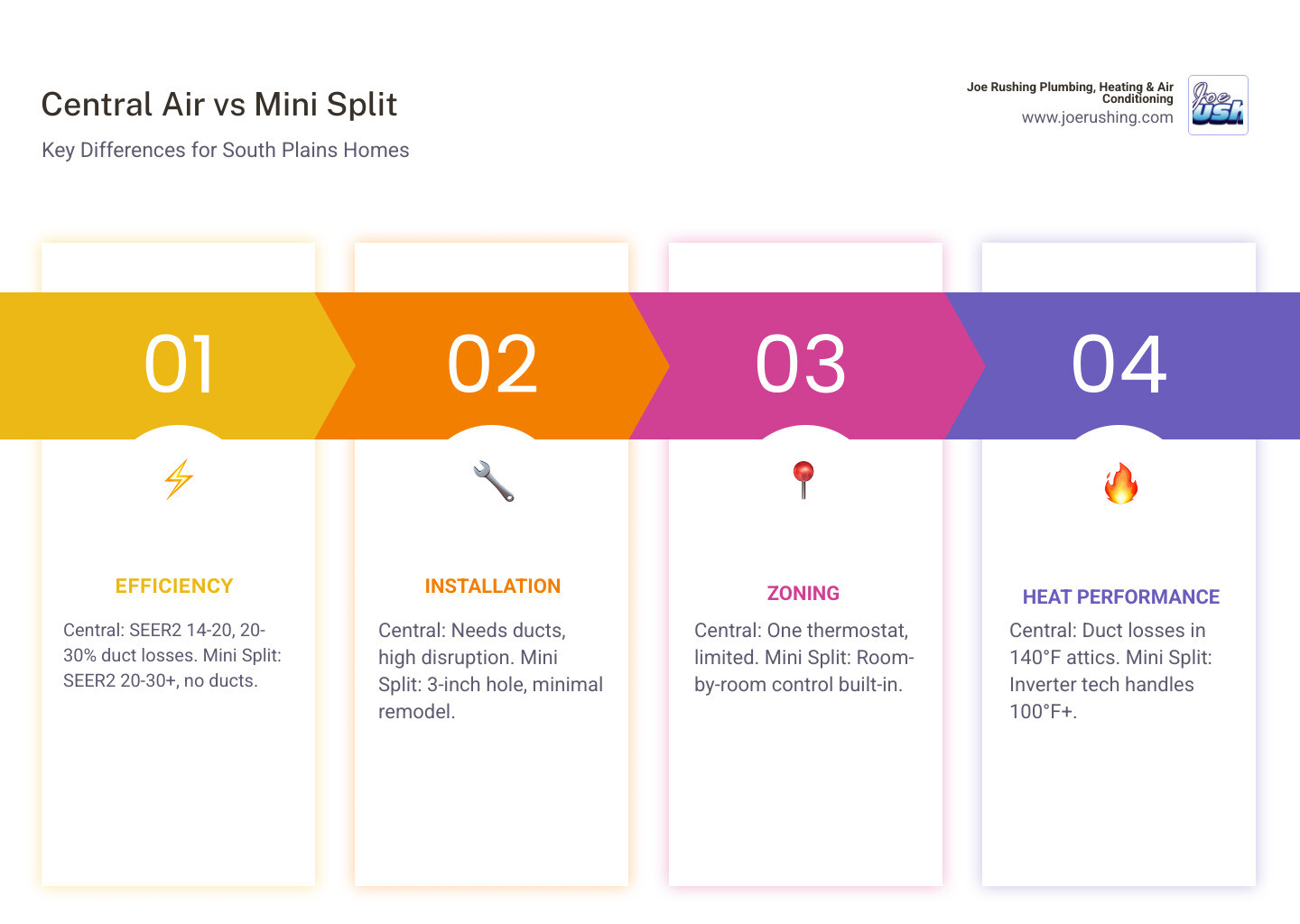
| Factor | Central Air | Mini Split |
|---|---|---|
| Best for | Homes with existing ductwork, large open floor plans | Homes without ducts, older homes, room additions, zoned spaces |
| Energy efficiency | SEER2 14–20; loses 20–30% through duct leaks | SEER2 20–30+; no duct losses |
| Installation disruption | High if no ducts exist | Low — only a 3-inch wall hole needed |
| Zoned control | Limited without upgrades | Built-in, room by room |
| South Plains performance | Effective but duct losses worsen in 140°F attics | Handles extreme heat well with inverter technology |
| Whole-home coverage | Yes, from one thermostat | Yes, with a multi-zone setup |
| Year-round use | Cooling only (unless heat pump) | Both heating and cooling as a heat pump |
The right choice depends on your home's age, existing infrastructure, and how you use your space. Both systems have a real place in West Texas homes — and sometimes the smartest move is using both together.
I'm Ronda Rushing Brown, a third-generation leader at one of the South Plains' longest-running HVAC and plumbing companies, and I've spent years helping Lubbock and Levelland homeowners navigate exactly this decision — central air vs mini split for south plains homes — in one of the most demanding climates in Texas. Read on and I'll walk you through everything you need to know to make the right call for your home.
Understanding Central Air vs Mini Split for South Plains Homes
To settle the debate of central air vs mini split for south plains homes, we first have to look at how these systems actually move air. Central air is the "old school" heavyweight. It uses a single, large outdoor condenser and an indoor evaporator coil (usually tucked in a closet or attic) to chill air, then pushes that air through a spiderweb of ducts to every room. It’s designed for whole-home distribution managed by one central thermostat.
Ductless mini splits, on the other hand, skip the middleman. They consist of an outdoor compressor linked to one or more indoor air handlers by small refrigerant lines. Instead of pushing air through dusty ducts, the indoor units sit directly in the room they are cooling. This localized cooling allows for incredible precision. When you look at our Air Conditioning Services, you’ll see that both systems are staples of Texas comfort, but they serve different architectural needs.
In Lubbock, many of our mid-century homes were built with central air in mind. However, as these homes age, the ductwork often fails. If you’re browsing General Air Conditioning - Lubbock options, you'll find that while central air is great for maintaining a uniform temperature in a large, open-concept ranch, mini splits are the "problem solvers" for hot spots, additions, or homes where the ducts have simply given up the ghost.
How Central Air vs Mini Split for South Plains Homes Differs in Efficiency
When we talk about efficiency in April 2026, we’re looking at SEER2 ratings. Central air systems typically range from 14 to 20 SEER2. That’s respectable, but they face a major enemy in West Texas: the attic. In Lubbock, attic temperatures can soar to 140°F or even 150°F. When your cooled air travels through ducts sitting in that oven, it loses 20% to 30% of its cooling power before it ever reaches your vents.
Ductless Mini Split Systems don't have this problem because they don't use ducts. They deliver 100% of their cooling directly into the living space. Furthermore, mini splits utilize inverter technology. Think of it like a dimmer switch for your AC. While traditional central units often kick on at 100% power and then shut off (wasting energy with every cycle), a mini split’s variable-speed compressor slows down or speeds up to maintain a steady temp.
This is exactly Why Lubbock Homeowners Are Splitting Up with Traditional AC. By switching to a system that doesn't leak air into a sweltering attic, some homeowners see their cooling bills drop by 30% or more. In a climate where the AC runs from April through October, those savings add up fast.
Installation Considerations for Central Air vs Mini Split for South Plains Homes
Installation is where the two systems truly diverge. If your home already has a healthy network of ducts, an AC Installation & Replacement - Lubbock is relatively straightforward. We swap out the old units, and you’re back in business.
But what if you live in one of Lubbock’s beautiful historic homes or a "barndominium" without existing ductwork? Adding ducts to an older home can be a nightmare—it often requires lowering ceilings, destroying original plasterwork, and losing precious closet space. This is where Ductless Mini-Split Installation & Replacement - Lubbock shines.
A mini split installation is non-invasive. All we need is a small 3-inch hole in the wall to run the refrigerant and power lines. We can often have a single-zone unit up and running in just a few hours with zero remodeling required. It preserves the structural integrity of your home while providing modern, high-tech comfort.
Performance in the Extreme West Texas Climate
The South Plains climate is a special kind of beast. We don't just deal with 100-degree heat; we deal with haboobs, fine red dust, and sudden winter freezes. When your system is struggling, you need a reliable AC Repair Service - Lubbock that understands these local variables.
Central air systems are workhorses, but that West Texas dust can be brutal on ductwork. If ducts aren't sealed perfectly, they act like a vacuum, pulling dust and allergens into your air stream. Mini splits, because they are ductless, avoid this "dust-circulating" effect.
In the winter, most mini splits function as high-efficiency heat pumps. While older heat pumps used to struggle when the temperature dropped below freezing, modern units are designed to provide warmth even during our Lubbock "blue northers." If you want to dive deeper into how these systems handle our unique weather, check out Ductless in Lubbock.
Humidity Control and Air Quality in the South Plains
While we are known for "dry heat," our late summer monsoon moisture can make things sticky. Central air systems are designed to dehumidify, but they often do it in short, aggressive bursts. Mini splits, thanks to those variable-speed compressors, run for longer periods at lower speeds. This constant, gentle airflow is actually much better at pulling moisture out of the air, making your home feel cooler at a higher temperature setting.
For those with allergies—a common struggle on the South Plains—mini splits offer multi-stage filtration that doesn't get contaminated by attic dust. If you're looking to breathe easier, Ductless AC Replacement in Lubbock Made Simple explains how these systems act as a front-line defense against the pollen and dust that frequently blow through our region.
Zoned Comfort and Long-Term Reliability
One of the biggest advantages of the mini split in the central air vs mini split for south plains homes debate is zoning. In a traditional home, one thermostat in the hallway controls the whole house. If you're cooking in the kitchen, the bedroom might be freezing while the kitchen stays hot.
With a multi-zone mini split system, every room has its own "brain." You can keep the guest room at 78°F while your bedroom stays a crisp 68°F. This is a game-changer for several types of homes in our Service Areas - Lubbock:
- Barndominiums: Large open spaces that are notoriously hard to heat and cool evenly.
- Garage Conversions: Perfect for turning that dusty garage into a usable home gym or office.
- Older Homes: Where the upstairs always feels 10 degrees hotter than the downstairs.
- Home Additions: Sunrooms or new bedrooms that the original HVAC wasn't sized to handle.
Maintenance and Lifespan Expectations
Regardless of which system you choose, the South Plains environment demands regular care. A central air system needs its ducts inspected and its filters changed religiously to avoid "choking" the motor. Our AC Maintenance & Tune-Up - Lubbock service focuses on keeping those traditional systems running through the peak of August.
Mini splits require a slightly different approach. You’ll need to rinse the indoor filters every few weeks (a simple DIY task in the sink) and schedule a professional deep clean once a year. Because they have fewer moving parts and no ductwork to fail, a well-maintained mini split can easily last 15 to 20 years. If something does go wrong, Ductless Mini-Split Repair Service - Lubbock is usually faster because the components are easily accessible. For the outdoor unit, keeping it clear of Lubbock weeds and tumbleweeds is the best way to ensure a long life. You can find more tips on this at Ductless Mini-Split Maintenance & Tune-Up - Lubbock.
Frequently Asked Questions about South Plains Cooling
Can I use a hybrid setup with both central air and mini splits?
Absolutely! This is actually one of our favorite recommendations. Many Lubbock homeowners keep their existing central air for the main living areas but add a single-zone mini split to a "problem room"—like a master bedroom that won't stay cool or a new home office. This allows you to stay comfortable without replacing your entire HVAC system.
Which system is quieter for indoor use in Lubbock homes?
Hands down, the mini split. Because the noisy compressor is outside and the indoor unit only has a small, whisper-quiet fan, most mini splits operate at about 19 to 30 decibels. That’s quieter than a library. Central air systems often have that "whoosh" of air and the clatter of ductwork expanding and contracting, which can be disruptive at night.
Are there local rebates or incentives for high-efficiency upgrades in Texas?
Yes. As of 2026, there are several federal tax credits (like the 25C credit) that can provide significant savings for installing high-efficiency heat pumps and mini splits. Some local utility providers in the South Plains also offer "peak demand" rebates for homeowners who switch to high-SEER2 equipment. We always recommend checking current local incentives before you buy, as they can change annually.
Conclusion
The "Great AC Debate" doesn't have a single winner—it has the right winner for your specific home. If you have a newer home with well-insulated ducts, central air remains a reliable, invisible way to stay cool. But if you're dealing with an older home, a new addition, or energy bills that make you wince every July, a mini split might be the upgrade you've been waiting for.
At Joe Rushing Plumbing, Heating & Air Conditioning, we’ve been serving Lubbock and Levelland for generations. Whether it’s using our unique underground camera inspections to check your home’s infrastructure or providing non-invasive cooling solutions, we’re here to make sure your home is a sanctuary from the West Texas heat.
Ready to find the perfect fit for your home? Schedule your consultation with Joe Rushing today, and let’s get your South Plains home ready for whatever the Texas sky throws at us next.
Need HVAC Help?
Our certified technicians are ready to help with all your heating and cooling needs.
Get Free EstimateMore Articles
View All PostsRelated Articles
Ready to Get Started?
Whether you need a repair, maintenance, or a new system installation, our expert team is here to help.