How Tree Roots Invade Sewer Lines and How to Stop Them
Joe Rushing
Discover how tree roots invade sewer lines in West Texas. Spot signs, compare fixes & prevent blockages with expert Lubbock inspections.
How Tree Roots Invade Sewer Lines and How to Stop Them
How Tree Roots Invade Sewer Lines — and Why It's a Bigger Problem Than You Think
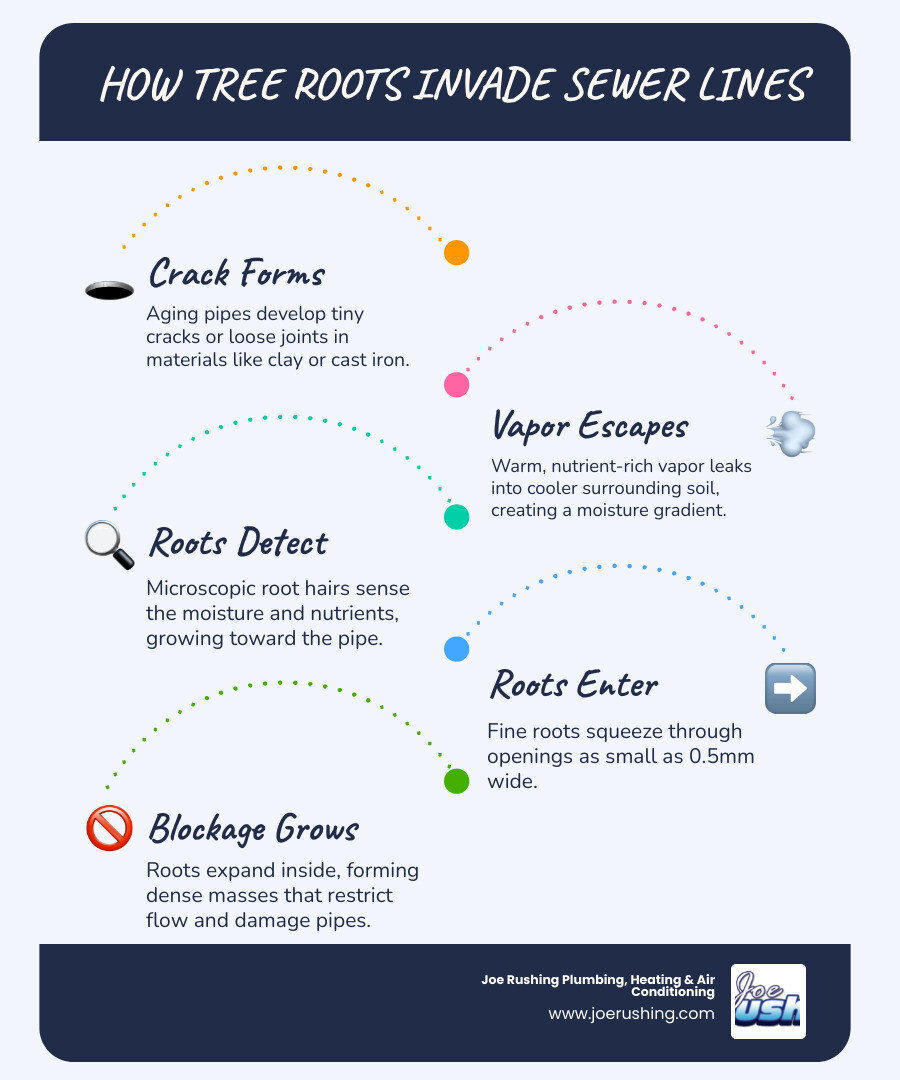
How tree roots invade sewer lines is one of the most damaging — and most overlooked — plumbing problems facing homeowners in Lubbock, TX. Tree roots naturally seek out moisture and nutrients in the soil. When a sewer pipe develops even a tiny crack or loose joint, warm, nutrient-rich vapor escapes into the surrounding soil and acts like a beacon. Roots follow that signal, squeeze through openings as small as half a millimeter, and then grow rapidly inside the pipe — eventually causing blockages, backups, and serious structural damage.
Here's a quick overview of how the process works:
- A crack or gap forms in an aging pipe — often clay, cast iron, or Orangeburg
- Warm vapor escapes from the pipe into cooler surrounding soil
- Fine root tips detect the moisture and nutrient gradient and grow toward the pipe
- Roots enter through the opening — even gaps less than 1 mm wide
- Roots expand inside the pipe, forming dense fibrous masses that trap grease and debris
- Flow is restricted, leading to slow drains, gurgling, backups, and eventually pipe collapse
The EPA estimates between 23,000 and 75,000 sanitary sewer overflows happen across the U.S. every year, with root intrusion being one of the leading mechanical causes. Research also shows that tree roots are responsible for more than 50% of all sewer blockages — making this a widespread problem, not just a rare one.
In Lubbock and surrounding West Texas communities, dry soil conditions push roots to search even harder for moisture — which means local sewer lines are especially vulnerable.
I'm Ronda Rushing Brown, a Registered Nurse turned third-generation family business leader at Joe Rushing Plumbing, Heating & Air Conditioning, and over decades of serving Lubbock homeowners, I've seen how understanding how tree roots invade sewer lines can mean the difference between a simple cleaning and a costly pipe replacement. Read on — we'll walk you through exactly what's happening underground, how to spot it early, and how to stop it for good.
The Science Behind How Tree Roots Invade Sewer Lines
To understand the "how" of root intrusion, we have to look at the biology of a tree. Trees are survivalists. They possess a sophisticated sensory system in their root tips that allows them to detect moisture and nutrient gradients in the soil. Inside your sewer line, the environment is a perfect "root greenhouse": it is warm, humid, and filled with nitrogen, phosphorus, and other nutrients that act as fertilizer.
The intrusion usually starts with microscopic root hairs. These hairs are incredibly small and can find their way into a pipe through a gap as tiny as 0.5mm. This is why Deep Dive into Mainline and Lateral Line Camera Inspections are so critical; a standard visual inspection from the surface can never reveal these microscopic entry points. Once a single root hair penetrates the pipe, it begins to feast on the wastewater. As it grows, it thickens, exerting immense pressure on the pipe material. This pressure can force joints apart or turn a hairline crack into a structural fracture.
Why do tree roots invade sewer lines during West Texas dry spells?
In Lubbock and Levelland, we are no strangers to drought. During these dry periods, the soil moisture evaporates, leaving trees desperate for a drink. This is when "hydrotropism"—the growth of plant roots toward water—kicks into high gear.
Because the water inside your sewer line is warmer than the surrounding West Texas soil, it creates a nutrient-rich vapor. This vapor escapes through tiny leaks or even through the porous walls of older pipe materials. The roots track this vapor gradient like a heat-seeking missile. In May 2026, as we continue to see shifting weather patterns, the search for oxygen and water makes your sewer line the most attractive target in the yard. To see this in action without digging up your lawn, many homeowners rely on a Pipe Camera Inspection in Lubbock TX: A Homeowners Guide to Non-Invasive Diagnostics.
Vulnerable pipe materials and entry points
Not all pipes are created equal when it comes to resisting nature. If your home was built before the 1980s, you likely have one of the following:
- Vitrified Clay: These pipes were standard for decades but are highly susceptible. They are installed in short sections with many joints. Over time, the seals between these sections fail, providing easy access for roots.
- Cast Iron: While strong, cast iron eventually corrodes. This corrosion creates rough patches and holes that roots easily exploit.
- Orangeburg: Made of bituminized fiber (essentially tar paper), these pipes are the most vulnerable. They often flatten or delaminate, allowing roots to tear right through the walls.
- Concrete: Like clay, concrete pipes have many joints and can become porous over time.
Modern PVC is much more resistant because it has fewer joints and those joints are chemically fused. However, even PVC can fail if soil shifts cause a joint to pull apart. Understanding the difference between these materials is a key part of the Sewer Camera Inspection vs. Exploratory Digging: The Ultimate Showdown.
Identifying the Warning Signs of Root Intrusion in Lubbock Homes

Because this battle happens underground, you won't see the roots themselves until they’ve caused a major problem. However, your plumbing will try to tell you something is wrong. In our 77 years of experience serving West Texas, we’ve found that homeowners who catch these signs early save thousands in repair costs. If you notice any of these, it’s time to find Who to Call for a Professional Sewer Camera Inspection in Lubbock TX.
Early indicators of a developing blockage
- The "Gurgle": If your toilet gurgles when you run the bathroom sink or the washing machine, it’s a sign that air is being trapped by a partial blockage.
- Slow Drains: If multiple drains in the house are slow, the problem isn't a simple hair clog in the sink; it’s likely a root mass in the main line.
- Lush Grass Patches: Is one area of your lawn greener or growing faster than the rest? That "free fertilizer" from a leaking sewer pipe is feeding the grass above.
- Sewage Odors: Roots trap debris and grease, which then rot inside the pipe, sending foul smells back up through your drains.
- Sinkholes: In severe cases, the water leaking from a root-damaged pipe can wash away the soil, leading to soft spots or actual depressions in your yard.
To get a definitive answer, we recommend you Stop Guessing and Start Seeing with Lubbock Sewer Camera Inspections.
Short-Term vs. Long-Term Solutions for Root Removal
When we find roots in a line, we have to decide: do we just clear the path, or do we fix the pipe?
| Method | How it Works | Pros | Cons |
|---|---|---|---|
| Mechanical Auger | A motorized snake with blades cuts through roots. | Fast, immediate flow restoration. | Like "pruning a hedge"; roots grow back thicker. |
| Hydro Jetting | High-pressure water (up to 4,000 PSI) blasts roots out. | Cleans pipe walls thoroughly. | Temporary; does not seal the entry point. |
| Chemical Fillers | Foaming root killers (like copper sulfate) kill root tissue. | Can reach the top of the pipe. | Requires regular application; environmental concerns. |
| Trenchless Lining | An epoxy-saturated liner creates a new pipe inside the old one. | Permanent, 50-year solution. | Higher upfront cost than a simple cleaning. |
For those in need of immediate help, our Sewer Line Repair & Replacement Lubbock TX services cover everything from basic clearing to advanced restoration.
How tree roots invade sewer lines and regrow after mechanical cleaning
Many homeowners make the mistake of thinking a quick "snaking" of the drain solves the problem. In reality, mechanical cleaning often triggers the "pruning effect." Just like pruning a hedge makes it grow back thicker and bushier, cutting roots inside a pipe encourages them to send out even more fibrous shoots.
Within 6 to 18 months, the roots often return with a vengeance, creating a denser mass that is even harder to clear. This cycle of "clean and repeat" eventually leads to structural compromise, where the pipe can no longer support the weight of the soil above. This is a common issue we see when providing Sewer Line Repair & Replacement Levelland TX.
Permanent fixes with Perma-Liner trenchless technology
At Joe Rushing, we are proud to be Perma-Liner certified. This is the gold standard for long-term sewer health. Instead of digging up your entire yard, we use a "trenchless" method. We insert an epoxy-saturated sleeve into your existing pipe. Once it cures, it forms a seamless, jointless, "pipe-within-a-pipe."
Because there are no joints or cracks in this new liner, there is nowhere for roots to enter. It effectively "starves" the roots by sealing off the moisture and nutrients they crave. This solution is rated to last 50+ years and is a favorite for Sewer Line Repair & Replacement Wolfforth TX customers who want to save their landscaping.
Preventing Future Blockages and Protecting Your Plumbing
Prevention is always better than a midnight emergency. If you are planning new landscaping, your choices today will dictate your plumbing health in 2030 and beyond. A great place to start is The Homeowners Guide to Preventing Sewer Line Headaches.
Maintenance practices for West Texas homeowners
- Know Your Lines: Before planting, know exactly where your sewer lateral runs.
- Distance Requirements: Plant large trees at least 10 to 15 feet away from sewer lines.
- Root Barriers: You can install physical barriers (plastic or metal sheets) or chemical barriers (strips containing root growth inhibitors) between the tree and the pipe.
- Annual Inspections: If you have mature trees and older pipes, a camera inspection every 1–2 years is the best insurance against a backup.
- PVC Upgrades: If you are doing major yard work, consider replacing old clay sections with PVC to eliminate entry points. We offer these upgrades as part of our Sewer Line Repair & Replacement Shallowater TX services.
Frequently Asked Questions
How quickly do roots grow back after being cut?
In the nutrient-rich environment of a sewer pipe, roots can regrow and cause a total blockage in as little as 6 to 12 months. Growth is most aggressive during the spring and fall, but in the relatively warm West Texas soil, roots can continue to grow even when the tree appears dormant above ground. For residents in Sewer Line Repair & Replacement Slaton TX, we often recommend a monitoring schedule to catch this regrowth.
Can tree roots actually break a solid pipe?
Yes. While they start as fine hairs, they grow in diameter as they consume nutrients. The expansion force of a thickening root is enough to crack concrete, lift sidewalks, and certainly separate the joints of a sewer pipe. Once the pipe is weakened, the surrounding soil can wash into the pipe, leading to a total structural collapse. This is a frequent challenge we address in Sewer Line Repair & Replacement Plainview TX.
Which trees are safest to plant near sewer lines?
If you must plant near a line, choose slow-growing species with non-aggressive root systems. These include:
- Flowering Dogwood
- Japanese Maple
- Eastern Redbud
- Amur Maple
Avoid "water-seekers" like Willows, Silver Maples, American Elms, and Poplars, which are notorious for invading pipes. We often discuss these options with homeowners looking for Sewer Line Repair & Replacement Littlefield TX.
Conclusion
Tree roots are a force of nature, but they don't have to be the end of your sewer system. By understanding how tree roots invade sewer lines, you can take proactive steps to protect your home. Whether it's through a non-invasive camera inspection or a permanent Perma-Liner repair, Joe Rushing Plumbing, Heating & Air Conditioning has the expertise to help.
We’ve been serving Lubbock since 1948, making us the city's second-oldest plumbing company. With 77 years of experience, a BBB A+ rating, and a team of licensed and insured technicians, we know exactly how to handle West Texas plumbing challenges. From Sewer Line Repair & Replacement Brownfield TX to 24/7 emergency services right here in Lubbock, we are here to ensure your pipes stay clear and your home stays protected.
Don't wait for a backup to ruin your day. Contact our expert team for professional sewer solutions and let us help you stop root intrusion for good.
Need HVAC Help?
Our certified technicians are ready to help with all your heating and cooling needs.
Get Free EstimateMore Articles
View All PostsRelated Articles
Ready to Get Started?
Whether you need a repair, maintenance, or a new system installation, our expert team is here to help.