Sewer Camera Inspection vs Exploratory Digging: The Ultimate Showdown
Joe Rushing
Discover if a camera inspection better than digging up your yard saves time, money & landscaping. Expert Lubbock sewer diagnostics revealed!
Sewer Camera Inspection vs Exploratory Digging: The Ultimate Showdown
Is a Camera Inspection Better Than Digging Up Your Yard? Here's What You Need to Know
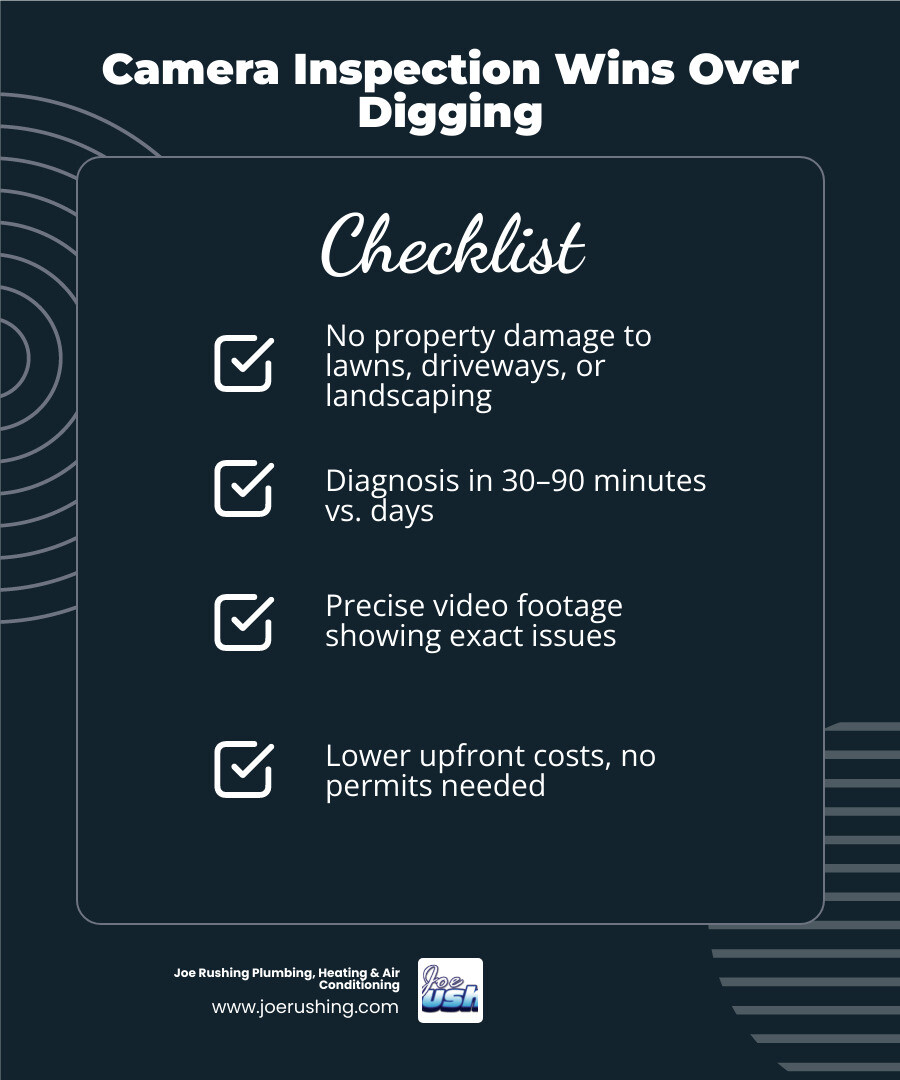
Is a camera inspection better than digging up your yard? Yes — in most situations, a sewer camera inspection is the smarter, faster, and far less destructive way to diagnose what's going on underground. Before anyone breaks ground on your Lubbock or Levelland property, a camera inspection can pinpoint the exact problem inside your pipes in under two hours, without touching your lawn, driveway, or landscaping.
Here's a quick comparison:
| Factor | Camera Inspection | Exploratory Digging |
|---|---|---|
| Property damage | None | Significant — lawn, driveway, plants |
| Time to diagnose | 30–90 minutes | Days |
| Accuracy | Precise — sees the exact issue | Hit or miss — guesswork involved |
| Cost | Low upfront | High — labor, equipment, restoration |
| Permits required | No | Often yes |
| Results | Immediate video footage | Visual only after excavation |
That said, there are situations where digging is still unavoidable — for example, when a pipe has fully collapsed and needs physical replacement. This guide walks you through both methods so you can make a confident, informed decision.
When your drains are backing up or something just feels off with your plumbing, the last thing you want is a crew tearing apart your yard on a hunch. For decades, that was the only option. Plumbers would make an educated guess, dig exploratory holes across your property, and hope they landed close to the problem. Today, sewer camera technology has changed that completely. A small, waterproof camera feeds real-time high-definition video through your pipes, showing exactly what's wrong and precisely where — before a single shovel hits the ground.
I'm Ronda Rushing Brown, a third-generation family business leader at Joe Rushing Plumbing, Heating & Air Conditioning, and I've seen how often homeowners ask is a camera inspection better than digging up your yard — the answer almost always saves them time, money, and a torn-up lawn. Let's break down exactly how these two diagnostic approaches compare so you can see why the choice is usually clear.
How Sewer Camera Technology Works
At Joe Rushing, we treat your plumbing system like a doctor treats a patient. You wouldn't want a surgeon to operate without an X-ray or MRI first, right? Sewer camera technology is essentially the "MRI" for your home’s underground infrastructure.
The process involves a high-definition, waterproof camera mounted on the tip of a flexible rod. This rod is made of fiber-optic cable, allowing it to navigate the twists and turns of your plumbing without getting stuck. As we feed the camera through an existing access point, such as a sewer cleanout or even a roof vent, it transmits real-time video to a high-resolution monitor.
One of the most impressive parts of this technology is the sonde technology. A sonde is a small signal transmitter located inside the camera head. While the camera is underground, we use a handheld receiver above ground to pick up the signal. This allows us to pinpoint the exact location and depth of a problem. If we find a crack or a root intrusion, we don't have to guess where it is under your lawn; we can mark the spot on the surface with sub-millimeter precision.
For a more detailed look at the specifics of different pipe systems, check out our Deep Dive into Mainline and Lateral Line Camera Inspections. Whether it is the main line leading to the city sewer or the lateral lines connecting your home, high-definition footage ensures we see every detail, from hairline cracks to major blockages.
Why is a camera inspection better than digging up your yard?
When you live in West Texas, you know how much work goes into maintaining a healthy lawn or a clean driveway. Traditional excavation—often called "exploratory digging"—is exactly what it sounds like: a search mission. It involves backhoes, shovels, and a lot of dirt.
Is a camera inspection better than digging up your yard when it comes to accuracy? Absolutely. Exploratory digging relies on surface symptoms, which can be misleading. A wet spot in the yard doesn't always mean the pipe is broken directly underneath it; water can travel along the outside of a pipe for yards before surfacing. A camera, however, shows us the internal reality.
| Feature | Camera Inspection | Traditional Digging |
|---|---|---|
| Landscaping | Preserved; no digging required. | Destroyed; requires replanting or sod. |
| Driveways | No impact; cameras go under concrete. | May require cutting and replacing asphalt/concrete. |
| Accuracy | Pinpoints exact footage and depth. | Based on "best guesses" and surface signs. |
| Speed | Completed in about an hour. | Can take several days to dig and backfill. |
By choosing a non-invasive approach, you maintain the structural integrity of your property. Digging deep trenches can sometimes lead to soil settling issues later on, which can affect foundations or walkways. You can learn more about these non-destructive methods in our Pipe Camera Inspection in Lubbock TX: A Homeowner's Guide to Non-Invasive Diagnostics.
Is a camera inspection better than digging up your yard for real estate transactions?
In the 2026 real estate market, transparency is everything. If you are buying a home in Lubbock, a standard home inspection usually only covers what is visible. It won't tell you if the 50-year-old clay pipes are about to collapse or are filled with roots from that beautiful oak tree in the front yard.
A pre-purchase camera inspection provides incredible negotiation leverage. If we find a hidden liability, you can ask the seller for a repair credit or ensure the work is done before you close. For sellers, providing a clean inspection report builds buyer confidence and can actually speed up the sale. It’s about meeting modern standards of due diligence. We provide a full report of our findings, which you can read about here: Affordable Sewer Camera Service in Lubbock TX (and Why You Need a Report).
Is a camera inspection better than digging up your yard for preventative maintenance?
We always say that a $300 root intrusion problem today is much better than an $8,000 pipe replacement next year. Preventative maintenance is where camera technology truly shines. By scheduling an inspection every few years, we can monitor:
- Root Intrusion: Catching tiny "hair" roots before they grow into thick, pipe-breaking woody masses.
- Pipe Scaling: Identifying mineral buildup in cast iron pipes (tuberculation) that slows down drainage.
- Corrosion: Spotting the early signs of thinning pipe walls.
Establishing a baseline record of your plumbing’s health allows us to track changes over time. It’s the difference between being proactive and being in a state of emergency. To see how we help homeowners move from guesswork to certainty, visit Stop Guessing and Start Seeing with Lubbock Sewer Camera Inspections.
Common Sewer Issues Detected Without Excavation

The "eyes" of our high-resolution cameras can spot a wide variety of issues that would otherwise remain hidden until a major backup occurs. In West Texas, we see a few common culprits more than others:
- Root Intrusion: Trees are desperate for water in our climate. They can sense the moisture in a sewer line and send tiny roots through the smallest cracks or joints. Once inside, they feast on the nutrients and expand, eventually acting like a "net" that catches grease and debris.
- Pipe Bellies and Sagging: Over time, the soil under a pipe can shift or settle, causing a section of the pipe to sink. This "belly" creates a pool where waste collects instead of flowing away, leading to chronic clogs.
- Offset Joints: In older clay or concrete pipes, sections can shift out of alignment. This creates a "lip" that catches solid waste and provides an easy entry point for roots.
- Cast Iron Tuberculation: Older Lubbock homes often have cast iron pipes. Over decades, rust and minerals build up on the inside walls, narrowing the diameter of the pipe and creating a rough surface that snags toilet paper and waste.
- Orangeburg Pipe Deformation: Used primarily between 1945 and 1972, Orangeburg is essentially tar-paper pipe. It is notorious for flattening or becoming oval-shaped under the weight of the soil, eventually delaminating and failing completely.
When to Schedule a Professional Inspection
You don't always have to wait for a disaster to call us. In fact, we prefer it if you don't! Here are the key warning signs that it’s time to see what’s happening underground:
- Recurring Clogs: If you are snaking the same drain every three months, you aren't fixing the problem; you're just poking a hole in it. A camera will show you why it keeps coming back.
- Slow Drains: If multiple fixtures in the house are sluggish, the issue is likely in the main sewer lateral.
- Sewage Odors: A persistent smell of sewer gas inside or outside the home often indicates a crack or a dried-out trap that a camera can help locate.
- Lush Grass Patches: If one area of your lawn is significantly greener or faster-growing than the rest, it might be getting "fertilized" by a leaking sewer line.
- Gurgling Toilets: This is often a sign of a venting issue or a partial blockage in the main line.
Whether you've just experienced a major West Texas storm or you're planning a new landscaping project, getting a clear picture of your utility lines is vital. If you’re wondering Who to Call for a Professional Sewer Camera Inspection in Lubbock TX, our team is ready to help with the latest diagnostic tools.
Frequently Asked Questions About Sewer Inspections
Can a camera see through a complete blockage?
If a pipe is completely backed up with standing water and debris, the camera’s "vision" will be obscured—it’s like trying to drive through a thick fog with your high beams on. In these cases, we typically use hydro-jetting or a mechanical drain snake to clear the path first. Once the water drains away, we can insert the camera to see what caused the blockage in the first place.
How long does a typical inspection take?
For most residential properties in Lubbock or Levelland, the actual inspection takes between 30 and 90 minutes. This includes the time to locate an access point, run the camera the full length of the line (usually up to 100 or 200 feet), and record the findings. We can often show you the footage on-site and explain our recommendations immediately.
Are there limitations to what the camera can find?
While cameras are incredible for structural issues, they aren't perfect for every single leak. For example, a camera might not see a tiny pinhole leak if water is only escaping out (exfiltration). In those specific cases, we might recommend hydrostatic testing, which involves plugging the line and filling it with water to see if the level drops. Also, if a pipe has multiple tight 90-degree bends or is smaller than 2 inches, standard sewer cameras may have trouble navigating the entire run.
Conclusion
At Joe Rushing Plumbing, Heating & Air Conditioning, we believe in working smarter, not harder. When you ask is a camera inspection better than digging up your yard, our answer is rooted in over 75 years of serving the Lubbock and Levelland communities. We want to save your rose bushes, your pristine driveway, and your hard-earned money.
If a problem is found, we don't just leave you with bad news. We specialize in Perma-Liner no-dig drain repair, a trenchless solution that allows us to essentially create a brand-new pipe inside your old one without digging a single trench. It is the ultimate follow-up to a non-invasive camera inspection.
Don't leave your home's health to guesswork. Stop wondering what's happening beneath your feet and start seeing it for yourself. Schedule your professional sewer service today and let us give you the peace of mind that comes with a clear, high-definition view of your plumbing system.
Need HVAC Help?
Our certified technicians are ready to help with all your heating and cooling needs.
Get Free EstimateMore Articles
View All PostsRelated Articles
Ready to Get Started?
Whether you need a repair, maintenance, or a new system installation, our expert team is here to help.