Why Your Shower is Weak and How Mineral Scale is to Blame
Joe Rushing
Discover how mineral scale reduces water pressure in pipes. Fix weak showers, clogged lines & hard water issues with expert tips from Lubbock plumbers.
Why Your Shower is Weak and How Mineral Scale is to Blame
Why Your Shower Is Weak: How Mineral Scale Reduces Water Pressure
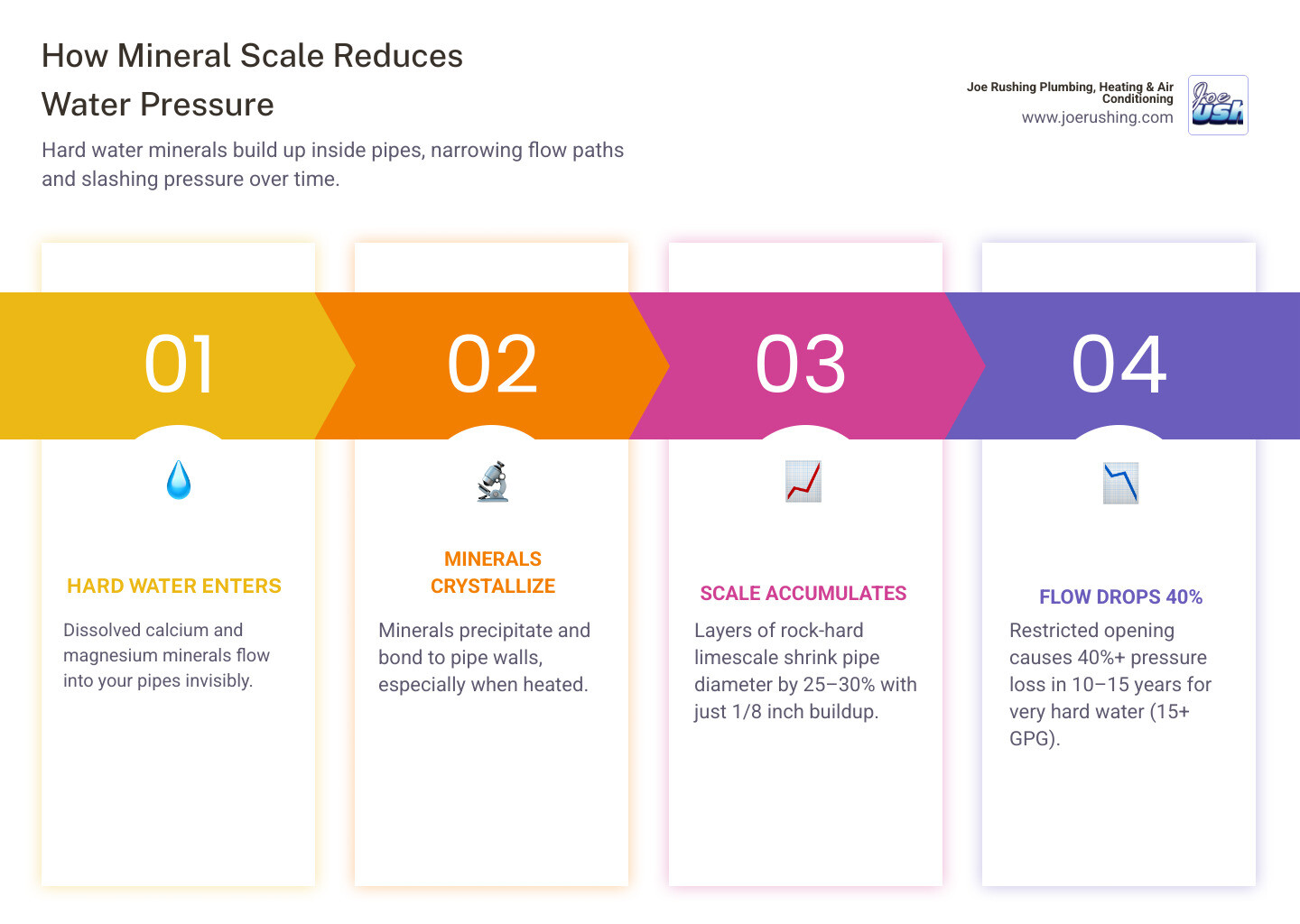
How mineral scale reduces water pressure is simple: hard water leaves behind calcium and magnesium deposits inside your pipes. Over time, these deposits build up into a rock-hard crust called limescale. That crust narrows the inside of your pipes, forcing water to squeeze through a tighter and tighter space — reducing flow until your once-powerful shower feels like a sad drizzle.
Here is a quick breakdown of exactly what happens:
- Hard water enters your pipes carrying dissolved calcium and magnesium minerals.
- Minerals crystallize on the interior pipe walls, especially when water is heated.
- Scale layers accumulate over months and years, steadily shrinking the pipe's inner diameter.
- Water flow is restricted — just 1/8 inch of scale can reduce a pipe's opening by 25–30%.
- Flow drops by 40% or more in homes with very hard water (15+ GPG) within 10–15 years.
If you live in the Lubbock or Levelland area, this is not a rare problem. About 85% of U.S. households deal with hard or very hard water, and West Texas is no exception. The damage is slow, invisible, and easy to ignore — until the day your shower pressure becomes impossible to overlook.
My name is Ronda Rushing Brown, and as a third-generation leader of Joe Rushing Plumbing, Heating & Air Conditioning, I have seen how mineral scale reduces water pressure in homes across our region, quietly robbing families of water flow before they even realize what is happening. If you are noticing weak pressure, especially in your hot water lines, keep reading — we are going to walk you through exactly what is going on inside your pipes and what you can do about it.
Understanding Mineral Scale: The Silent Saboteur of Your Plumbing
To understand why your water pressure is dropping, we first need to look at what exactly is hiding inside your plumbing. Mineral scale—often called limescale—isn't just "dirt" or "sand." It is a hard, rock-like substance formed by dissolved minerals in your water.
In West Texas, our water is often classified as "hard" or "very hard." Water hardness is measured in Grains Per Gallon (GPG). Anything over 7 GPG is considered hard, and many homes in Lubbock and Levelland deal with levels significantly higher than that. These minerals, primarily calcium and magnesium, are invisible while they are dissolved in the water. However, as the water travels through your home, these minerals undergo a chemical change. They precipitate out of the liquid and bond to the surfaces of your pipes, faucets, and appliances.
This is an "inorganic obstruction," meaning it grows like a crystal. It isn't soft like a clog made of hair or grease; it is a permanent, stony layer that gets thicker every single day. While it affects your entire home, it is particularly brutal on Water Heaters, where the heating process speeds up the crystallization.
Common scale-forming minerals include:
- Calcium Carbonate: The primary ingredient in white, crusty limescale.
- Magnesium: Often works alongside calcium to create stubborn deposits.
- Iron Oxide: Can sometimes mix in, giving the scale a reddish or orange tint.
The Science of Clogged Pipes: How Mineral Scale Reduces Water Pressure

Think of your home's plumbing like the arteries in a human body. When arteries are clear, blood flows freely. When they become narrowed by plaque, the heart has to work harder, and the flow is restricted. Your pipes are the same. How mineral scale reduces water pressure is largely a matter of fluid dynamics and "effective diameter."
A standard copper pipe in a home usually has an inside diameter of about 0.5 to 0.75 inches. When just 1/8 inch of scale builds up around the interior wall, it doesn't just take up 1/8 inch of space—it reduces the total opening by 25–30%. This creates a massive amount of friction. Water can no longer glide smoothly along the pipe walls; instead, it hits the rough, jagged surface of the scale, which acts like a brake.
By the time the scale reaches 1/4 inch in thickness, your flow volume can be cut by 40% or more. This is why your shower feels weak. Even if the city is pumping water to your house at the correct pressure, the "bottleneck" inside your own walls prevents that volume of water from reaching your showerhead.
Why how mineral scale reduces water pressure is more aggressive in hot water lines
Have you ever noticed that your cold water seems to have plenty of "zip," but your hot water is just a lazy stream? There is a scientific reason for that. Calcium carbonate has an unusual property: it is less soluble in hot water than in cold water.
When water is heated, the minerals "precipitate" (turn from a liquid state into a solid state) much faster. This is why scale accumulates most aggressively in:
- Hot water exit lines: The pipes leading directly away from your heater.
- Heat Exchangers: Especially in Tank vs Tankless Water Heaters Lubbock systems, where water is heated rapidly in narrow channels.
- Tank Bottoms: In traditional heaters, scale settles at the bottom, creating an insulating layer of "rock" between the burner and the water.
Diagnosing how mineral scale reduces water pressure in different pipe materials
The type of pipes in your Lubbock home will determine how the scale behaves:
- Galvanized Steel: These are the most vulnerable. The scale bonds to the interior zinc coating. As that coating wears away, the scale and rust combine to create a "crusty" mess that can almost entirely seal a pipe shut.
- Copper Pipes: These usually develop smoother, more uniform layers of scale. While it takes longer to completely clog, the reduction in flow is still steady and measurable.
- PEX Tubing: Plastic PEX is much more resistant to scale because its surface is so smooth. However, scale still loves to grow at connection points, elbows, and inside the brass fixtures attached to the PEX.
Signs and Diagnosis: Is Hard Water Choking Your Pipes?
You don't need X-ray vision to know if scale is the culprit. Here are the tell-tale signs we look for during a service call:
- The "Jekyll and Hyde" Pressure: Compare your hot and cold water. If the cold water blasts out but the hot water is weak, you almost certainly have a scale issue in your hot water lines or heater.
- Visible Evidence: Look at your faucets and showerheads. Are there crusty white or green rings? That is scale. If it's on the outside, it is definitely on the inside.
- Cloudy Film: If your glass shower doors or glassware come out of the dishwasher looking cloudy, your water is hard enough to be leaving scale in your pipes.
- The Rumbling Heater: If your water heater sounds like it’s boiling marbles or making a "popping" noise, that is the sound of steam bubbles fighting through a thick layer of scale at the bottom of the tank.
- Faucet Aerator Clogs: Unscrew the small screen (aerator) at the tip of your sink faucet. If it's full of white, pebble-like debris, your pipes are "shedding" scale.
If you're unsure, you can use a water hardness test kit. In West Texas, we frequently see levels above 15 GPG, which is considered "very hard." If you are experiencing these symptoms, we recommend 24-Hour Water Heater Flushing in Lubbock TX to clear out the sediment before it causes a total failure.
Restoring Your Flow: Temporary Fixes and Permanent Solutions
If your shower is weak, you don't necessarily have to replace all your plumbing tomorrow. There are steps we can take to restore your flow.
Temporary Fixes for Fixtures
For immediate relief at the showerhead or faucet, you can use a mild acid to dissolve the scale.
- The Vinegar Soak: Fill a plastic bag with white vinegar, tie it around your showerhead so the nozzles are submerged, and let it sit overnight.
- Citric Acid: For stubborn aerators, soaking them in a citric acid solution can break down the calcium bonds.
Permanent Prevention
To stop the "silent saboteur" for good, you need to treat the water at the point it enters your home.
| Solution | How It Works | Best For |
|---|---|---|
| Salt-Based Softener | Uses ion exchange to physically remove calcium and magnesium. | Very hard water (15+ GPG); homes with heavy staining. |
| Salt-Free Conditioner | Uses Template-Assisted Crystallization (TAC) to keep minerals from sticking. | Moderate hardness; those who want low maintenance. |
| Whole-House Filtration | Removes sediment and chemicals along with some minerals. | Improving overall water taste and pipe health. |
Regular maintenance is also key. Following a Water Heater Flushing Lubbock TX Guide can help you keep your heater clear of the 0.4 pounds of scale that the average hard-water home accumulates every single year.
Protecting Your Home’s Efficiency and Appliances
How mineral scale reduces water pressure is just the beginning of the trouble. It is also a massive drain on your wallet. Scale is a "thermal insulator." When it coats the heating element in your water heater or the bottom of the tank, the heat has to travel through the "rock" before it can reach the water.
Research shows that just 1/4 inch of scale can reduce heat transfer efficiency by up to 40%. In some cases, a heavily scaled water heater can lose up to 48% of its efficiency! This means you are paying for twice as much energy to get the same amount of hot water.
Beyond the water heater, scale wreaks havoc on:
- Dishwashers: Clogged spray arms lead to dirty dishes.
- Washing Machines: Scale can clog the intake valves and the standpipes where the water drains.
- Appliance Lifespan: Most appliances in hard-water areas fail 30–50% sooner than they should.
We recommend an annual system purge or professional descaling to keep these systems running at peak performance.
Frequently Asked Questions about Mineral Scale
How long does it take for scale to cause noticeable pressure loss?
In West Texas, where water is very hard (15+ GPG), you might start noticing a "weaker" shower in as little as 5 to 7 years. However, the most significant "choking" of the pipes usually happens over a 10 to 15-year window. Because the loss is so gradual, many homeowners don't realize how bad it has become until they visit a friend's house and realize their own shower should be twice as strong!
Will installing a water softener remove existing scale?
A water softener is primarily a preventive tool—it stops new scale from forming. However, there is a "clean slate" effect. Once you start running soft water through scaled pipes, the existing deposits can slowly soften and flake off over 1 to 2 years. While this won't fix a pipe that is 90% clogged, it can improve flow in moderately affected systems.
Can I remove scale from inside my pipes without replacing them?
For fixtures and water heaters, professional chemical descaling (using specialized pumps and food-grade acids) can be very effective. However, for the pipes hidden inside your walls, there is no safe "DIY" chemical that can clear them without risking damage to the pipe material itself. If the buildup is irreversible, we often recommend a whole-home repipe using PEX tubing, which is much more resistant to future scale.
Conclusion
At Joe Rushing Plumbing, Heating & Air Conditioning, we have been serving the Lubbock and Levelland communities for generations. We know exactly what West Texas water does to a plumbing system. Whether you are dealing with a weak shower, a noisy water heater, or you want to prevent damage before it starts, we are here to help.
From unique underground camera inspections that let us see exactly what's clogging your lines to our Perma-Liner no-dig drain repair and water damage restoration services, we provide non-invasive solutions to keep your home running smoothly. Don't let mineral scale win the hidden battle inside your walls.
Give us a call today or visit our Plumbing Services page to schedule a professional inspection and get your water pressure back to where it belongs!
Need HVAC Help?
Our certified technicians are ready to help with all your heating and cooling needs.
Get Free EstimateMore Articles
View All PostsRelated Articles
Ready to Get Started?
Whether you need a repair, maintenance, or a new system installation, our expert team is here to help.