Why Your AC Is Turning Into an Icebox for All the Wrong Reasons
Joe Rushing
Discover how dirty filters cause frozen evaporator coils. Fix ice buildup, boost efficiency & stay cool with our expert guide!
Why Your AC Is Turning Into an Icebox for All the Wrong Reasons
Why a Dirty Air Filter Is Quietly Freezing Your AC From the Inside Out
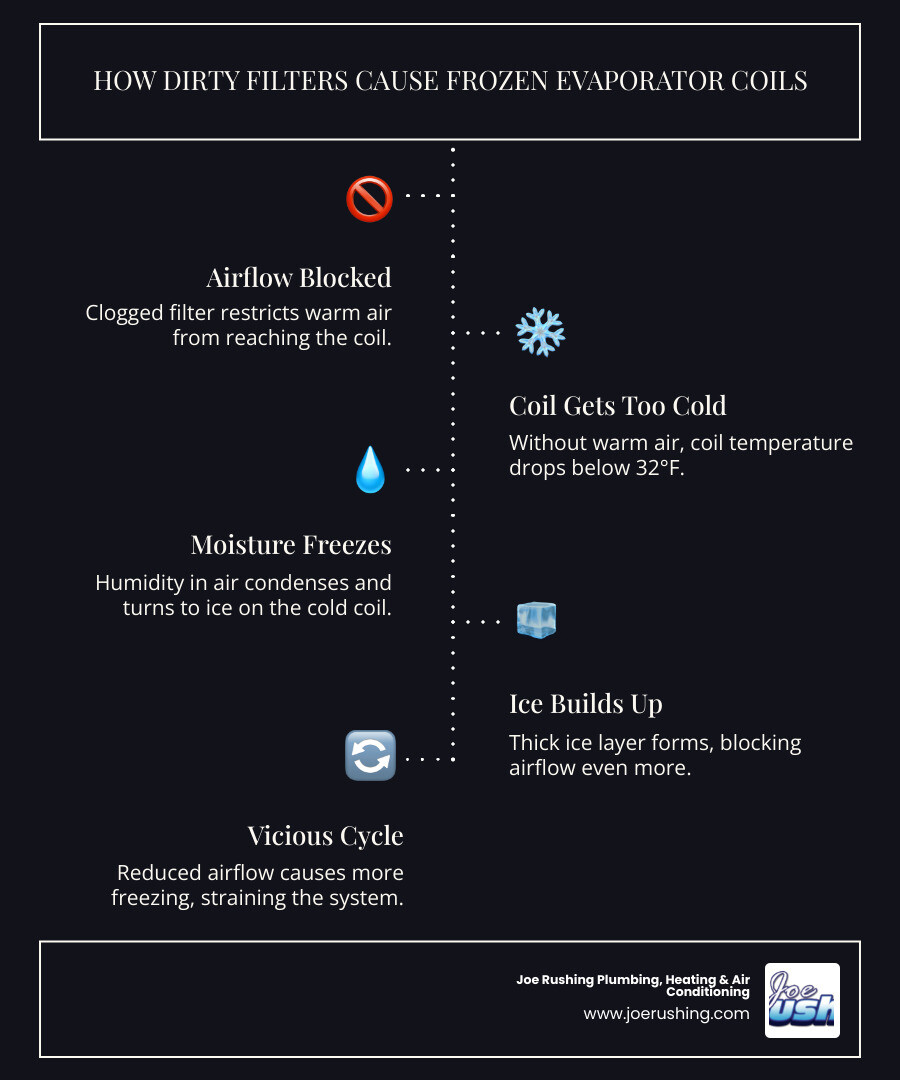
How dirty filters cause frozen evaporator coils comes down to one simple problem: when your filter gets clogged, air can't move freely across the evaporator coil. Without enough warm air flowing over it, the coil gets too cold, drops below 32°F, and the moisture in the air freezes right onto it. Here's the quick version:
- Dirty filter blocks airflow to the evaporator coil
- Coil temperature drops below freezing without enough warm air to absorb
- Moisture condenses and freezes on the coil surface
- Ice builds up, blocking even more airflow and making the problem worse
- System strains or shuts down if left untreated
That one neglected filter can snowball — fast. A severely clogged filter can cause freezing within 24 to 48 hours of continuous operation, and once ice starts forming, it feeds itself. The ice acts as insulation, cutting off more airflow, which causes more freezing, which causes more ice. It's a cycle that can end in a damaged compressor if you don't catch it in time.
The good news? This is one of the most preventable AC problems there is. And understanding exactly what's happening inside your system is the first step to stopping it.
I'm Ronda Rushing Brown, a third-generation family business leader with Joe Rushing Plumbing, Heating & Air Conditioning, and I've seen how something as simple as a forgotten filter can lead to costly repairs — which is exactly why understanding how dirty filters cause frozen evaporator coils is something every homeowner in our area needs to know. Let's walk through everything you need to spot the problem, fix it safely, and keep it from happening again.
The Science of Airflow: How Dirty Filters Cause Frozen Evaporator Coils
To understand why your air conditioner is acting like a walk-in freezer, we have to look at the basic physics of how it cools your home. Many people believe an AC "creates" cold air. In reality, it removes heat.
This process relies on thermodynamic principles. Your system moves refrigerant through a cycle where it changes from a liquid to a gas. This transformation happens inside the evaporator coil, and it requires heat to work. In a healthy system, the warm air from your Lubbock home is blown over these cold coils. The refrigerant inside the coils absorbs that heat, turns into a gas, and carries the heat away to the outdoor unit.
However, there is a delicate balance. The coils are naturally very cold, but as long as they have a steady stream of warm indoor air blowing over them, they stay above the freezing point. When you have a clogged filter, you disrupt this heat exchange. Without that warm air "feeding" the coils, the temperature of the copper and the refrigerant drops below the 32°F threshold.
At this point, moisture condensation—the humidity we often feel in West Texas—turns from water droplets into ice crystals. This involves both latent heat (the energy used during a phase change like water to ice) and sensible heat (the actual temperature drop). Once that first layer of frost appears, it acts as an insulator, making it even harder for any remaining airflow to reach the refrigerant.
Before the summer heat really hits in April 2026, it is vital to ensure your airflow is unobstructed. You can learn more about getting your system ready in our guide on How to Prep Your AC Before the Summer Sun Tries to Melt You.
What Is an Evaporator Coil and How Does It Function?
The evaporator coil is the "business end" of your indoor AC unit. Usually located inside your air handler or attached to your furnace, it consists of a network of copper tubing surrounded by thin aluminum cooling fins.
As the liquid refrigerant enters the coil, it expands. This expansion causes a massive drop in temperature. As your blower motor pushes warm air through the cooling fins, the refrigerant extracts the heat. A secondary benefit of this process is dehumidification; as the air cools, it loses its ability to hold moisture, which drips off the fins into a drain pan. If the coil freezes, this entire process grinds to a halt.
Why a Dirty Filter Is the Most Frequent Cause of Freezing
In HVAC troubleshooting, we often say that a frozen coil is the AC "suffocating." Airflow starvation is the number one reason for this issue. When a filter is caked in dust, pet hair, and West Texas grit, the blower motor can't pull enough air through.
This leads to a dramatic pressure drop within the system. When pressure drops, the temperature of the refrigerant drops along with it. Without enough warm air to keep the coils "warm" (relatively speaking), the ice accumulation cycle begins.
Common airflow inhibitors include:
- Neglected filters: The most common culprit.
- Blocked return vents: Furniture or curtains covering the intake.
- Closed supply registers: Closing too many vents to "save energy" actually starves the system of air.
- Dirty cooling fins: If dust gets past a poor filter, it sticks directly to the coil.
5 Warning Signs Your AC Coils Are Turning Into a Glacier
You don't always have to open up your unit to know you have a problem. Your AC will usually give you a few "cries for help" before it freezes solid. Keeping an eye on these signs is part of a smart A-Z Guide to AC Maintenance Frequency for South Plains Homes.
- Reduced Airflow: If you put your hand up to a vent and the breeze feels like a faint whisper instead of a strong gust, your filter or coils are likely obstructed.
- Warm Air from Vents: If the air coming out isn't cold, the ice on the coils is likely acting as a barrier, preventing the refrigerant from absorbing any heat from the air.
- Hissing Sounds: This can indicate a refrigerant leak, but it can also be the sound of air struggling to squeeze through a tiny gap in a frozen coil.
- High Indoor Humidity: Since a frozen coil can't properly dehumidify the air, your home may start to feel "clammy" or sticky.
- Visible Frost: If you see white frost on the copper pipes leading into your indoor unit or on the exterior of the air handler, you have a "mini-glacier" on your hands.
How Dirty Filters Cause Frozen Evaporator Coils and System Strain
The damage isn't just limited to the ice. How dirty filters cause frozen evaporator coils also involves massive strain on your mechanical components. Your blower motor has to work twice as hard to pull air through a clogged filter, leading to motor overheating and energy spikes on your monthly bill.
Furthermore, the system may begin "short cycling"—turning on and off rapidly—as it struggles to reach the temperature set on the thermostat. By April 2026, efficiency standards will be stricter than ever, and running a frozen system is the fastest way to blow your utility budget and shorten the lifespan of your equipment.
Step-by-Step: How to Safely Defrost Your AC System
If you find a block of ice where your evaporator coil should be, do not keep running the AC. This can cause permanent damage to your compressor, which is a very expensive part to replace.
Immediate Actions to Take When You Spot Ice
- Turn the AC Off: At the thermostat, switch the "Cooling" mode to "Off."
- Switch Fan to "On": Move the fan setting from "Auto" to "On." This keeps the blower motor running without the refrigeration cycle. The room-temperature air blowing over the ice will help it melt naturally.
- Check the Filter: This is the perfect time to slide out that old filter. If it looks gray, furry, or you can't see light through it, throw it away and prepare a fresh one.
- Manage the Water: As the ice melts, it produces a lot of water. Ensure your drain pan isn't overflowing and place towels around the base of the unit to protect your floors.
- Wait: Depending on the thickness of the ice, it can take anywhere from 4 to 24 hours to defrost completely. Do not use a hair dryer or try to chip the ice off with a screwdriver; you could easily puncture the fragile copper coils.
For more tips on keeping your system clean, check out our guide on Spring Cleaning for Your Pipes and AC.
Preventing How Dirty Filters Cause Frozen Evaporator Coils
Prevention is always better (and cheaper) than a repair.
- Check MERV Ratings: Use a filter with a MERV rating between 8 and 11. Higher ratings (like MERV 13+) can sometimes restrict airflow too much for older residential systems unless they are specifically designed for them.
- Stick to a Schedule: In Lubbock and Levelland, the dust can be intense. We recommend checking your filter every 30 days and replacing it at least every 90 days.
- Set Reminders: Use your smartphone to set a recurring alert. Even HVAC pros sometimes forget their own filters!
- Visual Inspection: If you live in a high-dust environment or have multiple pets, you might need to change your filter once a month during the peak of summer.
Beyond the Filter: Other Reasons Your AC Is Freezing Up
While how dirty filters cause frozen evaporator coils is the most common scenario, it isn't the only one. Sometimes, the filter is clean, but the ice still comes back.
| Cause | Symptom | Fix |
|---|---|---|
| Low Refrigerant | Hissing sounds, ice starts at the bottom of the coil | Call a pro to find and fix the leak |
| Dirty Evaporator Fins | Reduced airflow even with a new filter | Professional coil cleaning |
| Blower Motor Failure | No air coming from vents at all | Motor or capacitor replacement |
| Blocked Returns | Hot spots in the house, whistling at the intake | Clear furniture and obstructions |
| Undersized Ductwork | Frequent freezing in a newly installed system | Ductwork evaluation and modification |
If you've ruled out the filter, it's time to dig deeper. The Complete Guide to Annual AC Maintenance - Is It Worth It? explains why professional oversight is necessary for these more complex issues.
Frequently Asked Questions About Frozen AC Coils
Is there a difference between frozen evaporator coils and frozen condenser coils?
Yes. The evaporator coil is the indoor component that absorbs heat. The condenser coil is the outdoor component that releases heat. While it is rare for an outdoor condenser to freeze in the summer, it can happen in heat pumps during the winter (which is normal and handled by a "defrost cycle"). However, if your indoor evaporator coil freezes, the "cold" can actually travel through the refrigerant lines and cause the outdoor unit to ice up as well.
When should you call a professional HVAC technician instead of DIY fixes?
If you change the filter, defrost the system, and it freezes up again within 24 hours, you likely have a refrigerant leak or a mechanical failure. You should also call us if you hear loud clanging, smell burning, or notice that your outdoor unit isn't turning on at all. Refrigerant handling requires a specialized license and equipment—it's never a DIY job.
Can a dirty filter cause other AC problems beyond frozen coils?
Absolutely. Beyond freezing, a dirty filter can lead to "liquid slugging." This happens when the refrigerant doesn't evaporate into a gas (because it didn't get enough heat) and returns to the compressor as a liquid. Compressors are designed to squeeze gas, not liquid. Trying to compress a liquid can shatter the internal components of the compressor, leading to a total system failure.
Conclusion
At Joe Rushing Plumbing, Heating & Air Conditioning, we’ve been serving the Lubbock and Levelland communities for generations. We know that West Texas weather—and the dust that comes with it—can be tough on your HVAC system. Understanding how dirty filters cause frozen evaporator coils is the best way to protect your investment and keep your family comfortable as we head into the April 2026 cooling season.
From our unique underground camera inspections to our expert AC maintenance, we are here to ensure your home runs smoothly. Don't let a simple filter issue turn into a major headache. Schedule your professional air conditioning service today and let us keep your "icebox" working the way it was meant to—by keeping you cool, not by freezing up!
Need HVAC Help?
Our certified technicians are ready to help with all your heating and cooling needs.
Get Free EstimateMore Articles
View All PostsRelated Articles
Ready to Get Started?
Whether you need a repair, maintenance, or a new system installation, our expert team is here to help.