Why the West Texas Wind is Your AC's Worst Nightmare
Joe Rushing
Discover how long does an HVAC system last in West Texas (8-12 years). Beat heat, dust & haboobs with maintenance tips to extend life.
Why the West Texas Wind is Your AC's Worst Nightmare
How Long Does an HVAC System Last in West Texas? Here's What You Need to Know First
How long does an hvac system last in west texas is one of the most common questions we hear from homeowners in Lubbock and Levelland — and the honest answer may surprise you.
Quick Answer:
| Condition | Expected Lifespan |
|---|---|
| West Texas (no maintenance) | 8–12 years |
| West Texas (regular maintenance) | 12–16 years |
| West Texas (excellent maintenance) | Up to 15–20 years |
| National average | 12–15 years |
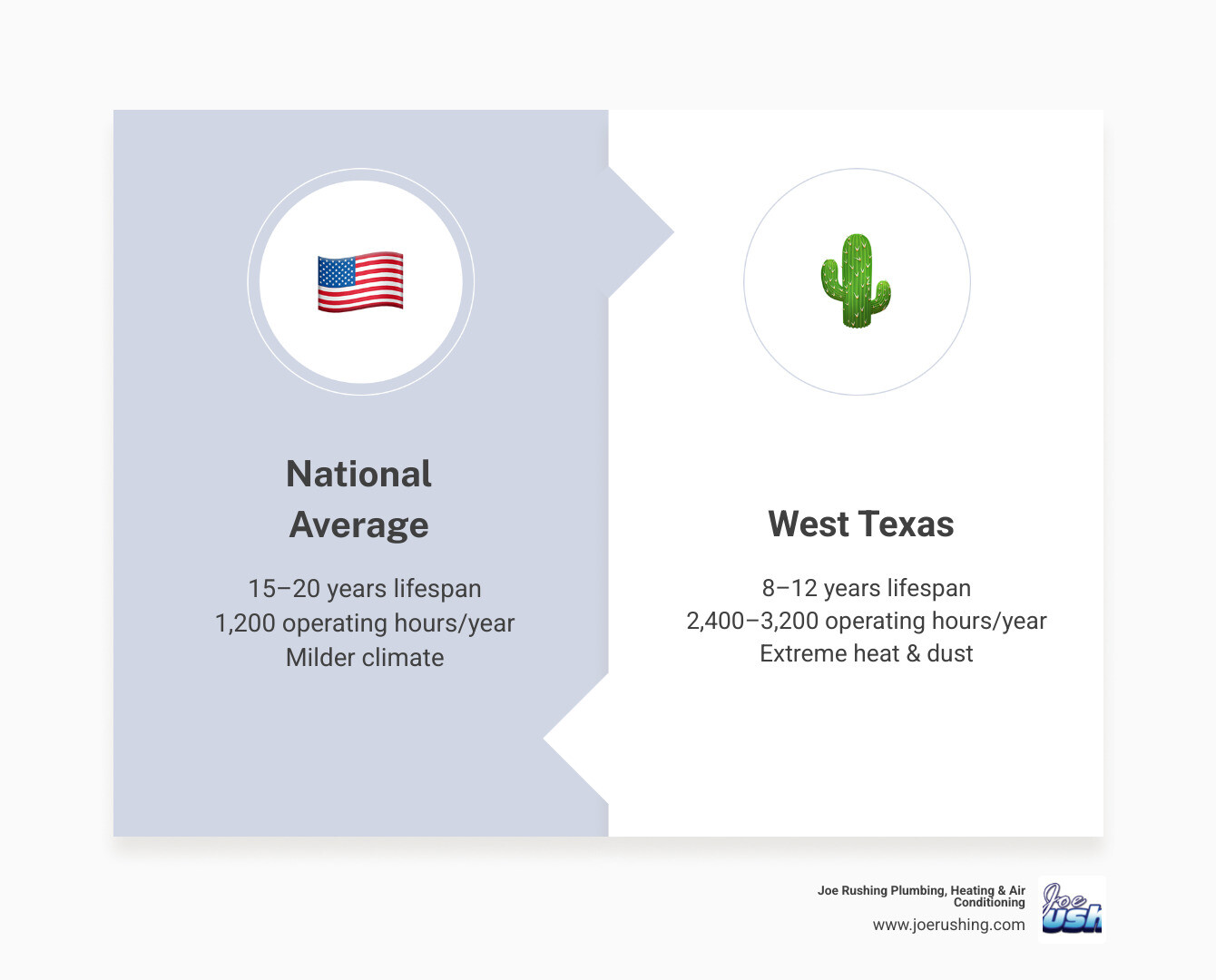
That gap exists for a simple reason: West Texas HVAC systems run roughly 2,400–3,200 hours per year — more than double the national average of around 1,200 hours. Extreme heat, relentless dust, and near year-round cooling demand compress what would otherwise be a 15-year system into one that can wear out in less than a decade without proper care.
This guide walks you through why that happens, what warning signs to watch for, and what you can do to get the most life out of your system before it gives out during a 105°F July afternoon.
I'm Ronda Rushing Brown, a third-generation family business leader with Joe Rushing Plumbing, Heating & Air Conditioning, and I've spent years helping West Texas homeowners understand exactly how long does an hvac system last in west texas — and what makes the difference between a system that fails at year 9 and one that's still running strong at year 18. Let's dig into what the local climate is actually doing to your equipment.
How Long Does an HVAC System Last in West Texas?
When we look at national data from April 2026, the consensus is that a central air conditioner should last about 15 to 20 years. However, if you live in Lubbock, Levelland, or the surrounding South Plains, those numbers are a bit optimistic. In our neck of the woods, a residential split system often reaches its "retirement age" between 8 and 12 years if it hasn't been pampered.
Why the discrepancy? It comes down to "HVAC dog years." Because our cooling season starts in early spring and can stretch into November, your system is working twice as hard as a unit in a milder climate. While a system in the Midwest might hum along for 1,200 hours a year, a West Texas unit is grinding through 2,400 to 3,200 hours. We are essentially asking our ACs to do 30 years of work in just 15 years.
The compressor, which is the heart of your system, bears the brunt of this load. In the extreme heat of a Texas summer, the compressor cycles more frequently and runs at higher pressures. This constant strain is why How Energy-Efficient HVAC Installation Pays for Itself in West Texas is such a vital topic; modern, high-efficiency systems are built to handle these specific regional stresses better than the older models of the past.
Environmental Stressors: Heat, Dust, and the South Plains Climate
If the heat is the "heavy lifting" for your AC, the West Texas wind is the "silent killer." We all know the sight of a massive haboob rolling across the horizon. While we’re busy sealing our windows and doors, your outdoor condenser unit is sitting right in the middle of it, acting like a giant vacuum cleaner.
The Dust Factor
Fine particulate matter from our famous dust storms gets sucked into the condenser coils. These coils are responsible for releasing the heat from inside your home to the outside air. When they are coated in a layer of West Texas silt, they become insulated. Your system then has to run longer and hotter to achieve the same cooling effect. This leads to:
- Coil Degradation: Dust combined with occasional moisture can lead to corrosion.
- Thermal Stress: Internal components operate at higher temperatures than they were designed for.
- Airflow Restriction: If the air can't move through the fins, the heat exchange process fails.
Because of these unique factors, following a standard maintenance schedule isn't enough. You need a plan tailored to our environment. Check out our A-Z Guide to AC Maintenance Frequency for South Plains Homes to see how we adjust care for the local climate.
Factors Influencing How Long an HVAC System Lasts in West Texas
Beyond the weather, how your system was born and raised matters.
Installation Quality: The most important day in the life of your HVAC system is the day it's installed. If the refrigerant lines aren't brazed correctly or the vacuum isn't pulled properly, that system is doomed from the start.
Manual J-Load Calculations: We see a lot of "rule of thumb" sizing in West Texas, but an oversized unit is just as bad as an undersized one. An oversized unit will "short-cycle," turning on and off rapidly. This puts massive wear on the compressor and fails to remove humidity. Proper sizing ensures the unit runs in steady, efficient cycles. Knowing How to Pick the Perfect HVAC Installation Company Near Lubbock ensures you get a team that does the math instead of guessing.
Maximizing How Long an HVAC System Lasts in West Texas
You aren't powerless against the elements. There are several practical steps you can take to push your system toward that 15–20 year mark:
- Filter Changes: In the South Plains, a "90-day filter" is often a "30-day filter." During dust storm season, check your filters every two weeks. A clogged filter starves the system of air, causing the indoor coil to freeze and the blower motor to burn out.
- Smart Thermostats: These help manage "cycling frequency." By allowing the temperature to rise slightly when you're away and cooling down gradually, you reduce the number of times the compressor has to kick on against high head pressure.
- Duct Sealing: If your ducts are leaking in the attic, you're losing 20-30% of your cooling power before it ever reaches your living room. This forces the unit to run longer to satisfy the thermostat.
- Annual Professional Tune-ups: A professional can wash the "invisible" dust out of your coils and check capacitor ratings. A failing capacitor is a cheap fix, but if it's left to fail, it can take the expensive fan motor or compressor with it. For more on this, see The Complete Guide to Annual AC Maintenance: Is It Worth It?.
Warning Signs Your System is Reaching End-of-Life
How do you know when the West Texas climate has finally won? Your system usually won't just explode; it will start sending you "distress signals."
- Frequent Repairs: If you feel like you have your HVAC technician on speed dial, or you’ve had more than two significant repairs in the last twelve months, the system is likely cascading toward total failure.
- Rising Utility Bills: As components wear out, they draw more electricity to do the same amount of work. If your July bill in 2026 is significantly higher than 2025 without a rate hike, your efficiency is tanking.
- Inconsistent Temperatures: Does the master bedroom feel like a sauna while the kitchen is a walk-in freezer? This often indicates the blower motor or the compressor can no longer maintain the necessary static pressure.
- Grinding or Screeching Noises: These are mechanical cries for help. Bearings in the motors are failing, or the compressor valves are giving out.
- Electrical Odors: A "burning" smell that doesn't go away after the first time the heater kicks on in the fall is a major red flag. It often points to failing capacitors or charred wiring.
- Poor Air Quality: Increased dust inside the home, despite frequent cleaning, can mean your ductwork has pulled apart or the internal filtration system is bypassed due to age-related gaps.
When these signs appear, it's time to bring in the experts. Understanding The Importance of Hiring Certified HVAC Pros in the Hub City ensures that you get a real diagnosis rather than just a sales pitch.
Repair vs. Replace: The $5,000 Rule for Homeowners
Deciding whether to sink more money into an old unit or invest in a new one is a tough call. At Joe Rushing, we like to use the $5,000 Rule to give homeowners an objective perspective.
The Formula: Multiply the age of the system by the cost of the repair. If the total is more than $5,000, it’s usually time to replace.
- Example A: A 12-year-old system needs a $600 repair. (12 x 600 = 7,200). Result: Replace.
- Example B: An 8-year-old system needs a $300 capacitor. (8 x 300 = 2,400). Result: Repair.
Beyond the math, consider these industry shifts:
- Refrigerant Phase-out: If your system still uses R-22 (Freon), repairs involving the sealed system are often prohibitively expensive because the gas is no longer produced. Even the newer R-410A is seeing transitions as of 2025-2026, making older units harder to support.
- SEER2 Efficiency: New standards (SEER2) mean that a new unit will likely cut your cooling costs by 30-40% compared to a 12-year-old unit.
- The 50% Rule: If a repair costs 50% of what a new system would, always opt for the replacement. You’ll get a fresh warranty and significantly lower bills.
For a deeper dive into this decision-making process, read our guide on When to Repair vs Replace Your HVAC or Plumbing.
Frequently Asked Questions about West Texas HVAC Longevity
Can regular maintenance extend my AC life to 20 years?
While the West Texas climate is harsh, it isn't an absolute death sentence. We have seen well-maintained systems in Lubbock reach the 20-year mark. The secret is consistency. Annual coil cleanings prevent the "insulation effect" of dust, and regular lubrication of moving parts prevents friction heat. If you catch small electrical issues early, you prevent the "cascade failure" that usually kills a compressor.
Why does dust shorten my HVAC lifespan so significantly?
Dust acts like sandpaper. When it gets past a poor-quality filter, it coats the blower wheel and the evaporator coil. This creates two problems: first, it adds weight to the motor, making it work harder and run hotter. Second, it creates a physical barrier to heat exchange. In West Texas, our dust is often alkaline, which can actually eat away at the copper and aluminum in your coils over time, leading to refrigerant leaks.
What type of HVAC system is best for the Lubbock area?
In our dry, high-heat climate, we generally recommend high-SEER2 residential split systems or high-efficiency heat pumps. Because we have low humidity, "two-stage" or "variable-speed" compressors are fantastic. They can run at a lower, more efficient speed most of the day to keep the air moving and filtered, only ramping up to "high" during the peak heat of the afternoon. This reduces the number of hard starts the system has to endure, which is the most taxing part of an AC's life.
Conclusion
At the end of the day, how long does an hvac system last in west texas depends on a combination of the environment, the quality of the initial install, and how well you stay on top of maintenance. While the South Plains wind and heat are working against you, a proactive approach can save you from an early replacement and thousands of dollars in wasted energy.
At Joe Rushing Plumbing, Heating & Air Conditioning, we’ve been serving Lubbock and Levelland for generations. We don't just fix units; we look at the whole picture—from your ductwork to your insulation—to ensure your home stays comfortable regardless of what the West Texas sky throws at us. Whether you need a professional longevity assessment or a high-efficiency upgrade, we're here to help.
Need HVAC Help?
Our certified technicians are ready to help with all your heating and cooling needs.
Get Free EstimateMore Articles
View All PostsRelated Articles
Ready to Get Started?
Whether you need a repair, maintenance, or a new system installation, our expert team is here to help.