Discover water heater efficiency options explained: UEF ratings, heat pumps, tankless vs. tanks. Save energy & cut bills with expert Lubbock guides!
What is the Most Energy Efficient Hot Water Heater?
Why Understanding Water Heater Efficiency Options Can Save You Real Money
water heater efficiency options explained simply means understanding how different types of water heaters use energy — and which ones waste the least. Here's a quick overview:
| Water Heater Type | Efficiency (UEF) | Key Benefit |
|---|---|---|
| Standard Electric Tank | 0.90–0.95 | Low upfront cost |
| Natural Gas Tank | 0.60–0.70 | Fast recovery, widely available |
| Propane Tank | 0.60–0.70 | High BTU output |
| Tankless Gas | 0.82–0.97 | No standby heat loss |
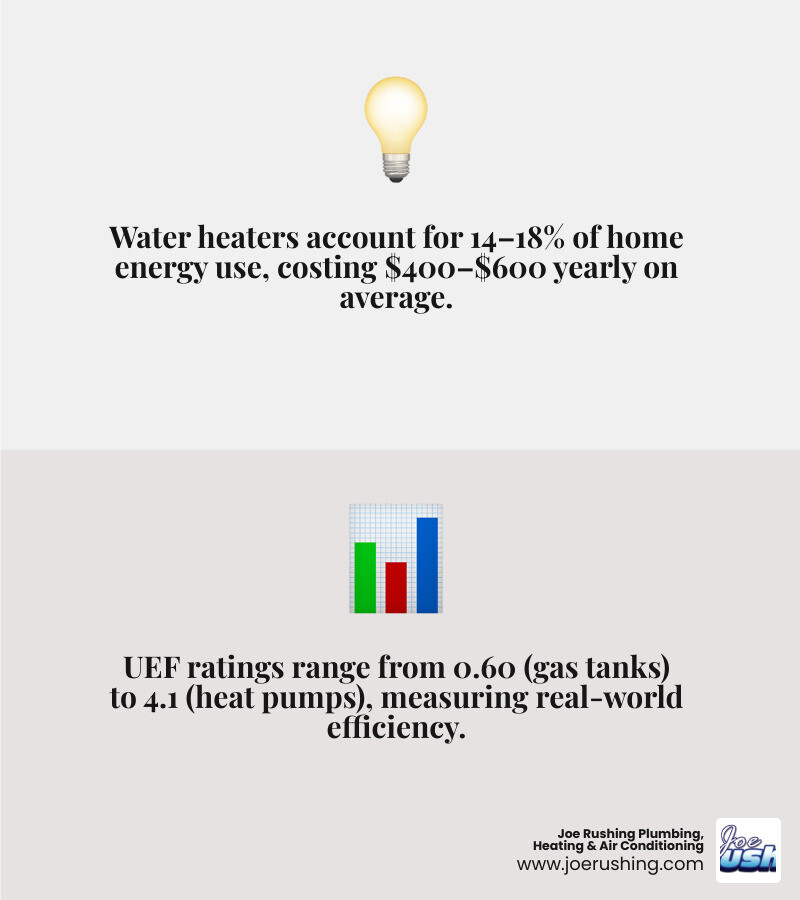
| Heat Pump (Hybrid) | 3.3–4.1 | Highest efficiency available |
| Solar | Varies | Uses free renewable energy |
Water heating is the second-largest energy expense in most homes, accounting for roughly 14–18% of your utility bill — that's anywhere from $400 to $600 every year. For homeowners in Lubbock and Levelland, where energy costs are a real concern, choosing the right water heater isn't just a comfort decision. It's a financial one.
The problem is that shopping for a water heater feels confusing fast. You'll see numbers like 0.65, 0.93, and 3.5 on the same shelf — and without context, those figures mean nothing. Knowing what those ratings actually measure, and how different technologies stack up in real-world use, puts you in control of a decision that affects your home for the next 10–20 years.
I'm Ronda Rushing Brown, a third-generation leader at Joe Rushing Plumbing, Heating & Air Conditioning, and with nearly eight decades of combined family experience helping Lubbock homeowners navigate exactly these kinds of decisions — including water heater efficiency options explained in plain, practical terms. Let's break it all down so you can make the smartest choice for your home and budget.
Water Heater Efficiency Options Explained
When you walk into a home improvement store or browse a manufacturer's website, the sheer amount of data can be overwhelming. To truly have water heater efficiency options explained, we have to start with the "Yellow Label" you see on every unit—the EnergyGuide. This label is your best friend when comparing models because it provides a standardized way to look at energy consumption.
Efficiency in a water heater is generally lost in two ways:
- Standby Loss: This is heat that escapes through the walls of a storage tank while the water is just sitting there waiting to be used.
- Flue Loss: In gas models, this is the heat that escapes through the venting system along with the exhaust gases.
Modern units are designed to minimize these losses. For instance, higher-efficiency storage tanks often have thicker insulation to fight standby loss. If you are planning a new setup, checking out our Water Heater Installation Lubbock TX Guide can help you understand how these physical factors fit into your West Texas home.
How UEF Measures Water Heater Efficiency Options Explained
In June 2017, the Department of Energy (DOE) changed the game by introducing the Uniform Energy Factor (UEF). Before this, we used the "Energy Factor" (EF), which was a bit like testing a car’s fuel efficiency in a laboratory—it didn't always reflect how people actually drive.
The UEF is a more accurate "apples-to-apples" comparison. It measures how much energy actually goes into heating your water versus how much is wasted. A higher UEF always means a more efficient unit. However, there is a catch: you can only compare UEF ratings within the same "Usage Bin."
The DOE categorizes water heaters into four bins based on how much hot water they can provide: very small, low, medium, and high. If you have a massive family that takes back-to-back showers, you’ll be looking at a "high" usage bin. Comparing a UEF from a small unit to a UEF from a high-usage unit is like comparing the fuel economy of a moped to a heavy-duty truck—it just doesn't work.
Sizing Your System: First Hour Rating and Water Heater Efficiency Options Explained
Efficiency doesn't matter if you're shivering in a cold shower. This is where the First Hour Rating (FHR) or First Hour Delivery (FHD) comes in.
The FHR tells you exactly how many gallons of hot water the unit can deliver in its first hour of operation, starting with a full tank. This is critical for sizing. If your peak hour involves three showers and a load of laundry, you need an FHR that can keep up.
One thing we often tell our Lubbock neighbors is to look at the "actual" capacity versus the "nominal" capacity. A tank labeled as "50 gallons" might actually only hold 42 gallons of water because of the space taken up by heating elements or internal components. If you find yourself constantly running out of steam, you might be dealing with a No Hot Water Lubbock TX situation that stems from improper sizing rather than a mechanical failure.

Comparing Fuel Types and Technology
The fuel you use has a massive impact on both your monthly bill and the environment. In West Texas, we primarily see natural gas and electricity, but propane is a common player in more rural areas.
| Fuel Type | Typical UEF | Speed of Recovery | Common in West Texas? |
|---|---|---|---|
| Natural Gas | 0.60 – 0.90 | Very Fast | Yes (Lubbock/Levelland) |
| Propane | 0.60 – 0.90 | Very Fast | Yes (Rural areas) |
| Electric | 0.90 – 4.0+ | Slower | Yes (All areas) |
While electric units often have a higher UEF (approaching 1.0 for standard tanks), electricity is frequently more expensive per unit of energy than natural gas. This is why a gas heater with a lower UEF might actually cost less to run annually than a standard electric heater with a higher UEF. If you're weighing these options, our team specializing in Water Heater Repair & Installation Lubbock TX can help calculate the long-term trade-offs for your specific neighborhood.
Natural Gas and Propane Performance
Gas-fired water heaters are the workhorses of the industry. They heat water much faster than electric resistance heaters. To make them even more efficient, manufacturers have introduced condensing technology.
A standard gas heater lets a lot of heat escape through the vent. A condensing unit, however, captures those hot exhaust gases and uses them to pre-heat the incoming cold water. This can push thermal efficiency to 90% or higher.
Another efficiency and safety boost comes from sealed combustion. These units pull air for the burner from outside the home rather than using the air inside your utility closet. This prevents "backdrafting," where dangerous gases could be pulled back into your living space—a major win for both efficiency and indoor air quality.
Electric Resistance vs. Advanced Technology
Standard electric water heaters use large "plunge-in" heating elements. They are incredibly simple and have very few parts to break, but they are the most expensive to operate over time. Because they don't have a vent (flue), they don't lose heat that way, which is why their UEF is often around 0.95. However, they still suffer from standby heat loss.
If you live in Levelland and are tired of high electric bills, it might be time to look beyond the basic resistance heater. We provide specialized Water Heater Repair & Installation Levelland TX services to help residents transition to more advanced technologies like heat pumps, which we will dive into next.
The Heat Pump and Tankless Advantage
If you want the absolute "gold standard" of efficiency, you're looking at two main contenders: Heat Pump (Hybrid) water heaters and Tankless (On-Demand) systems. Both are featured prominently in our Lubbock Tankless Installation Complete Guide.
Why Heat Pump Water Heaters Lead the Market
Heat pump water heaters (HPWHs) are fascinating because they don't actually create heat; they move it. Think of it like a refrigerator running in reverse. While a fridge pulls heat from inside the box and dumps it into your kitchen, a heat pump water heater pulls heat from the surrounding air and dumps it into the water tank.
Because moving heat is much easier than creating it from scratch, these units are incredibly efficient. They often boast UEF ratings between 3.3 and 4.1. That means for every $1 of electricity you put in, you get $3 to $4 worth of heat.
Benefits of Heat Pumps:
- Massive Savings: A family of four can save around $600 per year compared to a standard electric tank.
- Dehumidification: As a byproduct of the process, these units cool and dehumidify the air around them—perfect for a damp basement or a stuffy utility room.
- Hybrid Modes: Most have a "High Demand" mode that kicks in standard electric elements if you have guests over and need hot water fast.
Tankless Performance and Endless Supply
Tankless water heaters are often called "demand-type" heaters. They don't have a tank at all. Instead, when you turn on the hot water tap, cold water travels through a pipe into the unit, where either a gas burner or an electric element heats it instantly.
The primary efficiency advantage here is the total elimination of standby heat loss. You aren't paying to keep 50 gallons of water hot while you're at work or sleeping. According to the DOE, tankless systems can be up to 34% more efficient than storage tanks in homes that use moderate amounts of hot water.
When choosing a tankless unit, you'll look at Gallons Per Minute (GPM) rather than FHR. If you want to run two showers and a dishwasher at the same time, you need a unit with a high enough GPM to handle that flow. For a professional setup that meets local codes, consult our Licensed Tankless Installation Lubbock Guide.
Maximizing Efficiency Through Maintenance
You could buy the most expensive, high-UEF water heater on the market, but if you don't maintain it, that efficiency will vanish faster than a West Texas tumbleweed in a windstorm.
Protecting Your Investment with Flow-Tech
In Lubbock and the surrounding areas, we deal with "hard water"—water that is rich in minerals like calcium and magnesium. When this water is heated, the minerals solidify and settle at the bottom of your tank as sediment.
This sediment acts like a thick wool blanket between the heating element (or burner) and the water. The heater has to work twice as hard to get the heat through that layer of "rock" to reach the water. This is why we are big proponents of the Flow-Tech anti-scale system. Unlike traditional water softeners that use salt, Flow-Tech uses physical water treatment to prevent these minerals from sticking to your heater's internal components.
Regular maintenance is also vital. Following a Water Heater Flushing Lubbock TX Guide at least once a year can clear out that sediment and restore your unit's efficiency. If you've ignored your heater for a few years, you might need our 24-Hour Water Heater Flushing in Lubbock TX service to get things back on track.
Installation Considerations for Peak Performance
Where and how your water heater is installed can make a 10–15% difference in its efficiency.
- Airspace: Heat pump water heaters need about 700 to 1,000 cubic feet of air space to "breathe" properly. If you stick one in a tiny, unventilated closet, it won't be able to pull enough heat from the air to work efficiently.
- Insulation: Insulating the first few feet of hot and cold water pipes can reduce heat loss as the water travels toward your faucets.
- Drainage: High-efficiency condensing gas units and heat pumps produce "condensate"—basically water pulled from the air or exhaust. You need a proper drain or a condensate pump to handle this moisture safely.
For residents in outlying areas, we offer tailored Water Heater Repair & Installation Wolfforth TX services to ensure these specific installation requirements are met based on your home's layout.
Frequently Asked Questions about Water Heater Efficiency
What is a good UEF rating for a new water heater?
For a standard gas storage tank, a "good" rating is typically between 0.64 and 0.70. For a standard electric tank, look for 0.92 to 0.95. If you are going for "high efficiency," you want a tankless gas unit above 0.90 or a heat pump water heater with a UEF of 3.3 or higher.
How do I find rebates for high-efficiency models in Texas?
As of May 2026, there are several federal and local incentives. The federal tax credit (Energy Efficient Home Improvement Credit) offers 30% of the project cost, up to $2,000, for ENERGY STAR certified heat pump water heaters. Local utility providers in Lubbock and Levelland occasionally offer additional rebates for switching from standard electric to heat pump models. Always check the ENERGY STAR rebate finder with your specific ZIP code.
Does a tankless water heater really save more energy than a tank?
Yes, in terms of raw energy usage, tankless heaters are almost always more efficient because they eliminate standby heat loss. However, they can be more expensive to install due to the need for larger gas lines or specialized venting. The "savings" depend on your hot water usage habits. If you have a large family that uses a lot of hot water, the "endless supply" is the bigger benefit; if you are a two-person household, the energy savings will be more noticeable on your bill.
Conclusion
Choosing the right water heater doesn't have to be a headache. By having the water heater efficiency options explained, you now know that UEF is your primary metric, FHR ensures you don't run out of hot water, and heat pumps are currently the champions of energy savings.
At Joe Rushing Plumbing, Heating & Air Conditioning, we’ve been serving the Lubbock community since 1948. As the second oldest plumbing company in town, we’ve seen every water heater innovation of the last 77 years. Whether you need a simple repair, a complex tankless conversion, or a high-efficiency heat pump installation, our licensed and insured technicians (M-12583) are ready to help.
We pride ourselves on our BBB A+ rating and our status as a Nextdoor Neighborhood Favorite. We don't just fix pipes; we protect your home with advanced technology like underground camera inspections and Perma-Liner trenchless repair.
Ready to upgrade your home's comfort and slash your utility bills? From Lubbock to Levelland and everywhere in between, we are your local experts. For professional, reliable service that treats your home like our own, contact us today for all your Water Heater Repair & Installation Lubbock TX needs. We’re available 24/7 because we know hot water emergencies don't wait for business hours!
Need HVAC Help?
Our certified technicians are ready to help with all your heating and cooling needs.
Get Free EstimateMore Articles
View All PostsRelated Articles
Ready to Get Started?
Whether you need a repair, maintenance, or a new system installation, our expert team is here to help.