What is the Best Experience with Tankless vs Tanked Hot Water?
Joe Rushing
Discover tankless vs tank water heater comparison: efficiency, lifespan, sizing for West Texas homes, and expert installation tips. Save energy now!
What is the Best Experience with Tankless vs Tanked Hot Water?
Tankless vs Tank Water Heater Comparison: What Lubbock Homeowners Need to Know
A tankless vs tank water heater comparison comes down to a few key differences most homeowners care about:
| Feature | Tank Water Heater | Tankless Water Heater |
|---|---|---|
| Hot water supply | Limited by tank size | Endless, on demand |
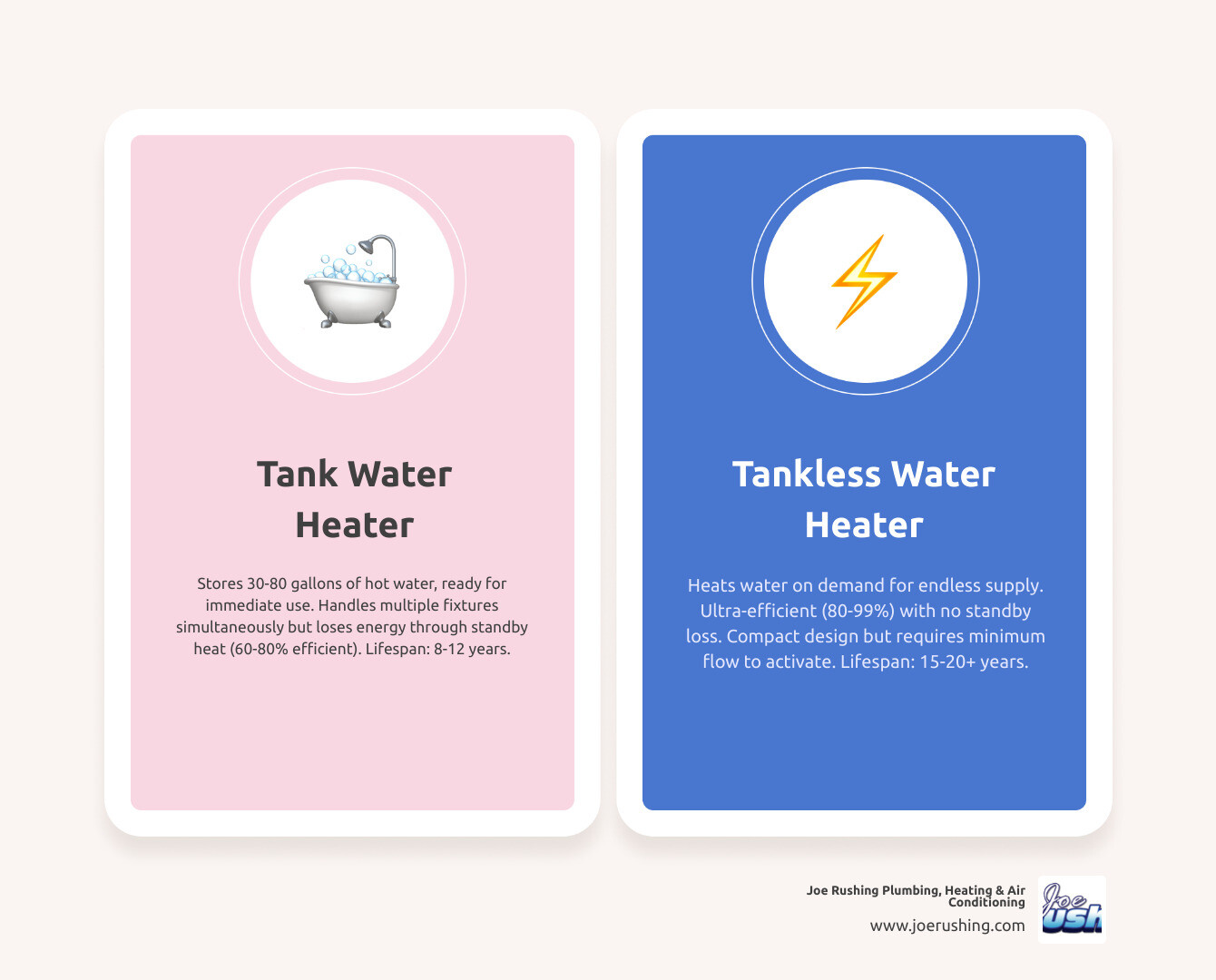
| Energy efficiency | 60–80% efficient | 80–99% efficient |
| Lifespan | 8–12 years | 15–20+ years |
| Space required | Large floor footprint | Wall-mounted, compact |
| Installation complexity | Simple | More involved |
| Best for | High simultaneous demand | Staggered use, space savings |
Here is the short answer: tank water heaters cost less upfront and handle multiple fixtures running at the same time with ease. Tankless units save energy, last longer, and never run out of hot water — but they cost more to install and need annual maintenance to stay efficient.
For most Lubbock and West Texas homeowners, the right choice depends on your household size, how you use hot water, and how long you plan to stay in your home. If your current water heater is aging or failing, the decision is more urgent than it might seem — roughly 90% of water heater replacements happen during an emergency, which can limit your options and increase costs.
In West Texas, hard water adds another layer to this decision. Mineral buildup affects both types of water heaters, but it hits tankless units especially hard. That is something worth understanding before you choose.
I am Ronda Rushing Brown, a third-generation leader at Joe Rushing Plumbing, Heating & Air Conditioning, and I have spent years helping Lubbock-area homeowners navigate exactly this kind of tankless vs tank water heater comparison — from sizing the right system to managing hard water challenges unique to our region. Let me walk you through everything you need to make a confident, informed decision.
How They Work: Storage vs. On-Demand Heating
To make an informed tankless vs tank water heater comparison, we first have to look under the hood. While both systems aim to deliver a hot shower, they take very different paths to get there.
Traditional Storage Tank Heaters
A traditional tank heater is essentially a large, insulated kettle. It keeps a reservoir of water (usually 40 to 50 gallons) at a set temperature 24 hours a day. Whether you are at work, sleeping, or on vacation, that tank is firing up its gas burners or electric elements to fight "standby energy loss"—the heat that naturally escapes through the tank walls over time. When you turn on the tap, hot water is drawn from the top of the tank, and cold water enters the bottom to be heated.
Tankless (On-Demand) Heaters
Tankless units, also known as demand-type heaters, eliminate the storage tank entirely. When you turn on a hot water faucet, cold water travels through a pipe into the unit. A gas burner or an electric element then activates a heat exchanger, which flash-heats the water instantaneously. Because there is no tank, there is no standby loss. You only pay to heat the water you actually use. Our Plumbing Services team often points out that while this is incredibly efficient, it relies on a complex dance of sensors and computers to work correctly.

Tankless vs Tank Water Heater Comparison: Performance and Lifespan
When we look at the long-term value, the tankless vs tank water heater comparison leans heavily toward the tankless side regarding durability.
| Metric | Traditional Tank | Tankless Unit |
|---|---|---|
| Average Lifespan | 8–12 Years | 20+ Years |
| Energy Efficiency | Standard | 24%–34% Higher* |
| Flow Rate | High (Initial) | 2–5 Gallons Per Minute |
| Maintenance | Low to Moderate | Annual Professional Service |
*For homes using 41 gallons or less of hot water daily.
A traditional tank heater lives a hard life. It is constantly full of water, which leads to inevitable corrosion. Even with a sacrificial anode rod designed to attract rust away from the tank walls, most tanks will eventually fail. In fact, nearly 75% of tank water heaters eventually burst or leak, which can spill 30 to 80 gallons of water into your home.
Tankless units are built with replaceable parts. This means if a component fails in year 15, we can often repair it rather than replacing the whole machine. With proper care, these units can easily double the lifespan of a standard tank. If you are looking for Water Heater Repair & Installation in Lubbock, TX, we can help you weigh these longevity factors against your current budget.
Understanding the Tankless vs Tank Water Heater Comparison for Large Families
For large families in West Texas, the "endless hot water" promise is the biggest selling point for tankless. If you have three teenagers taking back-to-back showers, a 50-gallon tank will eventually run out, requiring a "recovery time" of 30 to 60 minutes to get back up to temperature.
However, tankless units have a different limitation: flow rate. While they never run out of hot water, they can only heat so much at once. If you try to run the dishwasher, the washing machine, and two showers simultaneously, a single tankless unit might struggle to keep up. In these high-demand households, we often recommend either a high-capacity tank or multiple tankless units. If you're in the surrounding areas, our experts providing Water Heater Repair & Installation in Levelland, TX can help calculate your family's peak usage.
Sizing Your System for West Texas Homes
Sizing isn't just about the number of bathrooms; it is about the "temperature rise." In West Texas, our groundwater temperature can fluctuate. A tankless unit has to work harder to heat 55°F winter water to a comfortable 120°F than it does in the summer.
When performing a tankless vs tank water heater comparison for sizing, we look at your fixture count and "peak hour demand." We want to ensure that even on the coldest Lubbock morning, your system has the BTU "muscle" to provide the GPM (gallons per minute) you need. This is why professional sizing is critical for Water Heater Repair & Installation in Wolfforth, TX.
Installation and Space Requirements in West Texas
Space is another major factor. A traditional 50-gallon tank takes up about 9 to 12 square feet of floor space. They are bulky and often tucked into closets or garages where they are difficult to access.
Tankless units are roughly the size of a carry-on suitcase and are mounted on the wall. This can reclaim valuable square footage in your home. However, the installation is more complex. Because tankless gas units fire at a much higher BTU rate (sometimes up to 199,000 BTUs compared to 40,000 for a tank), they often require:
- Gas Line Upgrades: You may need a larger diameter gas pipe to feed the unit.
- Special Venting: They require Category III stainless steel or specific PVC venting to handle acidic condensate and exhaust.
- Electrical Needs: Even gas units need a 120V outlet to power the internal computer and fans.
If you are considering a switch, our team for Water Heater Repair & Installation in Shallowater, TX can inspect your current setup to see if your home is "tankless ready."
Maintenance and Efficiency: Managing Hard Water
Lubbock and the surrounding West Texas areas are famous for hard water. This is the "hidden" part of any tankless vs tank water heater comparison.
When hard water is flash-heated in a tankless unit, calcium and magnesium scale can precipitate instantly onto the tiny fins of the heat exchanger. If this scale builds up, it acts as an insulator, forcing the unit to work harder and eventually causing the heat exchanger to crack.
To protect your investment, we highly recommend:
- Annual Descaling: Flushing the unit with a vinegar solution to clear the scale.
- Flow-Tech Anti-Scale Systems: We specialize in Flow-Tech technology, which uses electronic pulses to keep minerals suspended in the water so they don't stick to your heater's internals.
- Anode Rod Checks: For tank owners, replacing the anode rod every 3 to 5 years can prevent the tank from rusting out prematurely.
For those in the outlying areas, we offer specialized Water Heater Repair & Installation in Slaton, TX that focuses specifically on these hard water mitigation strategies.
Maintenance Tips for Your Tankless vs Tank Water Heater Comparison
Whether you choose tank or tankless, maintenance is the key to reaching that 20-year lifespan.
- For Tanks: Drain and flush the sediment from the bottom of the tank at least once a year. This prevents the "popping" sound of boiling sediment and keeps the burner efficient.
- For Tankless: Clean the air intake filter regularly. If the unit can't "breathe," it won't burn gas efficiently.
- Safety First: Always check your temperature and pressure relief (T&P) valve. If it’s crusty or leaking, it needs attention.
Our technicians providing Water Heater Repair & Installation in Plainview, TX are trained to perform these deep-cleans to keep your utility bills low.
Frequently Asked Questions about Water Heaters
Is a tankless water heater worth the investment in 2026?
In 2026, the answer is usually "yes" if you plan to stay in your home for more than five to seven years. While the upfront cost is higher, the energy savings (up to 60% compared to electric tanks) and the 20-year lifespan offer a strong return on investment. Plus, the added home resale value and the luxury of never running out of hot water are significant perks.
Why does my tankless heater have a delay in hot water?
This is often called the "cold water sandwich." When you turn on the tap, the unit takes a few seconds to sense the flow, ignite the burner, and reach the target temperature. The water already in the pipes between the heater and your shower is also cold. We can solve this by installing a recirculation pump, which keeps hot water ready at the tap.
Can a tank water heater burst?
Yes. As mentioned earlier, nearly 75% of tanks eventually leak. In West Texas, where many water heaters are located in attics or interior closets, a burst tank can cause thousands of dollars in water damage. This is why we recommend safety pans and moisture sensors for all tank installations. If you're worried about an aging unit, our team for Water Heater Repair & Installation in Brownfield, TX can perform a safety inspection.
Conclusion
Choosing between a tank and a tankless system is a big decision that affects your home's comfort and your monthly budget for decades. At Joe Rushing Plumbing, Heating & Air Conditioning, we have been serving the Lubbock community since 1948. As the second oldest plumbing company in town, we have seen every type of water heater come and go.
Whether you need a reliable traditional tank or a high-tech tankless system, our 77 years of experience ensure you get a solution tailored to the West Texas climate. We are 24/7 emergency ready, BBB A+ rated, and Perma-Liner certified. We even use advanced underground camera inspections to ensure your home's plumbing is solid from the ground up.
If you are ready to upgrade or just need an honest professional opinion, we are here to help. From Water Heater Repair & Installation in Littlefield, TX to our main headquarters in Lubbock, we protect what matters most—your home and your family's comfort.
For more information or to schedule an inspection, visit our Water Heaters Service Page today. Let's make sure your next shower is the best one yet.
Need HVAC Help?
Our certified technicians are ready to help with all your heating and cooling needs.
Get Free EstimateMore Articles
View All PostsRelated Articles
Ready to Get Started?
Whether you need a repair, maintenance, or a new system installation, our expert team is here to help.