Treatment or Torture: Keeping Your Tankless Heater Scale-Free
Joe Rushing
Discover how water treatment helps tankless water heaters fight hard water scale, boost efficiency & extend lifespan in Lubbock. Expert guide!
Treatment or Torture: Keeping Your Tankless Heater Scale-Free
How Water Treatment Helps Tankless Water Heaters Last Longer and Run Better
How water treatment helps tankless water heaters comes down to one simple fact: hard water is quietly destroying your system from the inside out. Here's what you need to know right away:
- Prevents scale buildup — Water treatment removes or neutralizes the calcium and magnesium minerals that harden into limescale inside your heat exchanger
- Protects efficiency — A scale layer as thin as 1/32 of an inch can drop heat transfer efficiency by 10%, meaning higher energy bills every month
- Extends equipment life — Untreated hard water can cut your tankless heater's lifespan well short of its 20-year potential
- Preserves your warranty — Most major manufacturers, including Rheem and Navien, require water hardness treatment above 11 GPG (grains per gallon) to keep warranty coverage valid
- Reduces maintenance costs — Treated water means fewer descaling sessions and less wear on internal components
If you're in Lubbock or Levelland, this matters more than you might think. Over 85% of U.S. households deal with hard water — and West Texas is no exception. Tankless water heaters are especially vulnerable because their compact heat exchangers concentrate scale damage fast, often before you even notice something is wrong. Unlike traditional tank heaters, there's no buffer — minerals hit the heat exchanger directly every single time you turn on a tap.
I'm Ronda Rushing Brown, a third-generation family business leader with Joe Rushing Plumbing, Heating & Air Conditioning, and I've spent years seeing how water quality silently shortens the life of tankless systems throughout our region. Understanding how water treatment helps tankless water heaters is one of the most practical things a West Texas homeowner can learn — and this guide will walk you through everything you need to protect your investment.
The Science of Scale: Why Hard Water is a Tankless Heater’s Worst Enemy
To understand why we talk about "torture" for your appliances, we have to look at the chemistry of West Texas water. Hard water is essentially water that has high concentrations of dissolved minerals, specifically calcium and magnesium. As this water travels through the ground, it picks up these minerals from limestone and chalk deposits.
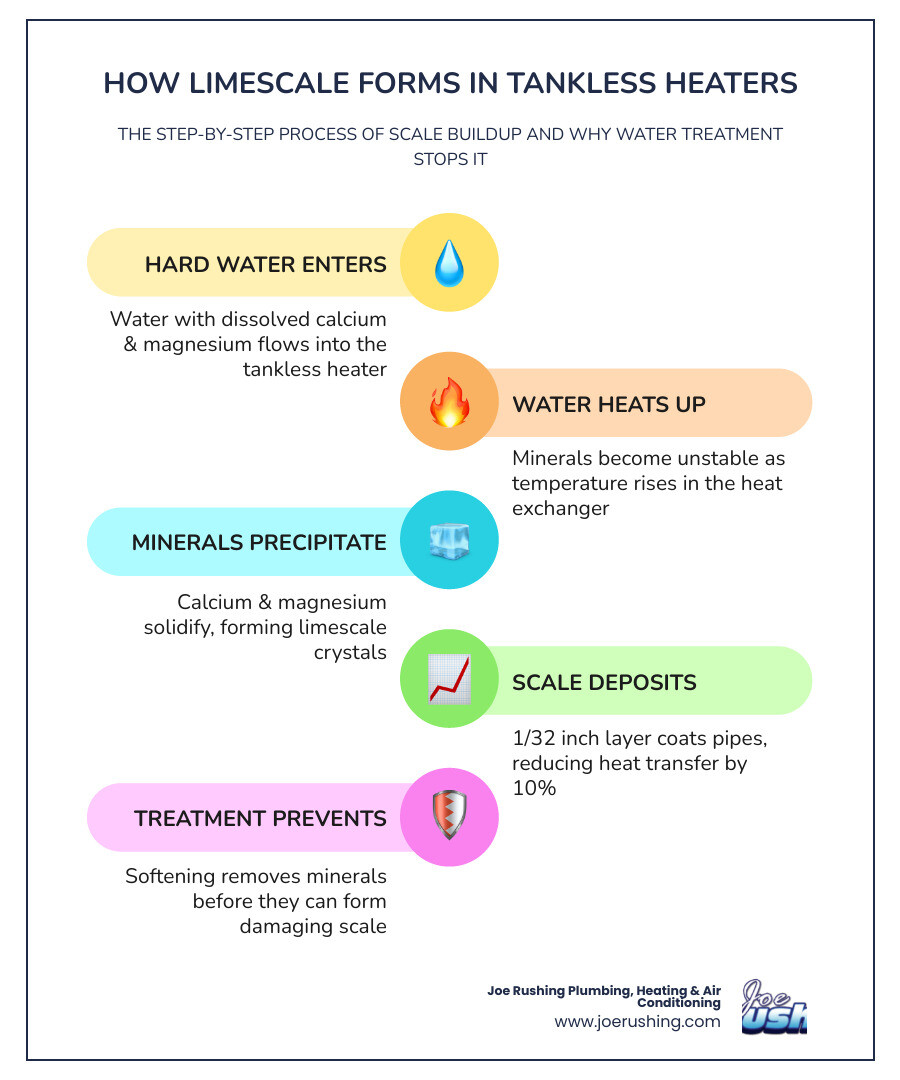
When you heat this water, a chemical reaction occurs. These dissolved minerals solidify and "fall out" of the water, creating a hard, crusty substance known as limescale. In a Water Heaters system, this scale doesn't just sit at the bottom; it attaches itself to the hottest surfaces it can find—the heat exchanger.
The impact is immediate and measurable. Research shows that a scale layer as thin as 1/32 inch (0.8 mm) can reduce heat transfer efficiency by 10%. This means your unit has to burn more gas or use more electricity to reach the same temperature. Over time, this scale acts like an insulator, forcing the heat exchanger to overheat to penetrate the mineral barrier. This overheating is the primary cause of premature failure in tankless units.

Comparing Vulnerability: Tank vs. Tankless Systems
You might wonder why your old tank heater lasted 15 years without a water softener while your new tankless unit is struggling after three. The answer lies in the design.
In a traditional tank, minerals often settle at the bottom. While this is bad (it reduces capacity and can lead to tank "popping" noises), the heating element or burner is usually heating through a larger volume of water. In Tank vs Tankless Water Heaters Lubbock comparisons, the tankless unit's "on-demand" nature is its Achilles' heel regarding water quality.
Tankless heaters use narrow copper or stainless steel pipes coiled tightly to maximize heat transfer. Because these pathways are so small, even a minor amount of scale can significantly restrict water flow and create "hot spots." These hot spots cause the metal to fatigue and eventually crack, leading to internal leaks that often cannot be repaired.
Signs of Hard Water Damage
How do you know if your heater is being "tortured" by scale? Keep an eye out for these red flags:
- Error Codes: Most modern units will throw a "Service Required" or specific scale-related error code when they detect the heat exchanger is getting too hot.
- Fluctuating Temperatures: If your shower goes from hot to cold (the "cold water sandwich"), scale might be interfering with the flow sensors or the heat transfer process.
- Rumbling or Squealing Noises: These sounds occur when water gets trapped behind scale and turns to steam, or when the unit is struggling to push water through narrowed passages.
- Reduced Water Pressure: If your hot water pressure is significantly lower than your cold water pressure, you likely have a physical blockage of scale.
If you notice these signs, it's time to call for Water Heater Repair & Installation Lubbock TX before the damage becomes permanent.
How Water Treatment Helps Tankless Water Heaters Maintain Peak Performance
Installing a water treatment system isn't just an "extra" in West Texas; it's the life support system for your plumbing. By removing the minerals before they reach the heater, you ensure that the heat exchanger remains as clean as the day it was installed.
This leads to several key benefits. First, your energy efficiency stays at the factory-rated level. You won't see that slow, creeping increase in your utility bills that happens as scale builds up. Second, the lifespan of your unit is significantly extended. A well-maintained tankless heater can last 20 years or more, but in hard water areas like ours, that can drop to 10 years or less without treatment.
For a deep dive into the installation process, check out our Lubbock Tankless Installation Complete Guide.
How water treatment helps tankless water heaters protect manufacturer warranties
This is perhaps the most overlooked benefit. Most homeowners don't realize that their warranty has "fine print" regarding water quality. Manufacturers like Rheem, Navien, and Rinnai explicitly state that damage caused by scale is not a manufacturing defect—it’s a maintenance issue.
Specifically, many manufacturers require water treatment if the hardness exceeds 11 GPG (approximately 188 mg/L). In much of Lubbock and Levelland, our water hardness can soar well above this limit. If your heat exchanger fails and the manufacturer finds it choked with scale, they may deny your warranty claim, leaving you with a massive bill for a new unit. Following a Licensed Tankless Installation Lubbock Guide ensures your system is set up to meet these warranty standards from day one.
How water treatment helps tankless water heaters on well systems
For our neighbors in Levelland and rural West Texas who rely on private wells, the challenges are different. Well water often contains more than just hardness; it can carry sediment, iron, and sulfate-reducing bacteria.
If you’ve ever noticed a "rotten egg" smell, you’re dealing with hydrogen sulfide gas. While tankless heaters don't have anode rods (which often cause this smell in tank heaters), the bacteria can still thrive in your pipes. How water treatment helps tankless water heaters in this scenario involves specialized filtration or "shocking" the system. We often recommend chlorine or hydrogen peroxide treatments for the well itself, combined with pre-filters to keep sand and grit out of the delicate tankless internals. You can learn more about these specific setups in our guide on Tankless Water Heater Installation Levelland TX.
Choosing the Right Defense: Water Softeners vs. Scale Inhibitors
Not all water treatment is created equal. Depending on your home’s needs and your local water chemistry, we typically recommend one of three paths:
| Feature | Ion Exchange (Water Softener) | TAC (Template Assisted Crystallization) | Scale Inhibitors (Polyphosphate) |
|---|---|---|---|
| How it Works | Removes calcium/magnesium and replaces with sodium. | Converts minerals into microscopic crystals that won't stick. | Adds a food-grade coating to minerals to prevent sticking. |
| Maintenance | Requires salt refills and periodic cleaning. | Requires cartridge replacement every 2 years. | Requires cartridge replacement every 6-12 months. |
| Water Feel | "Slippery" feel; great for skin/hair. | No change in water feel. | No change in water feel. |
| Best For | Whole-home protection; very hard water. | Salt-restricted areas; eco-friendly. | Budget-friendly; point-of-use protection. |
For most West Texas homes, a traditional ion exchange softener is the gold standard. It provides the most comprehensive protection for your entire plumbing system, not just the heater. For more details on choosing a system, see our Water Heater Installation Lubbock TX Guide.
Whole-House Filtration and Pre-Filters
Beyond hardness, we also have to deal with sediment. West Texas wind and aging municipal pipes can introduce sand, rust, and grit into your water line. Tankless heaters have small inlet filters, but these can clog quickly, starving the unit of water and causing it to shut down. A high-quality pre-filter catches these particles before they ever reach your expensive appliances.
Testing Your Water Hardness
You can't manage what you don't measure. We recommend testing your water at least once a year. You can use DIY test kits from a hardware store, which usually measure in Grains Per Gallon (GPG) or Parts Per Million (PPM). To convert PPM to GPG, simply divide by 17.1.
If you want a more accurate picture, professional lab analysis can identify other issues like high chlorine levels or heavy metals that might be affecting your plumbing.
Maintenance and Descaling: How Water Treatment Reduces the Workload
Even with a water treatment system, your tankless heater still needs a little love. However, the type of love changes. Without a softener, you might need to descale your unit every 6 to 12 months. With a softener, that frequency can often be pushed to every 2 to 4 years, depending on your usage.
Descaling involves circulating a food-grade acid (like citric acid or specialized descaling solutions) through the unit using a pump and hoses connected to isolation valves. This process dissolves any "stray" minerals that made it past the filter. For a step-by-step on this process, visit our Water Heater Flushing Lubbock TX Guide.
Reducing Flush Frequency
The goal of water treatment is to move descaling from an "emergency repair" to a "routine check-up." When we perform 24-Hour Water Heater Flushing in Lubbock TX, we often see the difference immediately. Units with upstream softeners produce almost no mineral debris during the flush, while untreated units can dump out handfuls of white "sand" (calcium flakes).
Calculating ROI on Water Treatment
Is it worth the investment? Let's look at the Return on Investment (ROI):
- Energy Savings: Maintaining that 10% efficiency boost saves significant money over the life of the unit.
- Repair Avoidance: A single heat exchanger replacement can cost nearly as much as a new unit.
- Detergent Reduction: Soft water allows you to use up to 50% less soap and detergent for laundry and dishes.
- Appliance Longevity: Your dishwasher, washing machine, and coffee maker will also last years longer.
Frequently Asked Questions about Tankless Water Treatment
Can I use a salt-free conditioner for my tankless heater?
Yes! TAC (Template Assisted Crystallization) systems are excellent for tankless heaters. While they don't "soften" the water in the traditional sense (you won't get that slippery feel), they are highly effective at preventing scale from sticking to the heat exchanger. They are a great choice if you are on a low-sodium diet or live in an area with salt restrictions.
How do I know if my tankless heater is already scaled?
If you notice a "lag" in how long it takes for the water to get hot, or if the unit's fan runs for a long time after you turn off the water, scale is likely the culprit. Also, check the aerators on your faucets; if you see white, chalky pebbles, that's scale that has broken loose from the heater and traveled through your pipes.
Does municipal water require treatment for tankless units?
Absolutely. Just because water is "treated" by the city doesn't mean the minerals are removed. Most municipal water in West Texas is still considered "hard" or "very hard." While the city ensures the water is safe to drink, they don't soften it to the levels required to protect a high-efficiency tankless heat exchanger.
Conclusion
At Joe Rushing Plumbing, Heating & Air Conditioning, we believe that a tankless water heater is one of the best upgrades you can make for your home in Lubbock or Levelland. But to make that investment last, you have to protect it from the "torture" of West Texas hard water.
By understanding how water treatment helps tankless water heaters, you’re taking the single most important step in ensuring endless hot water for your family for the next two decades. Whether you need a new installation, a water hardness test, or a professional descaling flush, our team is here to help with the expert, non-invasive solutions we’ve been known for since our family started this journey.
Don't let scale steal your efficiency and kill your heater early. Let's get your water quality under control today.
Ready to protect your home? Schedule your Water Heater Service with Joe Rushing today!
Need HVAC Help?
Our certified technicians are ready to help with all your heating and cooling needs.
Get Free EstimateMore Articles
View All PostsRelated Articles
Ready to Get Started?
Whether you need a repair, maintenance, or a new system installation, our expert team is here to help.