The West Texas Guide: How Often to Flush Your Heater
Joe Rushing
Discover how often should you flush your water heater in West Texas. Learn maintenance tips, signs of sediment, and DIY steps for efficiency.
The West Texas Guide: How Often to Flush Your Heater
Why West Texas Homeowners Need to Know How Often to Flush Your Water Heater
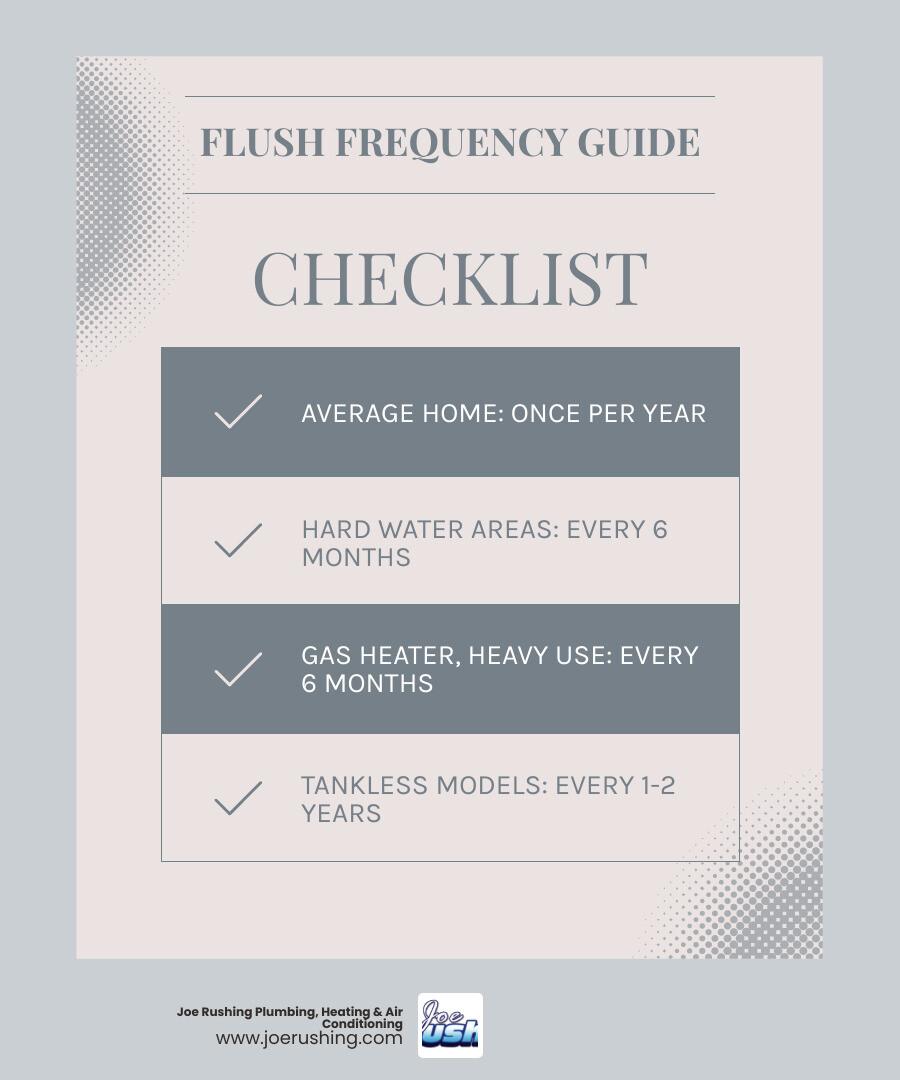
How often should you flush your water heater depends on a few key factors, but here is the short answer:
| Your Situation | Recommended Flush Frequency |
|---|---|
| Average home, normal water use | Once per year |
| Hard water area (like West Texas) | Every 6 months |
| Gas water heater, heavy use | Every 6 months |
| Older unit (10+ years) | At least once per year |
| Tankless water heater | Descale every 1-2 years |
Your water heater works hard every single day. It heats water for your showers, dishes, laundry, and more — without you ever having to think about it. But over time, minerals like calcium and magnesium dissolve in your water supply, and when that water gets heated, those minerals settle at the bottom of your tank as sediment. In West Texas, where hard water is a real and common challenge, this process happens faster than in most parts of the country. Left unchecked, that buildup forces your heater to work harder, drives up your energy bills, shortens the life of the unit, and can eventually lead to leaks or complete failure.
The good news? A simple annual flush — or every six months if your water is especially hard — can prevent most of these problems before they start.
I'm Ronda Rushing Brown, a third-generation leader of one of the region's longest-running plumbing and HVAC companies, and over the years I've seen how skipping this one maintenance step leads to costly water heater repairs and early replacements across West Texas homes. In this guide, I'll walk you through exactly how often you should flush your water heater and how to do it right.
Why Maintenance Matters: How Often Should You Flush Your Water Heater?
We often tell our customers in Lubbock and Levelland that a water heater is like the heart of the home. When it’s healthy, everything flows smoothly. When it’s clogged with sediment, the whole system suffers. Understanding how often should you flush your water heater is the first step in protecting your investment.
Sediment is essentially a layer of "rock" (mostly calcium and magnesium) that settles at the bottom of the tank. This layer acts as an insulator. If you have a gas heater, the burner has to heat through that thick layer of sediment just to reach the water. If you have an electric heater, the bottom element can become buried in the "sand," causing it to burn out prematurely.
By performing an annual flush, you can extend the life of a conventional tank from about 7 or 8 years (without maintenance) to 10 or even 15 years. It also keeps your energy bills lower because the unit doesn't have to run as long to reach the desired temperature. If you haven't had your system checked recently, our team provides expert Water Heater Repair & Installation Lubbock TX to ensure your unit is operating at peak efficiency.
Factors Influencing Your Maintenance Schedule
Not every home has the same needs. In our experience across West Texas, several factors can accelerate sediment buildup.
- Household Size: A family of five uses significantly more hot water than a couple. More water passing through the tank means more minerals being left behind.
- Water Source: Those of us on municipal water in Lubbock deal with high mineral content, but homeowners on well water often face even tougher challenges, including actual sand or grit in the lines.
- Temperature Settings: Higher temperatures (above 120°F) can cause minerals to precipitate out of the water faster, leading to quicker buildup.
| Water Source | Usage Level | Recommended Frequency |
|---|---|---|
| Municipal (Lubbock/Levelland) | Low (1-2 people) | Every 12 months |
| Municipal (Lubbock/Levelland) | High (4+ people) | Every 6-9 months |
| Well Water | Any | Every 6 months |
| Hard Water (Untreated) | Any | Every 6 months |
Gas vs. Electric Heater Requirements
One question we hear often is whether the type of fuel matters. The answer is a resounding yes.
Gas Water Heaters: These units usually require more frequent flushing. Because the burner is located at the very bottom of the tank, sediment settles directly on top of the heat source. This creates a barrier that can cause the bottom of the tank to overheat, potentially weakening the steel and leading to a "tank burst" or leak. We recommend a flush every six months for gas models in severe water conditions.
Electric Water Heaters: These use internal heating elements. While they don't have a bottom burner to worry about, sediment buildup displaces water, meaning you have less hot water available for your morning shower. If the sediment reaches the lower element, it will short out. For homeowners in Levelland, we offer specialized Water Heater Repair Installation Levelland TX to help diagnose element failures caused by sediment.
Critical Signs Your Tank Needs Immediate Attention
Sometimes, your water heater will literally scream for help. If you've been wondering how often should you flush your water heater, but you start hearing strange noises, the answer is "right now."
The most common sign of heavy sediment is a popping or rumbling sound coming from the tank. This happens when water gets trapped underneath the layer of sediment. As that trapped water boils, it creates steam bubbles that "pop" through the sediment layer. It can sound like someone is knocking on the tank or like a haunted house in your utility room!
Another red flag is rusty or discolored water. If your hot water looks like tea or has a metallic smell, it’s a sign that sediment is causing internal corrosion. If you notice these signs in Wolfforth, it’s time to look into Water Heater Repair Installation Wolfforth TX before a small sediment issue turns into a major flood.
Identifying Sediment-Related Performance Issues
Beyond the noises, you might notice your showers getting shorter. If you used to get 20 minutes of hot water and now you’re shivering after 10, sediment has likely taken up residence in the bottom of your tank, reducing its capacity.
Other performance issues include:
- Inconsistent Temperatures: The water fluctuates between hot and cold because the thermostat is struggling to read the temperature through the sediment.
- Foul Odors: A "rotten egg" smell is often caused by bacteria reacting with the sediment and the anode rod.
- Slow Recovery Time: It takes hours for the water to get hot again after one person showers.
For residents in Plainview, these issues are often a daily frustration. Regular maintenance through Water Heater Repair Installation Plainview TX can restore that "like-new" performance.
Step-by-Step: How to Flush Your Water Heater Safely
If you’re a DIY enthusiast, flushing your tank is a manageable task, but it requires caution. You are dealing with scalding hot water and either high-voltage electricity or combustible gas.
- Turn off the Power/Gas: For electric heaters, flip the breaker. For gas heaters, turn the knob to the "Pilot" setting.
- Shut off the Cold Water: Close the valve at the top of the heater that lets cold water in.
- Connect a Hose: Attach a standard garden hose to the drain valve at the bottom. Lead the other end to a floor drain or outside.
- Open a Faucet: Turn on a hot water faucet somewhere in the house (like a bathtub) to relieve pressure and allow the tank to drain faster.
- Open the Drain Valve: Carefully open the valve on the heater. Warning: The water will be very hot.
- Flush with Cold Water: Once the tank is empty, turn the cold water supply back on for a few minutes. This "stirs up" the remaining sediment and flushes it out the hose. Continue until the water runs clear.
- Refill and Restart: Close the drain valve, remove the hose, and let the tank refill completely before turning the power or gas back on.
If you’re in Littlefield and find that your drain valve is stuck or won’t close properly after the flush, give us a call for Water Heater Repair Installation Littlefield TX.
Essential Safety Precautions for DIY Maintenance
Safety is our top priority at Joe Rushing. If you decide to tackle this yourself, please keep these tips in mind:
- Cool the Water: We recommend turning the heater off the night before you plan to flush it. This ensures the water is at a safe temperature.
- Use the Right Hose: Ensure your garden hose is rated for hot water. A cheap, thin hose can soften and burst under the heat and pressure.
- Avoid Flooding: Double-check your drainage point. You don't want 50 gallons of sediment-filled water ending up in your hallway or flower beds.
- Don't Dry Fire: Never turn the power back on until the tank is full. If an electric element is turned on in an empty tank, it will burn out in seconds.
For our neighbors in Slaton, if the process feels a bit overwhelming, our professionals at Water Heater Repair Installation Slaton TX can handle the dirty work for you, ensuring everything is sealed and safe.
Preventing Sediment Buildup in West Texas
While knowing how often should you flush your water heater is vital, preventing the buildup in the first place is even better. In West Texas, the high mineral content is a fact of life, but you can fight back.
One of the best defenses is a water softener. By removing the calcium and magnesium before the water ever reaches your heater, you can significantly reduce the amount of sediment that collects.
Another key component is the anode rod. This is a "sacrificial" rod made of magnesium or aluminum that hangs inside your tank. Its job is to corrode so your tank doesn't have to. We recommend checking this rod every 3 to 5 years. If it's completely eaten away, your tank is the next thing the minerals will attack. For those in Shallowater, we can inspect your anode rod as part of a Water Heater Repair Installation Shallowater TX service call.
Maintenance for Tankless vs. Traditional Models
Tankless water heaters are becoming very popular in places like Brownfield, but they aren't maintenance-free. Instead of a "flush" to remove "sand," tankless units require "descaling."
Mineral scale builds up on the heat exchanger coils, which can eventually choke off the water flow and cause the unit to overheat.
- Frequency: Most manufacturers recommend descaling every 12 to 24 months.
- The Process: This involves circulating food-grade white vinegar through the unit using a small pump for about 45 minutes to an hour.
- Benefits: Regular descaling protects the sensitive flow sensors and ensures the heating coils last for their full 20-year life expectancy.
If you have a tankless system in Brownfield, our team at Water Heater Repair Installation Brownfield TX has the specialized pumps and solutions needed to descale your unit properly.
Frequently Asked Questions
How often should you flush your water heater with hard water?
In West Texas, we are famous for our "liquid rock" water. Because of the high concentrations of limestone and other minerals, we strongly recommend flushing your water heater every six months. Waiting a full year in Lubbock or Levelland often results in sediment that is so thick it becomes difficult to drain through the standard valve.
How often should you flush your water heater if it is a tankless model?
For tankless models, you should perform a descaling procedure every 12 to 24 months. However, if you do not have a water softener and your household uses a lot of hot water, you may want to move that to an annual schedule to protect the heat exchanger and maintain high flow rates.
When should I call a professional instead of doing it yourself?
You should call a professional if:
- Your drain valve is made of plastic (these often break or leak after being opened).
- Your water heater is more than 10 years old and has never been flushed (flushing a neglected old tank can sometimes trigger a leak by removing sediment that was "plugging" a hole).
- You see any signs of an active leak or heavy rust around the base.
- You are uncomfortable working with gas lines or high-voltage electrical panels.
Conclusion
Taking the time to understand how often should you flush your water heater is one of the smartest things a West Texas homeowner can do. It saves money, prevents the headache of cold showers, and protects your home from the devastating effects of a burst tank.
At Joe Rushing Plumbing, Heating & Air Conditioning, we’ve been serving the Lubbock and Levelland communities for generations. We don't just fix leaks; we provide comprehensive solutions, from our unique underground camera inspections to our Perma-Liner no-dig drain repairs. We are experts in handling the specific water challenges of our region, ensuring your home stays comfortable year-round.
Don't wait for the rumbling sounds to start. Whether you need a routine flush, an anode rod replacement, or a complete system upgrade, we are here to help.
Schedule your professional water heater service today and let us help you keep the hot water flowing!
Need HVAC Help?
Our certified technicians are ready to help with all your heating and cooling needs.
Get Free EstimateMore Articles
View All PostsRelated Articles
Ready to Get Started?
Whether you need a repair, maintenance, or a new system installation, our expert team is here to help.