Discover understanding the parts of your AC system: compressor, coils, refrigerant & more. Master maintenance for Lubbock home comfort!
The Secret Life of Your Indoor and Outdoor AC Units
What Every Lubbock Homeowner Should Know About AC Components
Understanding the parts of your AC system is the first step to keeping your home cool and comfortable through the brutal West Texas summers. Whether your system is running fine or acting up, knowing what each part does helps you spot problems early, talk confidently with technicians, and make smarter decisions about repairs and maintenance.
Here is a quick overview of the main AC components and what they do:
| Component | Location | Primary Function |
|---|---|---|
| Compressor | Outdoor unit | Pressurizes refrigerant to drive the cooling cycle |
| Condenser Coil | Outdoor unit | Releases heat from refrigerant to the outside air |
| Evaporator Coil | Indoor unit | Absorbs heat and humidity from your indoor air |
| Expansion Valve | Indoor unit | Controls refrigerant flow and triggers the pressure drop |
| Blower Fan / Air Handler | Indoor unit | Circulates air across the evaporator coil and through your home |
| Air Filter | Indoor unit | Traps dust, allergens, and debris before air enters the system |
| Thermostat | Wall-mounted | Monitors temperature and signals the system to run |
| Ductwork | Throughout home | Delivers and returns conditioned air to every room |
| Refrigerant Lines | Connecting units | Carry refrigerant between indoor and outdoor units |
| Condensate Drain | Indoor unit | Removes moisture pulled from the air during cooling |
These components work as one continuous system — when one part struggles, the rest of the system feels it. With 87% of U.S. households relying on air conditioning, understanding how your system works is genuinely useful knowledge for any homeowner.
I'm Ronda Rushing Brown, a third-generation leader at Joe Rushing Plumbing, Heating & Air Conditioning, and over the years I've seen how understanding the parts of your AC system helps homeowners avoid costly breakdowns and get more life out of their equipment. Let's walk through each component so you know exactly what's running behind the scenes every time you feel that cool air kick on.
Understanding the Parts of Your AC System: The Core Four
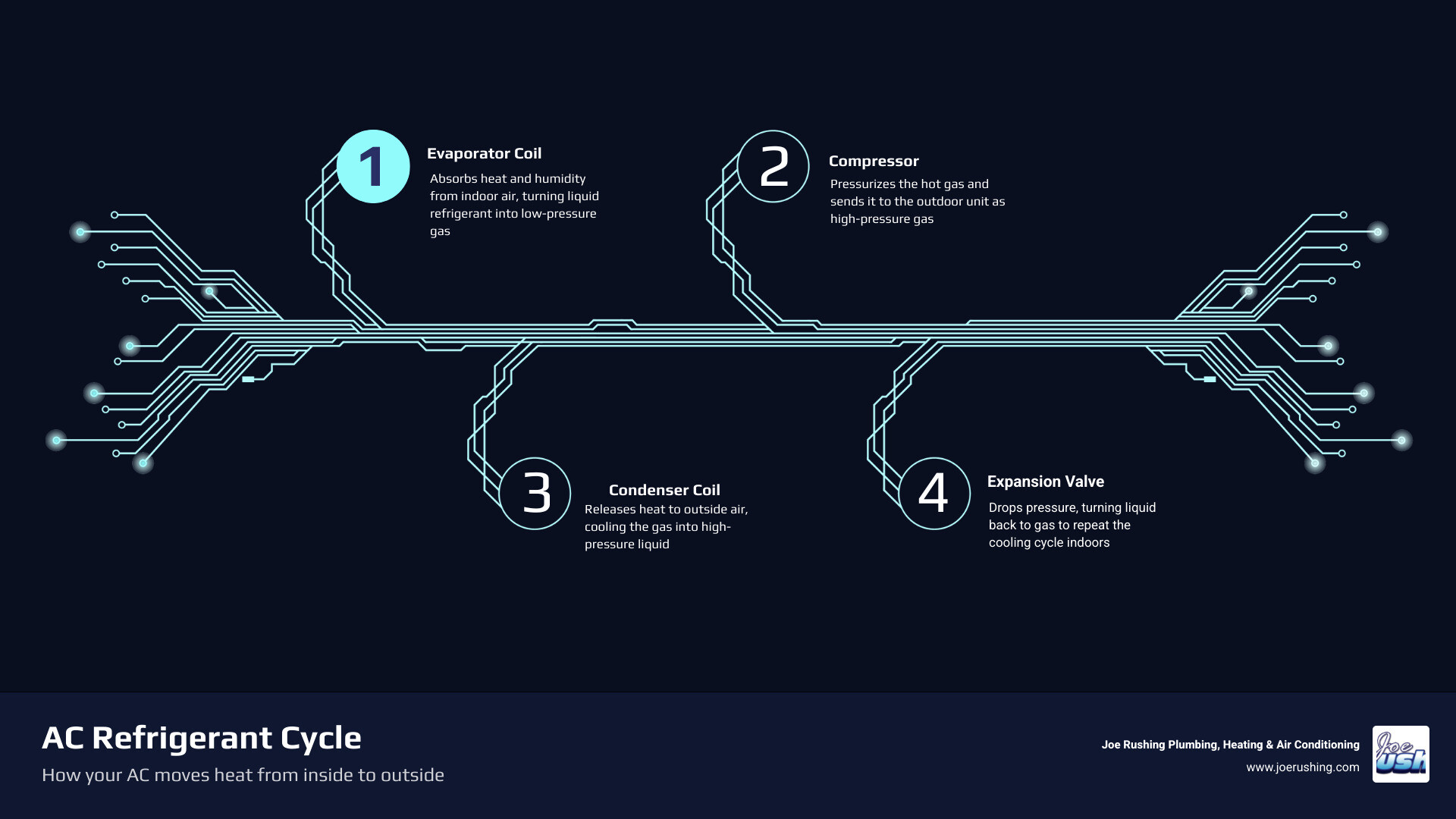
To truly master understanding the parts of your AC system, you have to think of your air conditioner as a "heat ferry." Contrary to popular belief, your AC doesn't actually "create" cold air. Instead, it works by removing heat from the air inside your home and dumping it outside. This magic happens through the refrigerant cycle, a continuous loop where a chemical refrigerant changes state from liquid to gas and back again.
In a typical Lubbock split system, these components are divided between an indoor unit and an outdoor unit. If this "ferry" breaks down, you’ll likely need professional AC Repair Service Lubbock to get the cycle moving again. There are four primary parts that do the heavy lifting in this process.
The Compressor: The Heart of the System
Located in the outdoor unit, the compressor is the "heart" of your AC. Just as your heart pumps blood through your body, the compressor pumps refrigerant through the system. Its job is to take low-pressure, cool refrigerant gas and squeeze it into a high-pressure, hot gas.
This pressurization is critical because heat naturally moves from warmer areas to cooler areas. By making the refrigerant extremely hot, the compressor ensures that the heat will easily escape into the outdoor air, even when it’s 100 degrees in West Texas. Because it does so much work, the compressor is responsible for up to 70% of your AC's total energy use.
The Condenser Coil: Releasing the Heat
Once the compressor has turned the refrigerant into a high-pressure hot gas, it travels into the condenser coil. This coil is located in the outdoor unit and is surrounded by thin aluminum fins. A large condenser fan pulls outdoor air across these fins, dissipating the heat from the refrigerant.
As the heat leaves the refrigerant, the gas cools down and condenses back into a high-pressure liquid. This is why you’ll feel hot air blowing out of the top of your outdoor unit during the summer—that’s literally the heat from your living room being shoved outside.

The Evaporator Coil: The Heat Sponge
Now that the refrigerant has released its heat outside, it travels back indoors to the evaporator coil. If the compressor is the heart, the evaporator coil is the "sponge." Usually located inside your furnace or air handler, this coil is filled with cold refrigerant liquid.
As the indoor blower fan pushes warm air from your home over the cold evaporator coil, the refrigerant absorbs the heat. This process also dehumidifies your air; moisture in the air condenses on the cold coil, much like water droplets form on a cold glass of sweet tea. This makes the air feel much cooler and more comfortable.
The Expansion Valve: The Precision Gatekeeper
Between the condenser and the evaporator sits the expansion valve. This component acts as a precision gatekeeper. It regulates the flow of high-pressure liquid refrigerant into the evaporator coil. When the refrigerant passes through this valve, it experiences a sudden pressure drop, which causes it to turn into a very cold mist. This transition is essential for the refrigerant to be able to absorb heat effectively once it hits the evaporator coil.
Indoor Components and Air Distribution
While the "Core Four" handle the refrigeration, your system wouldn't be very useful if it couldn't move that air around. The indoor unit, often referred to as the air handler or blower unit, is responsible for the "lungs" of the operation. If your system is old and struggling to keep up, you might want to Upgrade Your Lubbock Home with High-Efficiency AC Replacement to improve airflow and comfort.
Air Filters and the Blower Fan
The blower fan is a powerful motor that pulls air through your return vents, pushes it across the evaporator coil, and then sends it back through your ducts. To protect this fan and the evaporator coil, every system has an air filter.
Air filters are rated by MERV (Minimum Efficiency Reporting Value). For most Lubbock homes, a MERV rating between 8 and 13 is the "sweet spot"—high enough to catch dust and allergens, but not so restrictive that it chokes the blower motor. We recommend that air filters be inspected or replaced every 30 to 90 days. If you have pets or allergies, checking them monthly is a must. A clogged filter is like trying to breathe through a straw; it forces the system to work much harder, leading to higher bills and potential breakdowns.
Thermostats and Ductwork
The thermostat is the "brain" of your system. It monitors the indoor temperature and tells the AC when to turn on or off. Modern smart thermostats can even learn your family's patterns to save energy.
However, even the smartest thermostat can't overcome leaky ductwork. A typical home loses 20% to 30% of conditioned air through leaks in the duct system. This means you’re paying to cool your attic or crawlspace instead of your bedroom. Ensuring your ducts are sealed and insulated is one of the best ways to ensure your How Energy-Efficient HVAC Installation Pays for Itself in the long run.
How Indoor and Outdoor Units Work Together
A central AC system is a "split system," meaning it depends on the synergy between the indoor and outdoor units. They are connected by the lineset—two insulated copper tubes that carry the refrigerant back and forth. This creates a closed-loop system where no refrigerant should ever escape. If you are low on refrigerant, it means you have a leak that needs professional General Air Conditioning Lubbock service.
The Role of Refrigerant in Understanding the Parts of Your AC System
Refrigerant is the "blood" of your AC system. It is a special chemical that has a very low boiling point, allowing it to change from liquid to gas at low temperatures. In understanding the parts of your AC system, you’ll see that the refrigerant is what actually carries the heat. It absorbs heat indoors (becoming a gas) and releases it outdoors (becoming a liquid). Without the proper "charge" or amount of refrigerant, the heat transfer process fails, and your home stays warm.
Drainage and Moisture Control
As we mentioned, the evaporator coil also acts as a dehumidifier. All that moisture has to go somewhere. It drips off the coil into a drain pan and flows out through a condensate drain line.
In our dry West Texas climate, we don't always think about humidity, but your AC still pulls a significant amount of water from the air. If the drain line gets clogged with algae or dust, the pan can overflow, leading to water damage in your home. Regular maintenance involves checking this line to ensure it’s clear and the water is discharging safely outside.
Maintenance and Troubleshooting for Homeowners
Maintaining your AC isn't just about comfort; it's about protecting your investment. By following an A-Z Guide to AC Maintenance Frequency, you can prevent the most common causes of system failure.
Signs of Malfunctioning Components
Knowing the warning signs can save you from a total system breakdown during a July heatwave.
- Short-Cycling: If your AC turns on and off every few minutes, it could be a failing thermostat, a clogged filter, or an oversized system.
- Frozen Coils: If you see ice on the indoor evaporator coil or the outdoor refrigerant lines, you likely have restricted airflow (check your filter!) or a refrigerant leak.
- Strange Noises: Banging or clanking usually indicates a problem with the blower fan or compressor. Buzzing often points to electrical issues like a failing contactor or capacitor.
- Warm Air: If the vents are blowing lukewarm air, your compressor might be failing, or you could be out of refrigerant.
If you notice these signs, it's time to look into AC Installation & Replacement Lubbock or repair options before the damage spreads to other parts.
Proactive Care for Understanding the Parts of Your AC System
You don't have to be an HVAC expert to perform basic maintenance. Here are a few DIY tasks:
- Change your filter: Do this every 1-3 months.
- Clear the outdoor area: Keep at least two to three feet of clearance around your outdoor unit. Trim back bushes and remove weeds so the condenser can "breathe."
- Gently hose the coils: Once a year, use a garden hose (not a pressure washer!) to gently rinse dust and dirt off the outdoor condenser fins.
- Check the drain: Ensure water is flowing out of the condensate line.
For everything else, we recommend a professional tune-up. Learn How to Prep Your AC Before Summer by scheduling an inspection to check refrigerant levels, electrical connections, and motor health.
Frequently Asked Questions about AC Components
What is the most expensive part of an AC to replace?
The compressor is almost always the most expensive single part to replace. Because it is the "heart" of the system and requires specialized labor and refrigerant handling to replace, the cost is significant. If your system is more than 10-12 years old and the compressor fails, we often recommend a full system replacement rather than just replacing the part.
How often should I change my air filter?
As a general rule, every 30 to 90 days. However, in Lubbock, our "dust season" can clog filters much faster. If you have pets, live near a dirt field, or have family members with allergies, you should check your filter every 30 days.
Can I replace just the outdoor unit?
Technically, yes, but it is highly discouraged. Modern AC units are "matched systems." The indoor evaporator coil and the outdoor condenser are designed to work together at specific efficiency ratings (SEER2). If you mismatch them, you will likely experience reduced efficiency, poor humidity control, and premature failure of the new compressor.
Conclusion
Understanding the parts of your AC system doesn't just make you a more informed homeowner—it helps you maintain a cool, efficient, and safe home for your family. From the hard-working compressor outside to the air-purifying filters inside, every piece of the puzzle matters.
At Joe Rushing Plumbing, Heating & Air Conditioning, we’ve been serving the Lubbock and Levelland communities for generations. We don't just fix ACs; we provide peace of mind with unique solutions like our Perma-Liner no-dig drain repair and underground camera inspections to handle the tough plumbing and HVAC issues that West Texas throws our way.
If your system is making strange noises or just isn't keeping up with the heat, don't wait for a total breakdown. Contact us today to schedule your AC Maintenance Tune-Up Lubbock and keep your "heat ferry" sailing smoothly all summer long.
Need HVAC Help?
Our certified technicians are ready to help with all your heating and cooling needs.
Get Free EstimateMore Articles
View All PostsRelated Articles
Ready to Get Started?
Whether you need a repair, maintenance, or a new system installation, our expert team is here to help.