Discover gas line safety tips for homeowners: spot leaks, evacuate safely, call 811, and schedule pro inspections to protect your family.
The Homeowner's Guide to Not Blowing the Roof Off
Why gas line safety tips for homeowners Could Save Your Life
Gas line safety tips for homeowners are something every household needs to know — because a small leak can turn into a major emergency fast. Here are the most important ones at a glance:
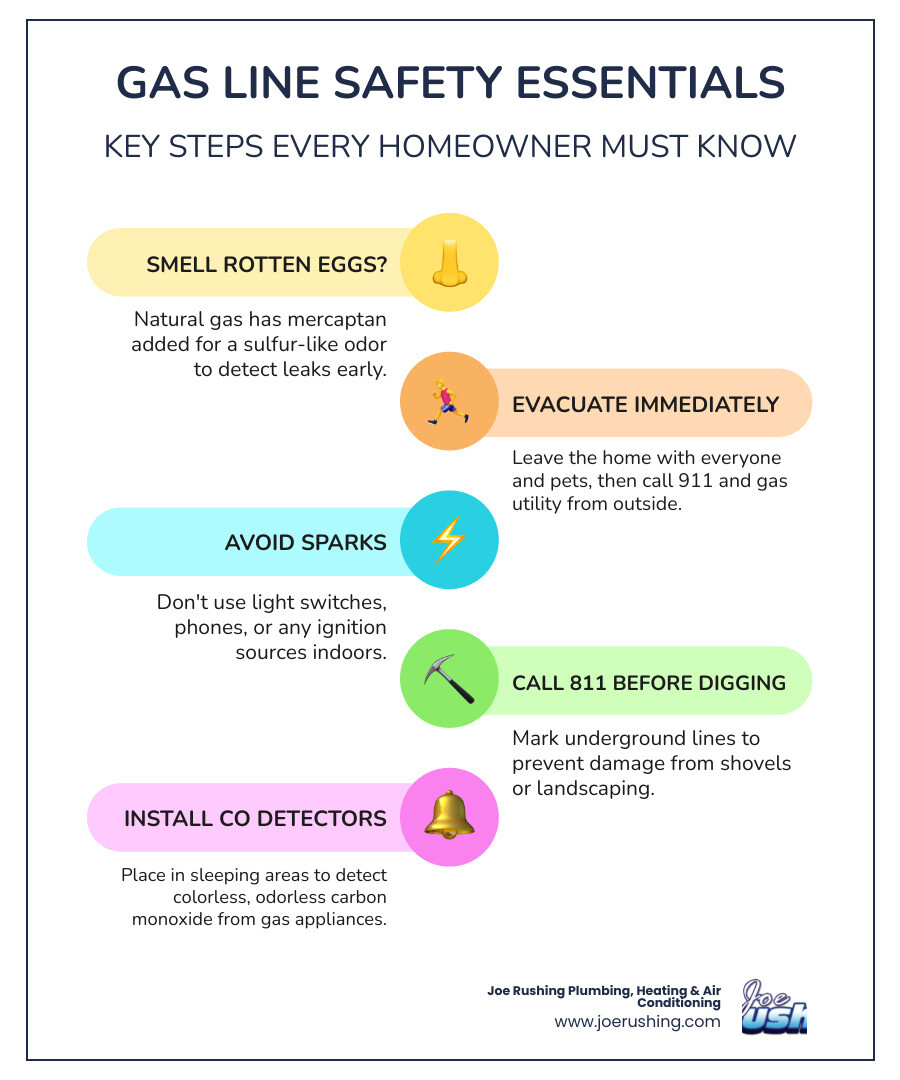
- Know the smell. Natural gas is odorless on its own, but utility companies add mercaptan to make it smell like rotten eggs. If you smell it, act immediately.
- Get out first, call second. If you suspect a leak, evacuate everyone — including pets — before doing anything else. Call 911 and your gas utility from outside.
- Never flip switches or use your phone indoors. A single spark can ignite accumulated gas.
- Know where your shut-off valve is. Find it before you ever need it.
- Call 811 before digging. Underground gas lines can be damaged by shovels, fence posts, or landscaping projects.
- Schedule professional inspections every 1–2 years. Many problems are invisible to the naked eye.
- Install carbon monoxide detectors. Gas appliances that burn incompletely produce CO — a colorless, odorless gas that sends roughly 100,000 Americans to the ER every year.
- Never attempt DIY gas line repairs. It's dangerous, and in most places, it's illegal without a license.
The stakes are real. Between 2010 and 2021, nearly 2,600 serious pipeline incidents across the U.S. led to 328 explosions, 122 deaths, and over 600 injuries. More recently, from 2023 to 2025, pipeline incidents caused more than $872 million in property damage and killed 41 people. A gas pipeline incident happens somewhere in America roughly every 40 hours. Most of these tragedies are preventable — and that starts with you knowing what to watch for and what to do.
I'm Ronda Rushing Brown, a Registered Nurse, third-generation family business leader, and part of the team at Joe Rushing Plumbing, Heating & Air Conditioning — where we've spent decades helping homeowners in Lubbock and beyond stay safe, including walking families through the exact gas line safety tips for homeowners covered in this guide. Let's walk through everything you need to know, step by step.
Recognizing the Warning Signs of a Gas Leak

One of the most critical gas line safety tips for homeowners is knowing how to use your senses to spot a problem before it becomes a catastrophe. Natural gas is actually naturally odorless and colorless. To protect us, utility companies inject a chemical called mercaptan. This additive gives the gas a pungent, "rotten egg" or sulfur-like smell. If you catch a whiff of this in your kitchen or laundry room, don't ignore it—even if it's faint.
However, your nose isn't the only tool at your disposal. You should also watch and listen for these signs:
- Hissing or Whistling Sounds: If a pipe has a crack or a fitting is loose, you might hear a distinct hissing sound near your gas appliances or the gas line itself.
- The "Dead Zone" in Your Garden: This is a sign many people miss. If you notice a patch of dead or discolored grass, or a specific row of plants that seem to be dying while the rest of the yard is thriving, it could indicate an underground leak. Gas escaping into the soil displaces oxygen, effectively suffocating the roots of your vegetation.
- Bubbling in Standing Water: If it has recently rained and you see bubbles rising through puddles near where your gas line is buried, that's a major red flag.
- Physical Symptoms: Are you feeling unusually dizzy, fatigued, or nauseous? Do you have a headache that magically disappears the moment you leave the house to run errands? These are common symptoms of low-level gas exposure or carbon monoxide buildup.
- Unexplained Spikes in Your Gas Bill: If your usage hasn't changed but your bill is climbing, you might have a "slow leak" that is literally draining money out of your pipes.
If you notice any of these signs in your home, it’s time to call in the experts for Gas Line Services Lubbock TX to perform a professional leak detection test.
Immediate Action: What to Do if You Suspect a Leak
If you suspect a gas leak, the time for "investigating" is over. You need to move, and you need to move fast. The goal is to avoid creating any kind of spark that could ignite the gas. In April 2026, we still see too many incidents where a simple light switch caused a tragedy.
Follow these emergency evacuation steps immediately:
- Stop what you are doing. Do not finish the dishes or look for your keys.
- Evacuate everyone. Get all family members and pets out of the house immediately.
- Leave the door open. This helps ventilate the area as you exit.
- Do NOT touch anything electrical. Do not flip light switches, do not unplug appliances, and do not use your garage door opener. Even the tiny static charge from a telephone or a flashlight can act as an ignition source.
- Do NOT use your cell phone inside. Wait until you are at least 100 feet away from the home before calling for help.
- Do NOT start your car. If your vehicle is in the garage or near the house, leave it there. Starting an engine creates sparks.
- Call for help. Once you are at a safe distance, call 911 and your local gas utility provider.
If you are comfortable and it is safe to do so, you can shut off the main gas valve at the meter. Typically, you’ll need a wrench to turn the valve a quarter-turn so it is perpendicular to the pipe. However, if the meter is in an area where you smell a heavy concentration of gas, skip this step and just keep running. For those in our neighboring communities, having the number for Gas Line Services Levelland TX saved in your phone can help you get a technician on-site quickly after the fire department has cleared the scene.
Essential Gas Line Safety Tips for Homeowners
Beyond emergencies, day-to-day prevention is the best way to keep your roof where it belongs—on top of your house.
The Magic Number: 811
Did you know that excavation damage is the leading cause of unplanned utility outages? Whether you are planting a new tree, installing a fence, or putting in a mailbox, you must call 811 at least two to three business days before you break ground. This service, led by the Common Ground Alliance, is free. They will send someone out to mark the location of your underground gas lines so you don't accidentally nick one with a shovel or power auger.
Carbon Monoxide: The Silent Killer
While natural gas leaks are explosive, the byproduct of incomplete combustion—carbon monoxide (CO)—is deadly in a different way. It is completely odorless and colorless. Around 100,000 Americans end up in the ER every year from CO poisoning.
- Install detectors on every level of your home and specifically outside of sleeping areas.
- Test them monthly and replace the batteries every year.
- Replace the units every 5 to 7 years, as the sensors do wear out.
Regular Professional Inspections
We recommend having your gas lines and appliances inspected by a professional every 1 to 2 years. If your home is older than 15 years, these checks are even more vital as pipes can corrode and seals can dry out over time. We provide comprehensive safety checks through our Gas Line Services Slaton TX and Gas Line Services Shallowater TX, ensuring your system meets current building codes.
Professional Maintenance and Prevention Strategies
When it comes to gas line safety tips for homeowners, the most important rule is this: Gas work is never a DIY project. While it’s tempting to try and hook up a new gas range yourself, the risks far outweigh the savings. A minor misalignment in a fitting or using the wrong type of sealant can lead to a slow leak that builds up behind your cabinets.
Why Professional Service Matters
Licensed technicians don't just look for leaks; they look for potential failures. This includes checking for:
- Corrosion: Steel pipes can rust over time, especially in damp crawlspaces.
- Aging Pipes: Older flexible connectors (common in the 1970s and 80s) are prone to cracking if moved.
- Appliance Venting: We ensure that your furnace and water heater are exhausting fumes correctly to prevent carbon monoxide buildup.
- Pressure Testing: This is something a homeowner simply cannot do. We use specialized gauges to ensure the system holds pressure perfectly.
| Feature | Homeowner Visual Check | Professional Pressure Test |
|---|---|---|
| Detects Small Leaks | Rarely (only if they smell) | Yes, even microscopic drops |
| Checks Pipe Integrity | No | Yes |
| Verifies Code Compliance | No | Yes |
| Safety Level | Low | High |
Whether you need Gas Line Services Wolfforth TX or Gas Line Services Plainview TX, our team uses advanced tools like underground camera inspections to see exactly what is happening with your lines without digging up your entire yard.
Frequently Asked Questions about Gas Line Safety
How often should I schedule gas line safety tips for homeowners inspections?
You should have a professional inspection at least once every year. However, if your gas appliances or the lines themselves are over 15 years old, you should consider more frequent checks. Aging systems are significantly more prone to corrosion and seal failure. If you live in an area with shifting soil, like much of West Texas, annual checks are non-negotiable. Our team at Gas Line Services Littlefield TX can help set up a recurring maintenance schedule for your peace of mind.
Why does natural gas smell like rotten eggs?
As mentioned earlier, natural gas is naturally odorless. Utility companies add a chemical called mercaptan specifically to make it easy to detect. This sulfur-like smell is designed to be unpleasant so that you can't ignore it. It is one of the most effective safety measures ever implemented in the energy industry.
What are the best gas line safety tips for homeowners with children?
Education is your best defense. Teach your children:
- The "Rotten Egg" Drill: Make sure they know what mercaptan smells like. You can sometimes find "scratch and sniff" cards from utility companies to help them learn.
- Stay Away from Appliances: Teach them that the stove, water heater, and furnace are not toys and should never be touched.
- The Exit Plan: Just like a fire drill, have a gas leak drill. Teach them to run to a specific neighbor's house or a "meeting tree" far away from the home if they ever smell that bad odor. If you're in the area, our Gas Line Services Brownfield TX team is always happy to answer questions about making your home safer for the little ones.
Conclusion
Vigilance is the key to home safety. By following these gas line safety tips for homeowners, you aren't just protecting your property; you're protecting the people who live inside it. From recognizing the smell of mercaptan to calling 811 before you landscape, these small steps make a massive difference.
At Joe Rushing Plumbing, Heating & Air Conditioning, we’ve spent years serving the Lubbock and Levelland communities. We pride ourselves on offering efficient, non-invasive solutions like our underground camera inspections and Perma-Liner no-dig repairs. We don't just fix pipes; we provide the peace of mind that comes with knowing your home is safe.
If you have any concerns about your gas lines, don't wait for an emergency. Contact us today for expert Gas Line Services Lubbock TX and let us help you keep your home secure.
Need HVAC Help?
Our certified technicians are ready to help with all your heating and cooling needs.
Get Free EstimateMore Articles
View All PostsRelated Articles
Ready to Get Started?
Whether you need a repair, maintenance, or a new system installation, our expert team is here to help.