Stop the Clog: Protecting Your AC from West Texas Dust Storms
Joe Rushing
Learn how extreme heat dust and wind stress your AC in West Texas. Protect your unit from dust storms, heatwaves & wind with expert tips!
Stop the Clog: Protecting Your AC from West Texas Dust Storms
Why Extreme Heat, Dust, and Wind in West Texas Are Your AC's Worst Enemies
How extreme heat dust and wind stress your ac comes down to three compounding forces that hit Lubbock and Levelland homeowners all at once:
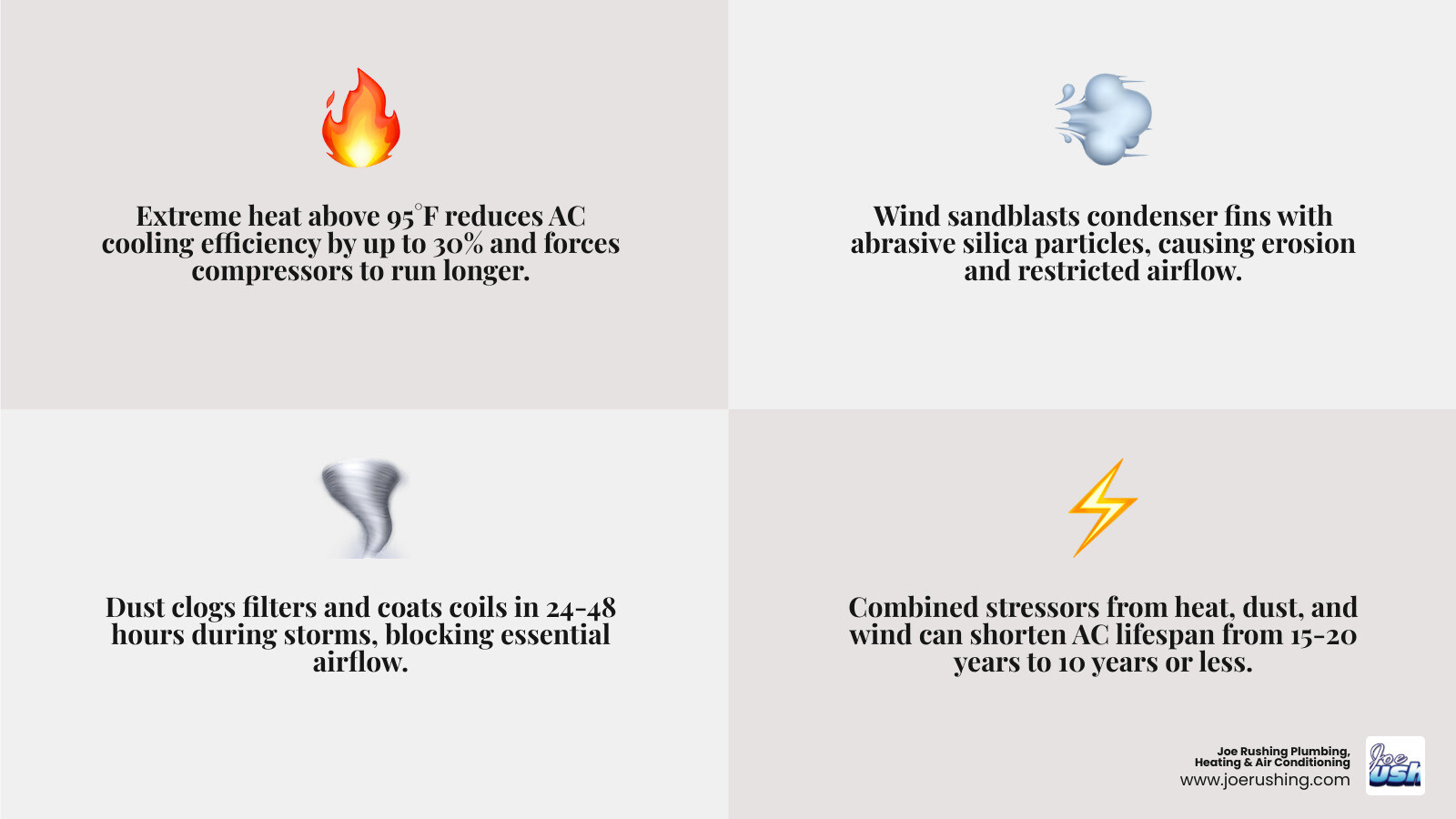
- Extreme heat forces your AC to run longer and harder, reducing cooling efficiency by up to 30% when temperatures climb above 95°F
- Dust coats condenser coils and clogs filters — sometimes within 24 to 48 hours during a bad storm — blocking the airflow your system needs to function
- Wind sandblasts delicate coil fins, carries abrasive silica particles deep into mechanical components, and can cause voltage fluctuations that stress electrical parts
Together, these three stressors can cut your AC's lifespan from the national average of 15 to 20 years down to 10 to 15 years — or even less without proper care.
West Texas doesn't give your AC a break. In April 2026, Lubbock and the surrounding South Plains are already seeing the early signs of what promises to be another punishing cooling season. Haboobs rolling in off the Llano Estacado, triple-digit temperatures that push compressors to their limits, and dry, relentless winds that carry some of the most abrasive dust in the country — your air conditioner is fighting all three at the same time, often for months on end. Most homeowners don't realize the damage is building until the system breaks down on the hottest day of the year.
I'm Ronda Rushing Brown, a third-generation family business leader with Joe Rushing Plumbing, Heating & Air Conditioning, and I've spent years watching West Texas weather do exactly what the research confirms — accelerate wear, shorten equipment life, and catch homeowners off guard when they least expect it. In this guide, I'll walk you through exactly how extreme heat dust and wind stress your AC, and what you can do about it before the damage becomes a costly repair.
How Extreme Heat Dust and Wind Stress Your AC
To understand how extreme heat dust and wind stress your ac, we have to look at the physics of how your home stays cool. Your air conditioner doesn't actually "create" cold; it removes heat from inside your home and dumps it outside. This process relies on a temperature differential.
Most residential systems are designed to handle outdoor temperatures up to about 95°F. Once the mercury in Lubbock hits triple digits—which happens more than 30 days a year on average—the system struggles to "shed" that heat into the already-scorching outdoor air. For every degree the temperature rises above 95°F, your AC can lose 1% to 2% of its cooling efficiency. This forces the compressor to run nearly non-stop, spiking energy consumption by 40% to 50% during those brutal 105°F afternoons.
The Mechanical Toll of Non-Stop Operation
When your system runs 18 to 20 hours a day to keep up with West Texas heat, every moving part is under immense pressure.
- Compressor Strain: The "heart" of your AC has to pump refrigerant at higher pressures to compensate for the lack of heat exchange.
- Thermal Overload: Components like capacitors and fan motors generate their own heat. When it's 100°F outside, they can’t cool down, leading to electrical failure or "tripping" the breaker to prevent a fire.
- Refrigerant Pressure Spikes: Extreme heat causes refrigerant to expand, putting stress on the seals and joints in your copper lines, which often leads to leaks.
In our A-Z Guide to AC Maintenance Frequency for South Plains Homes, we emphasize that the frequency of your service should match the intensity of our climate. In Lubbock, a system that isn't tuned up before the heat hits is a system waiting to fail.
The Sandblasting Effect: How Wind and Dust Damage Components
If the heat is a marathon, the wind and dust are a fistfight. West Texas dust isn't like the "fluff" you find under your couch. It is largely composed of fine silica particles—essentially tiny, sharp pieces of glass. When 50 to 60 mph wind gusts pick up this grit, it creates a "sandblasting" effect on your outdoor unit.
Abrasive Erosion and Airflow Restriction
The delicate aluminum fins on your outdoor condenser coil are designed to maximize surface area for heat exchange. When wind-driven dust hits these fins, it does two things:
- Physical Erosion: The sharp silica wears down the metal, making the fins brittle and less effective at transferring heat.
- Deep Clogging: Dust pushes deep into the "V" of the coils where a standard garden hose can’t reach it. This creates an insulating blanket. Instead of releasing heat, the dust traps it, forcing the compressor to work even harder.
Comparing the Culprits: Household Dust vs. West Texas Grit
| Feature | Standard Household Dust | West Texas Grit/Silica |
|---|---|---|
| Composition | Skin cells, fabric fibers, pet dander | Sharp silica, minerals, red clay |
| Impact on Coils | Soft buildup, easily rinsed | Abrasive "sandblasting," deep infiltration |
| Clog Speed | Weeks to months | 24 to 48 hours during a haboob |
| Mechanical Risk | Reduced airflow | Bearing wear, electrical shorts, fin erosion |
This is why we recommend Spring Cleaning for Your Pipes and AC every single year. Clearing out the winter's accumulation of dirt before the summer winds start is the only way to give your system a fighting chance.
Why your AC struggles to cool during high winds and heatwaves
During high winds, the static pressure around your outdoor unit changes. The wind can actually "push back" against the fan that is trying to blow hot air out of the unit. This creates resistance for the fan motor, causing it to draw more electricity and run hotter. If the wind is strong enough and the dust is thick enough, your system may experience "short cycling"—turning on and off rapidly—because it can't safely move enough air to complete a cooling cycle. If you notice your vents blowing lukewarm air during a dust storm, you likely need AC Repair Service Lubbock TX to clear the obstruction.
Proactive Steps to Protect Your Outdoor Condenser
You don't have to be a victim of the weather. There are several DIY steps we recommend to every Lubbock and Levelland homeowner to mitigate how extreme heat dust and wind stress your ac.
The Two-Foot Clearance Rule
Airflow is the lifeblood of your HVAC system. We recommend maintaining at least two feet of clear space around your outdoor condenser. In West Texas, this means constantly checking for:
- Tumbleweeds: These act as "dust magnets" and can completely wrap around your unit in a single afternoon.
- Dirt Drifts: High winds can pile dirt against the base of your unit, burying the bottom few inches of the coils.
- Vegetation: Ensure shrubs or tall grass aren't blocking the intake.
Windbreaks and Barriers
While you should never fully cover your AC unit while it is running, installing a breathable windbreak—like a lattice fence or strategic (but spaced out) shrubs—can help deflect the worst of the wind-blown debris. Just ensure the barrier doesn't trap the hot air the AC is trying to exhaust.
Coil Rinsing Techniques
After a major wind event or haboob, your coils are likely coated in a fine layer of silt. You can gently rinse these yourself.
- Turn off the power at the outdoor disconnect.
- Use a garden hose with a low-pressure spray (never a power washer, which will flatten the fins).
- Spray the coils from the top down to wash away the grit.
For more detailed preparation, check out our guide on How to Prep Your AC Before the Summer Sun Tries to Melt You.
Managing air filters and MERV ratings for how extreme heat dust and wind stress your AC
Your air filter is the primary line of defense for your indoor equipment. During a West Texas dust storm, the amount of particulate matter in the air is staggering.
- The 24-Hour Clog: In extreme conditions, a filter can go from clean to completely clogged in just 24 to 48 hours. When the dust is blowing, check your filter daily.
- MERV 8-11 is the Sweet Spot: For our region, we generally recommend pleated filters with a MERV rating between 8 and 11. These are strong enough to catch fine West Texas dust without being so restrictive that they "choke" your fan motor.
- Avoid Fiberglass "See-Through" Filters: These are virtually useless against the fine silt found in Lubbock. They allow dust to pass through and coat your indoor evaporator coil, which is much harder and more expensive to clean than an outdoor unit.
Understanding the value of these small tasks is part of The Complete Guide to Annual AC Maintenance: Is It Worth It?. (Spoiler: It absolutely is).
Warning Signs Your System is Under Weather-Related Stress
Your AC will usually try to tell you it’s struggling before it gives up entirely. Watch for these red flags:
- Ice on the Lines: It seems impossible when it's 100°F outside, but if dust has clogged your filter or coils, airflow drops. This causes the refrigerant to get too cold, turning condensation into ice. If you see ice, turn the system off immediately and call for a AC Maintenance Tune-Up Lubbock TX.
- Short Cycling: If the system turns on and off every few minutes, it may be overheating or struggling with a pressure imbalance caused by the heat.
- Skyrocketing Energy Bills: If your bill jumps 50% higher than last year’s same month, your system is likely working twice as hard to overcome a layer of dust or a mechanical failure.
- Grinding or Squealing Noises: This often indicates that dust has penetrated the bearings of the fan motor or the compressor, causing metal-on-metal friction.
Long-term effects of neglecting how extreme heat dust and wind stress your AC
Neglect is the fastest way to an early replacement. While a well-maintained system in a milder climate might last 20 years, a "stressed" system in Lubbock often dies by year 12.
- Premature Compressor Failure: The compressor is the most expensive part to replace. Constant heat stress eventually causes its internal valves or motor windings to fail.
- Permanent Efficiency Loss: Once those fins are eroded by sandblasting and the internal components are worn, the system will never again reach its original SEER rating.
- Indoor Air Quality Issues: Dust that bypasses a clogged filter settles in your ducts, leading to respiratory issues and a home that never feels truly clean.
If your system is more than 10 years old and showing these signs, it may be time to consider an Upgrade Your Lubbock Home with a High-Efficiency AC Replacement. Modern units are built with better "high-ambient" cooling capabilities that handle our heatwaves much more effectively.
Frequently Asked Questions about Weather-Related AC Stress
How often should I change my filter during a West Texas dust storm?
During active "dust season" (typically spring and early summer), you should check your filter every week. If a haboob or major wind event occurs, check it immediately afterward. In extreme cases, filters can clog in as little as 24 hours. At a minimum, change it once a month during the summer.
Is it safe to hose down my AC unit after a high-wind event?
Yes, and it is highly recommended! However, you must be careful. Always turn off the power at the disconnect box first. Use a gentle stream from a garden hose—never a high-pressure nozzle or power washer, which can bend the delicate aluminum fins and permanently restrict airflow.
Why does my AC run non-stop when temperatures exceed 100 degrees?
Most AC systems are sized to maintain a 20-degree difference between the outdoor air and your indoor setting. If it's 105°F outside and you want it to be 72°F inside, you are asking for a 33-degree drop. The system isn't broken; it's simply reached its physical limit. To help it out, close your blinds, avoid using the oven, and use ceiling fans to make the air feel cooler.
Does humidity affect my AC in West Texas?
While we are generally "dry," we do have humid days. Humidity can consume up to 40% of your AC's cooling capacity because the system has to work to remove moisture from the air before it can effectively lower the temperature. This is why "clogged drain lines"—where that removed moisture goes—are a common summer repair call in Lubbock.
What MERV rating is best for my home?
For most West Texas homes, a MERV 8 to MERV 11 filter provides the best balance. It is fine enough to capture the silica dust from our storms but porous enough to allow the high volume of airflow needed to keep your compressor cool during a heatwave.
Conclusion
Living in Lubbock and Levelland means accepting that the weather is always looking for a way to break your appliances. Understanding how extreme heat dust and wind stress your ac is the first step in protecting one of the most expensive investments in your home. By staying on top of filter changes, keeping your outdoor unit clear of tumbleweeds, and rinsing away the West Texas grit, you can extend the life of your system and keep your energy bills from spiraling out of control.
At Joe Rushing Plumbing, Heating & Air Conditioning, we’ve been serving the South Plains for generations. We know exactly what the "red dirt" does to a condenser, and we have the tools to fix it. Beyond standard HVAC care, we offer unique solutions like underground camera inspections and Perma-Liner no-dig drain repair to ensure your home's infrastructure is as resilient as the people who live here.
Don't wait for the next triple-digit heatwave to find out your system is struggling. Contact us today for a professional system inspection and let us help you stay cool, no matter what the West Texas sky throws your way. For more information on our full range of services, visit our General Air Conditioning Lubbock TX page.
Need HVAC Help?
Our certified technicians are ready to help with all your heating and cooling needs.
Get Free EstimateMore Articles
View All PostsRelated Articles
Ready to Get Started?
Whether you need a repair, maintenance, or a new system installation, our expert team is here to help.