Discover how plumbing camera inspections work: non-invasive diagnostics, HD video detection of roots & clogs. Lubbock pros reveal pipe secrets!
See What Your Plumber Sees with Camera Tech
See What's Really Happening Inside Your Pipes
How plumbing camera inspections work is simple: a waterproof camera attached to a flexible cable is fed into your drain or sewer line through an existing access point. LED lights illuminate the pipe interior while the camera streams live, high-definition video to a monitor above ground — no digging, no guesswork, no torn-up floors.
Here's a quick overview of the process:
- Access - The plumber locates a cleanout or drain opening to insert the camera
- Insert - A flexible rod with a waterproof camera head is guided into the pipe
- Illuminate - Built-in LED lights light up the pipe interior for a clear view
- Stream - Live HD video feeds to a monitor so the plumber can assess conditions in real time
- Locate - A radio transmitter on the camera pinpoints the exact position and depth of any problem from above ground
- Diagnose - The plumber identifies issues like blockages, root intrusion, cracks, or pipe deterioration
- Record - Footage is saved for documentation, insurance, or repair planning
Before this technology existed, diagnosing a sewer problem often meant digging up your yard or cutting through floors just to find out what was going on. Today, a camera does the detective work — quickly, cleanly, and without disturbing your property.
For homeowners in Lubbock and Levelland dealing with slow drains, recurring backups, or unexplained plumbing issues, a camera inspection cuts through the uncertainty fast. Instead of paying for exploratory damage, you get a clear picture of exactly what's wrong and where it is.
I'm Ronda Rushing Brown, a third-generation family business leader with Joe Rushing Plumbing, Heating & Air Conditioning, and understanding how plumbing camera inspections work is something I've seen make a real difference for homeowners trying to avoid costly surprises. Our team uses this technology every day to give customers the honest answers they deserve before any repair work begins.
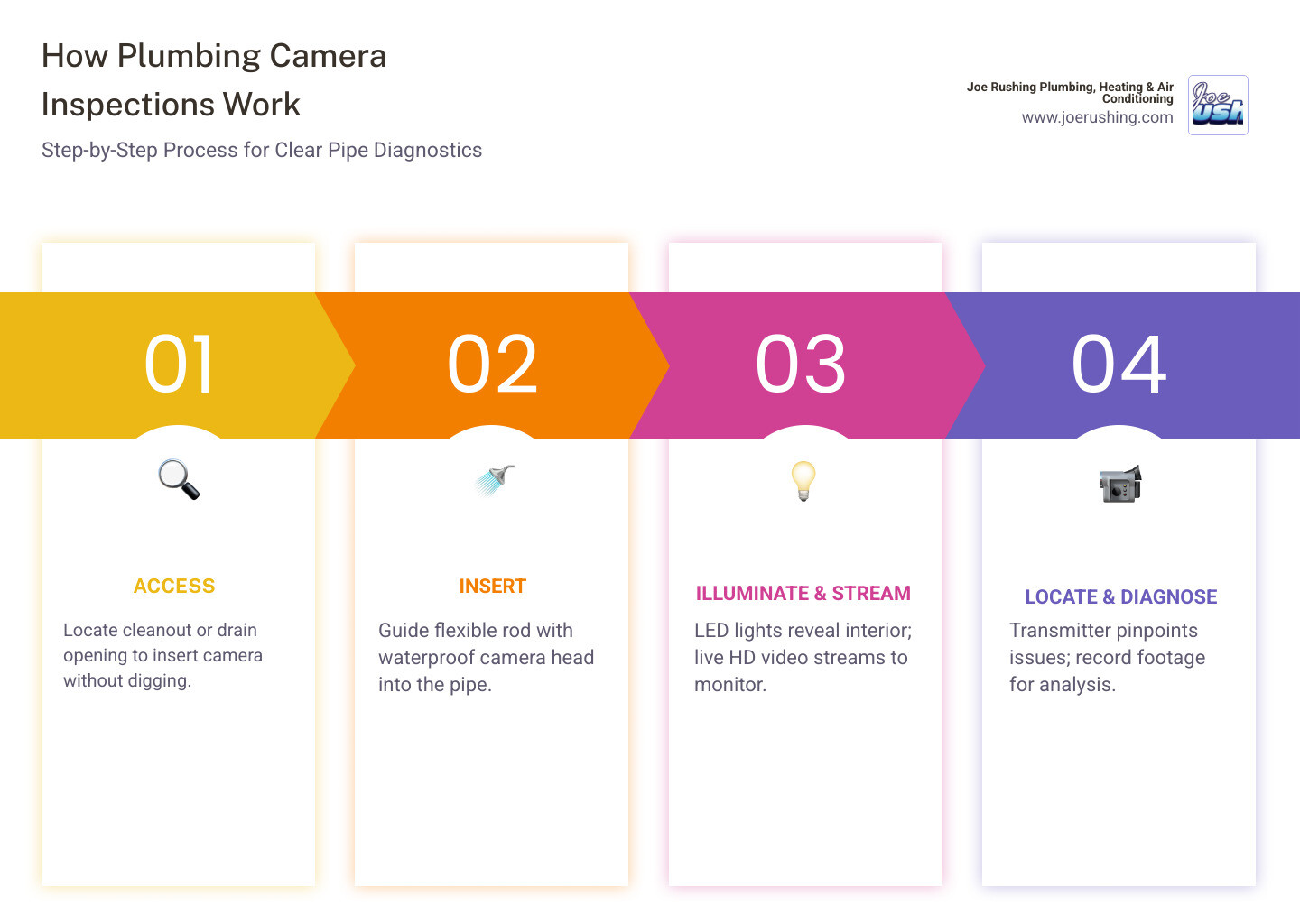
How Plumbing Camera Inspections Work: The Step-by-Step Process

When we arrive at your home in Lubbock or Levelland, we don't start by guessing. We start by seeing. The process of how plumbing camera inspections work is a methodical journey through your home's "hidden" infrastructure.
First, we look for a "cleanout." This is a capped pipe located outside your home or in a basement that provides direct access to the main sewer line. If a cleanout isn't available, we may use a roof vent or remove a toilet to gain entry. Once we have a clear path, the real magic begins.
We insert a high-resolution, waterproof camera head attached to a long, flexible fiber-optic cable. This isn't just any cable; it’s a "push rod" designed to be stiff enough to travel hundreds of feet but flexible enough to navigate those 45- and 90-degree bends in your plumbing. As we feed the line through, powerful LED lights on the camera head turn the pitch-black interior of your pipes into a bright, visible workspace.
The camera streams a live, high-definition feed back to a portable monitor. We watch this screen closely, looking for anything that shouldn't be there. We aren't just looking for big "monsters" like collapsed pipes; we’re looking for the small stuff—hairline cracks, offset joints where the pipe has shifted, or the very beginning of a grease buildup.
The 5-step professional inspection process typically looks like this:
- Initial Assessment: We discuss your symptoms (slow drains, gurgling sounds) to determine the best entry point.
- Insertion and Navigation: We carefully guide the camera through the system, using "finesse" rather than force to avoid damaging older, fragile pipes.
- Real-Time Observation: We monitor the HD feed, pausing at suspicious areas to get a 360-degree view.
- Signal Location: If we find a problem, we use a built-in transmitter to mark the exact spot on your lawn or floor.
- Reporting: We review the footage with you, explaining what we found and what the best next steps are.
If you are dealing with a mystery backup, it is vital to know Who to Call for a Professional Sewer Camera Inspection in Lubbock TX to ensure you get an accurate diagnosis.
The High-Tech Equipment Used in Modern Inspections
In April 2026, the equipment we use is more advanced than ever. Gone are the days of grainy, black-and-white static. Modern plumbing cameras use fiber-optic connections to deliver crystal-clear HD video. These lenses are often "self-leveling," meaning no matter how the camera twists or turns inside the pipe, the image on the screen stays upright. This prevents us from getting disoriented and helps us accurately identify the top, bottom, and sides of the pipe.
One of the most critical pieces of tech is the Sonde transmitter. This is a small radio device located inside the camera head. While the camera is underground, it emits a signal. We use a handheld receiver above ground to "catch" that signal. This allows us to tell you exactly where a break is—down to the inch—and how deep it is (often under 4-5 inches of concrete slab and 2 feet of West Texas dirt).
All this data is displayed on ground-level monitors that are sunlight-readable, and the entire session is digitally recorded. This recording is a "blueprint" for any future repairs, ensuring we don't dig a single inch more than necessary. For a more technical look at the differences between types of lines, check out our Deep Dive into Mainline and Lateral Line Camera Inspections.
Push Cameras vs. Crawler Cameras
Not all pipes are created equal, and neither are the cameras we use to see inside them.
- Push Cameras: These are the workhorses of residential plumbing. They are manually pushed by the technician. They are ideal for pipes ranging from 2 to 6 inches in diameter, which covers almost every drain in a standard Lubbock home. Their maneuverability allows them to navigate tight corners and smaller residential sewer laterals with ease.
- Crawler Cameras: Also known as robotic cameras, these are used for larger industrial or municipal pipes (up to 36 inches). They are remote-controlled and move on motorized wheels or treads. While rare for a standard kitchen sink clog, they are essential for inspecting large-scale neighborhood mainlines or commercial warehouse systems.
What a Plumbing Camera Can (and Can’t) Detect
A camera inspection is like an MRI for your home. It reveals a world of issues that were previously invisible. Some of the most common "villains" we find include:
- Tree Root Intrusion: In West Texas, thirsty roots will find even the tiniest crack in a pipe to reach the water inside. Once they get in, they grow quickly, eventually acting like a net that catches grease and debris.
- FOG Buildup: That stands for Fats, Oils, and Grease. Over time, these harden into a substance almost as tough as concrete, narrowing the pipe's diameter.
- Pipe Bellies: This is a "sag" in the line, often caused by shifting soil. Water and waste pool in the sag, leading to frequent clogs.
- Material Identification: We can tell if your pipes are PVC, cast iron, or old clay, which helps us decide if high-pressure tools like hydrojetting (which uses 3,000 to 4,000 PSI) are safe to use.
If you're tired of temporary fixes, it's time to Stop Guessing and Start Seeing with Lubbock Sewer Camera Inspections.
The Limitations of Visual Inspections
While the technology is incredible, it’s important to understand what it can’t do. A camera sees the inside of the pipe. It cannot "see" through the pipe wall to find water that has already escaped into the soil.
If a pipe is filled with muddy water or heavy waste, the camera's "eyes" are blinded. In these cases, we often have to clear the line with a snake or hydrojet first just to see what we're doing. Furthermore, because pipe walls (especially cast iron) are thick, what looks like a crack on camera might just be a surface scratch or a line of "gunk" that isn't actually leaking. This is why we often use secondary testing, like hydrostatic pressure tests or leak isolation tests, to confirm if a visible flaw is a true leak.
| Feature | Camera Inspection | Leak Isolation Test |
|---|---|---|
| Primary Goal | Visual identification of blockages/damage | Confirming if the system holds pressure |
| Sees Roots? | Yes | No |
| Sees Water Loss? | No (only the potential cause) | Yes |
| Detects Clogs? | Yes | No |
| Non-Invasive? | Highly | Requires plugging lines |
Why Visual Diagnostics are Essential for Homeowners
Why should you care about how plumbing camera inspections work? Because it saves you money and stress. Early detection through this technology can reduce emergency plumbing calls by up to 40 percent. By catching a small root intrusion today, you avoid a sewage backup in your bathtub next month.
These inspections are also vital for:
- Insurance Documentation: If you have a major failure, having a video record of the pipe's condition can be the difference between a claim being accepted or denied.
- Home Buying: Standard home inspections usually stop at the drains. A "sewer scope" ensures you aren't buying a house with a $10,000 hidden pipe collapse.
- Post-Repair Verification: We use the camera after we've finished a job to show you that the line is 100% clear. It’s our way of proving the job was done right.
To get the most out of your service, make sure you understand the Affordable Sewer Camera Service in Lubbock TX (and Why You Need a Report).
Understanding How Plumbing Camera Inspections Work in Older Homes
In older Lubbock neighborhoods, many homes still have cast iron or clay tile pipes. These materials were the gold standard decades ago, but by 2026, many are reaching the end of their structural integrity. Cast iron can suffer from internal corrosion (scale), which makes the pipe walls "bumpy" and prone to catching toilet paper.
A camera inspection allows us to see if the pipe is still thick enough to be cleaned or if it has "rotted out" at the bottom. This is essential for determining if a home is a candidate for trenchless solutions like Perma-Liner, which can fix a pipe from the inside without digging up your yard. For more on this, see our Pipe Camera Inspection in Lubbock TX: A Homeowner's Guide to Non-Invasive Diagnostics.
Frequently Asked Questions About How Plumbing Camera Inspections Work
How long does a plumbing camera inspection take?
Most residential inspections in Lubbock or Levelland take between 30 minutes and 2 hours. The timeframe depends on how easy it is to access your cleanout and the length of the pipe we need to inspect. If the line is heavily clogged with "gunk," it may take longer as we move slowly to ensure we don't miss anything.
Is a plumbing camera inspection invasive or damaging to pipes?
Not at all. This is a non-destructive diagnostic tool. The cables are flexible and designed to slide along the pipe walls. Even in older, more fragile clay or cast iron pipes, the camera is safe. We use existing access points, so we don't have to tear into your walls or floors just to take a look.
Can the camera find the exact location of a problem?
Yes! Thanks to the radio transmitters (Sondes) mentioned earlier, we can pinpoint the exact location and depth of an issue. We use a surface receiver to track the camera head from above ground. This means if there is a break under your flower bed, we can mark that exact spot, allowing for "precision digging" rather than trenching your entire yard.
Conclusion
At Joe Rushing Plumbing, Heating & Air Conditioning, we believe that you shouldn't have to pay for guesswork. Understanding how plumbing camera inspections work is the first step toward a more efficient, less stressful home maintenance experience. Whether you're in Lubbock, Levelland, or anywhere in West Texas, our team is equipped with the latest 2026 camera technology to provide you with clear, honest answers.
We specialize in non-invasive solutions, including Perma-Liner no-dig drain repair and trenchless pipe bursting. By seeing the problem clearly before we ever pick up a shovel, we save you time, protect your property, and ensure your plumbing system is ready for the years ahead.
Don't let a hidden pipe issue turn into a major disaster. Schedule your professional camera inspection today and see exactly what's going on beneath your feet.
Need HVAC Help?
Our certified technicians are ready to help with all your heating and cooling needs.
Get Free EstimateMore Articles
View All PostsRelated Articles
Ready to Get Started?
Whether you need a repair, maintenance, or a new system installation, our expert team is here to help.