Is Your Repair Bill Robbing Your Future Replacement Fund?
Joe Rushing
Discover your repair vs replacement cost guide for homeowners. Master the 50% Rule, lifespans & efficiency to save big on HVAC, plumbing & roofs!
Is Your Repair Bill Robbing Your Future Replacement Fund?
Is Your Repair Bill Actually Worth It? A Repair vs Replacement Cost Guide for Homeowners
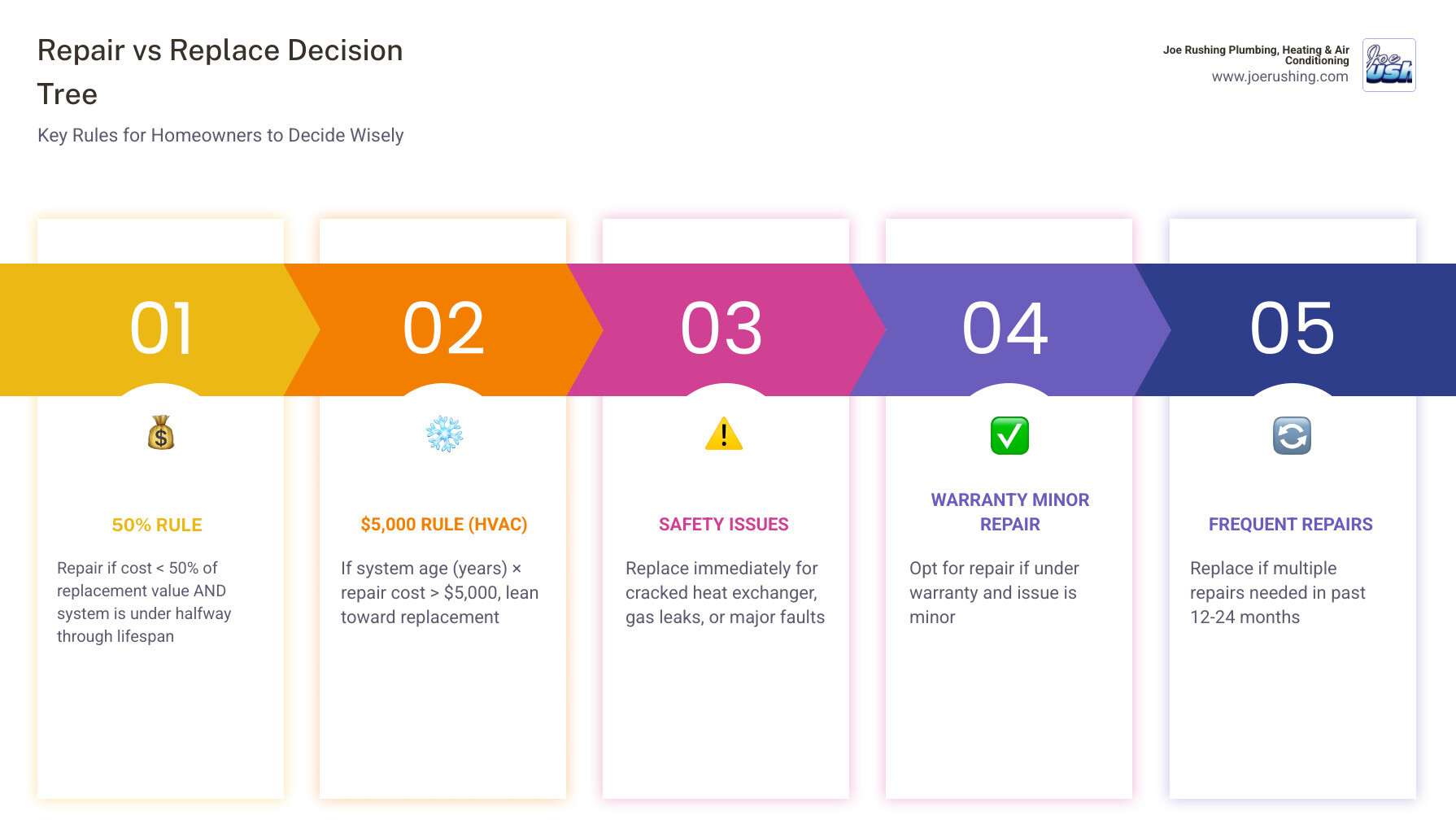
A repair vs replacement cost guide for homeowners can save you thousands — here's the quick answer most people need:
| Situation | Recommended Action |
|---|---|
| Repair costs less than 50% of replacement cost AND item is under halfway through its lifespan | Repair |
| Repair costs more than 50% of replacement cost OR item is past its expected lifespan | Replace |
| System age (years) × repair cost exceeds $5,000 (HVAC) | Lean toward replacing |
| Safety issue present (cracked heat exchanger, gas leak, major electrical fault) | Replace immediately |
| Item under warranty and repair is minor | Repair |
| Multiple repairs needed in the past 12–24 months | Replace |
Every homeowner eventually faces this moment. Something breaks — the furnace, the water heater, a leaking pipe — and suddenly you're staring at a repair quote wondering if you're throwing good money after bad. It's not just about what the fix costs today. It's about what that decision costs you over the next five, ten, or fifteen years.
The wrong call in either direction is expensive. Pay for a repair on a system that's already dying, and you'll likely be writing another check before long. Replace something that had years of life left, and you've spent money you didn't need to spend. The goal of this guide is to give you a clear, honest framework so you can make the right call — whether it's for your HVAC, plumbing, roof, or appliances.
I'm Ronda Rushing Brown, a third-generation leader at Joe Rushing Plumbing, Heating & Air Conditioning and a registered nurse who brings the same problem-solving mindset to home systems that I once brought to patient care — and this repair vs replacement cost guide for homeowners reflects decades of real-world experience helping families in Lubbock and Levelland make smarter, more confident decisions about their homes. Let's walk through exactly what you need to know.
The Financial Framework: A Repair vs Replacement Cost Guide for Homeowners
Deciding whether to fix an old unit or invest in a new one isn't just a "gut feeling" anymore. In April 2026, with the cost of materials and labor being what they are in West Texas, we need a more surgical approach to our home finances. We often tell our neighbors in Lubbock that your home is like a living organism; sometimes it needs a bandage, and sometimes it needs a transplant.
To help you decide, we rely on two primary mathematical frameworks that take the emotion out of the equation. These tools help you see if your current repair bill is actually a down payment on a replacement you’ll eventually have to buy anyway.

Applying the 50% Rule within the Repair vs Replacement Cost Guide for Homeowners
The 50% Rule is the "gold standard" for most household items, from your dishwasher to your water heater. The logic is simple: if the cost of the repair is more than 50% of the cost of a brand-new unit, and your current machine is more than halfway through its expected lifespan, you should probably replace it.
Why is this rule so effective? It accounts for investment recovery. When we pay for a major repair on an old system, we aren't just paying for a part; we are gambling that no other part will fail in the near future. In our experience across Lubbock and Levelland, once a system hits that 50% threshold in both age and repair cost, the "domino effect" of mechanical failure usually begins. By replacing the unit instead, you reset the clock on reliability and often gain a new manufacturer's warranty that protects your bank account for years to come.
Evaluating the 5,000 Rule for HVAC Systems
When it comes to heating and air conditioning, the stakes are higher because these systems are the most expensive mechanical components in your home. That’s where the 5,000 Rule comes in.
To use this rule, you multiply the age of the unit (in years) by the repair estimate. If the total is more than 5,000, it’s time to consider a replacement. For example:
- A 12-year-old AC unit needing a repair that is relatively significant: 12 × [Repair Cost] = If this exceeds 5,000, the math favors replacement.
- A 5-year-old unit needing the same repair: 5 × [Repair Cost] = This will likely be well under 5,000, making the repair a smart investment.
This rule is particularly helpful in West Texas because our climate puts an incredible strain on HVAC systems. The dust in Lubbock and the extreme summer heat in Levelland mean an "old" system here might be working twice as hard as one in a milder climate. The 5,000 Rule helps us account for that cumulative wear and tear.
| Indicator | Lean Toward Repair | Lean Toward Replacement |
|---|---|---|
| System Age | Less than 50% of expected life | More than 75% of expected life |
| Repair Frequency | First major issue in years | Second or third repair in 24 months |
| Energy Bills | Consistent with previous years | Stealthily rising every month |
| Parts Availability | Common, off-the-shelf parts | "Special order" or discontinued (R-22) |
| Safety Status | Minor mechanical wear | Cracked heat exchanger or electrical risk |
Lifespan Expectations and Red Flags for Major Systems
Knowing how long things should last is half the battle. If you don't know the "expiration date" of your equipment, you can't accurately use a repair vs replacement cost guide for homeowners.
In West Texas, we see a wide range of lifespans, but generally, you can expect:
- Central Air Conditioning: 15–20 years (though the Lubbock dust can shorten this if filters aren't changed).
- Gas Furnaces: 15–20 years.
- Water Heaters: 10–12 years.
- Asphalt Shingle Roofs: 20–30 years.
- Dishwashers and Washers: 9–13 years.
For a deeper dive into these specifics, check out our guide on When to Repair vs Replace Your HVAC or Plumbing.
Identifying Critical Failure Signs in Plumbing and HVAC
Sometimes, the decision is made for you by a "red flag" that signals a system is no longer safe or viable.
- The Cracked Heat Exchanger: In a furnace, this is a non-negotiable replacement. A crack can leak carbon monoxide into your home. Because the heat exchanger is the "heart" of the furnace, replacing just that part is often nearly as expensive as a new unit, but without the added benefits of a new blower motor and electronics.
- The "Death Rattle" Compressor: If your AC compressor is failing and the unit is over 10 years old, we almost always recommend replacement. The compressor is the most expensive part of the system; putting a new heart in an old body rarely leads to long-term success.
- Persistent Slab Leaks: In Lubbock and Levelland, many of our homes are built on concrete slabs. If you have recurring leaks under your floor, patching them one by one is a recipe for financial disaster and water damage. This is where modern technology like our camera inspections can help determine if you need a sectional repair or a full repipe.
Roof Longevity and Material Considerations
While we specialize in what's inside your walls, we know that what's on your house matters just as much. A roof with a few missing shingles after a West Texas windstorm is a prime candidate for a repair. However, if you're seeing widespread granule loss (the "sand" in your gutters) or your roof is over 20 years old, a replacement is often the better financial move.
A new roof doesn't just stop leaks; it improves your home's structural integrity and can significantly reduce your cooling costs. Modern "cool-roof" shingles are designed to reflect more sunlight, which is a lifesaver during those triple-digit August days in Levelland.
Hidden Factors: Efficiency, Insurance, and Resale
The sticker price of a repair or replacement is only part of the story. There are "invisible" costs and savings that can tip the scales.
Long-Term Savings and the Repair vs Replacement Cost Guide for Homeowners
When you replace an old system, you aren't just buying "not broken." You're buying efficiency.
As of April 2026, SEER2 standards have pushed HVAC technology to incredible heights. If you are replacing a 15-year-old AC unit (which might have been a SEER 10 or 13), moving to a modern SEER2-compliant system can reduce your monthly cooling bills by 20% to 40%. Over the course of five years, those savings can actually pay for a significant portion of the new system.
Furthermore, the R-22 refrigerant phaseout is now complete. If your older AC uses R-22 (often called Freon), a simple leak repair becomes a massive financial burden because the refrigerant itself is no longer produced and is incredibly expensive to source. If your system still runs on R-22 and has a leak, the "repair" is often just a very expensive temporary fix.
Navigating Insurance and Market Value
If your home has suffered storm damage—a common occurrence in West Texas—your insurance policy plays a huge role. It’s important to understand the difference between Replacement Cost Value (RCV) and Actual Cash Value (ACV).
- RCV policies pay to replace the item with a new one of similar quality.
- ACV policies pay what the item was worth at its current age (depreciated value).
If you have an RCV policy and a storm damages your 18-year-old roof or AC unit, you might only be responsible for your deductible to get a brand-new system. In that scenario, repairing it yourself out of pocket would be a massive financial mistake.
Additionally, consider your home's resale value. If you plan to sell your home in Lubbock within the next few years, a brand-new HVAC system or roof is a major selling point. Prospective buyers often flee when they see a 20-year-old furnace in the inspection report, fearing they'll be stuck with the replacement cost immediately after moving in.
Strategic Solutions and Modern Technology
At Joe Rushing, we believe in using the best technology to avoid unnecessary costs. Sometimes, you don't have to choose between a "patch" and "tearing everything out."
Perma-Liner and No-Dig Solutions
One of the biggest fears for homeowners in Lubbock and Levelland is a sewer line failure. Traditionally, replacing a sewer line meant digging a trench through your beautiful landscaping or, worse, jackhammering your living room floor.
We offer Perma-Liner no-dig drain repair. This technology allows us to create a "pipe within a pipe" using a specialized resin liner. It’s a permanent replacement for the structural integrity of your pipe, but without the cost and destruction of traditional excavation. This is a perfect example of a "strategic replacement"—you're getting a new pipe system without the collateral damage costs.
Questions to Ask Your Contractor Before Deciding
Before you sign off on a major repair or a full replacement, we encourage you to ask these five questions:
- "Can I see an itemized breakdown of parts vs. labor?" (This helps you see if you're paying for a cheap part that requires a very expensive, difficult installation).
- "What is the root cause of this failure?" (If the failure was caused by something else—like poor ventilation or dirty coils—a repair won't last unless that root cause is fixed).
- "What is the warranty on this repair versus a new unit?" (Repairs usually have a 30-90 day warranty; new units have 5-10 years).
- "Are there federal tax credits or utility rebates available for a replacement?" (The Inflation Reduction Act and local Texas utility programs often offer significant incentives for high-efficiency upgrades).
- "Would you do this repair if this were your own home?" (We pride ourselves on answering this one honestly every single time).
Frequently Asked Questions
When does a repair become a "money pit"?
A repair becomes a money pit when you find yourself calling for service more than twice in a 24-month period for the same system. Even if each individual fix is relatively affordable, the cumulative cost—plus the stress of repeated breakdowns—quickly outweighs the monthly payment of a new, reliable system. If you've spent more than 30% of what a new unit would cost on repairs over the last three years, you're officially in "money pit" territory.
How does the age of my home affect replacement decisions?
Older homes in West Texas often have "legacy" issues that make repairs more complicated. For example, if you have an older home in Lubbock with cast-iron pipes, a simple leak repair might reveal that the entire line is corroded. In these cases, a "spot repair" is often a waste of money because the pipe will just fail a few feet further down the line next month. Modernizing the system is usually the only way to find peace of mind.
Are there tax incentives for upgrading to high-efficiency systems in 2026?
Yes! As of 2026, federal tax credits (like those established by the Inflation Reduction Act) remain a powerful tool for homeowners. You can often claim credits for high-efficiency heat pumps, central AC units, and even water heaters. When you combine these with local Texas utility rebates, the "net cost" of a replacement often drops significantly, making the gap between a major repair and a new system much smaller than it looks on paper.
Conclusion
Choosing between repair and replacement is one of the most significant financial decisions you'll make as a homeowner. By using the repair vs replacement cost guide for homeowners, applying the 50% and 5,000 rules, and considering the long-term efficiency gains, you can stop "robbing" your future self and start investing in your home’s value.
At Joe Rushing Plumbing, Heating & Air Conditioning, we’ve been serving the Lubbock and Levelland communities for generations. We don't just want to fix your problem today; we want to be the team you trust for the next twenty years. Whether it’s using our underground camera inspections to save your yard or helping you navigate high-efficiency HVAC, we’re here to provide honest, non-invasive solutions.
Don't let a mounting pile of repair bills keep you from the comfort and safety you deserve. If you're facing a tough decision about your home systems, let us help you run the numbers.
Discover our full range of professional home services and let's make sure your home is working for you, not against you.
Need HVAC Help?
Our certified technicians are ready to help with all your heating and cooling needs.
Get Free EstimateMore Articles
View All PostsRelated Articles
Ready to Get Started?
Whether you need a repair, maintenance, or a new system installation, our expert team is here to help.