Discover how does hard water affect your plumbing: limescale buildup, leaks, pressure loss & water heater damage. Solutions inside!
Is Hard Water Trashing Your Home's Plumbing System?
What Hard Water Does to Your Home's Plumbing System
How does hard water affect your plumbing is one of the most important questions a homeowner in Lubbock or Levelland can ask — and the answer might surprise you. Here's a quick breakdown:
- Pipes narrow over time as calcium and magnesium minerals build up layer by layer on the interior walls
- Water pressure drops as mineral deposits restrict flow through your pipes and fixtures
- Appliances wear out faster — water heaters, dishwashers, and washing machines all take a hit
- Fixtures clog and corrode — showerheads, faucet aerators, and valves are especially vulnerable
- Energy bills go up because appliances have to work harder to push water through mineral-coated systems
- Pinhole leaks develop when scale buildup accelerates corrosion inside metal pipes
Hard water isn't just a minor inconvenience. It's a slow, quiet force working against your entire plumbing system every single day. About 85% of homes across North America sit in areas with hard water — meaning most homeowners are dealing with this problem whether they know it or not. The minerals responsible, primarily calcium and magnesium, are picked up naturally as groundwater moves through rock and soil before it ever reaches your tap. Once inside your pipes, those minerals don't just pass through. They stick, layer, and harden — and over time, that buildup can cause serious damage that's expensive to ignore.
I'm Ronda Rushing Brown, a third-generation leader of one of the region's longest-running plumbing and HVAC companies, and I've spent years helping West Texas homeowners understand exactly how does hard water affect your plumbing — and what to do about it before the damage becomes a much bigger problem. Let's walk through everything you need to know to protect your home.
Understanding Hard Water and Its Mineral Composition
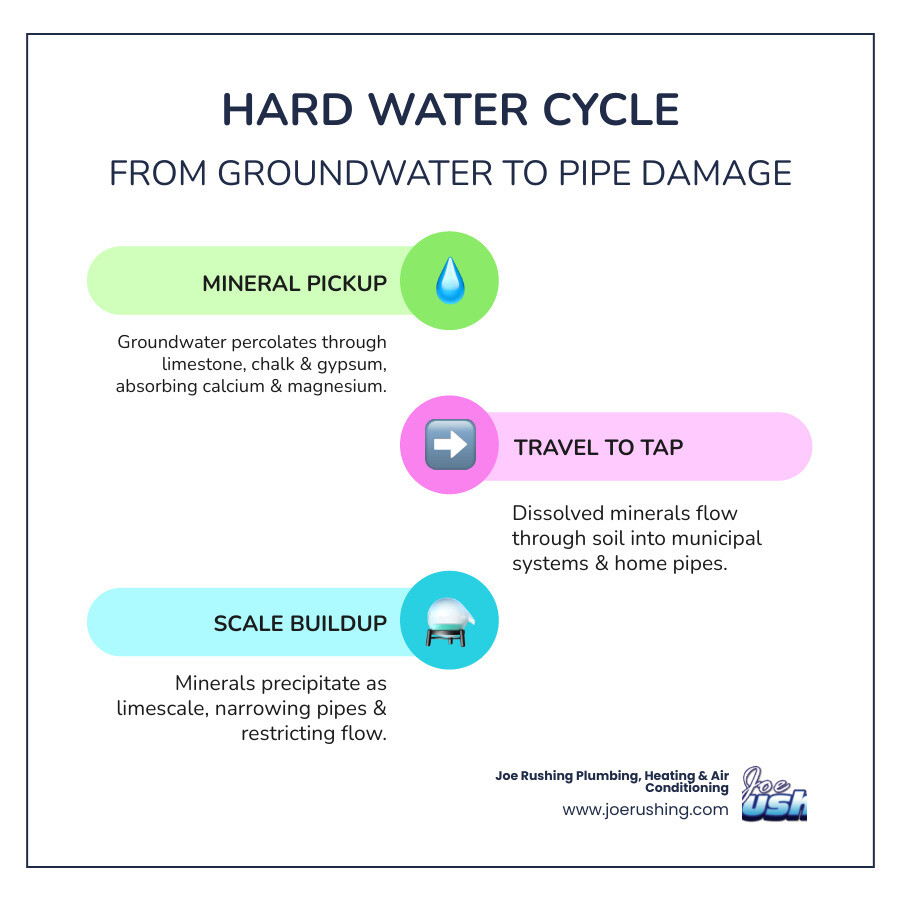
To understand the damage, we first have to look at the chemistry. Hard water is essentially water that contains a high concentration of dissolved minerals. As water travels through the ground in West Texas, it percolates through layers of limestone, chalk, and gypsum. During this journey, it "picks up" minerals like calcium and magnesium.
Specifically, hard water is rich in magnesium sulfates, calcium carbonates, and bicarbonates. While these aren't harmful to your health—and can actually provide a tiny boost of dietary minerals—they are a nightmare for inanimate objects like pipes and Water Heaters.
In the plumbing industry, we measure this hardness in two ways:
- Grains per gallon (gpg): This is the most common measurement for residential water softeners.
- Parts per million (ppm) or mg/L: This is often used in laboratory water analysis.
Generally, water is considered "hard" once it exceeds 7 grains per gallon (gpg) or 120 mg/L. In many parts of Lubbock and Levelland, we see numbers significantly higher than that. When water is this "heavy" with minerals, it is constantly looking for a place to deposit them.
How Does Hard Water Affect Your Plumbing and Pipes?

If you could see inside your walls, you’d likely see the primary culprit: limescale. Limescale is the rock-hard, chalky substance that forms when hard water minerals precipitate out of the liquid. This happens most aggressively when water is heated or when it sits still.
Think of mineral layering like the plaque in a human artery. Every time water flows through your home, a microscopic layer of minerals is left behind. Over years, these layers harden, leading to:
- Pipe Narrowing: As the scale gets thicker, the "inside diameter" of your pipe gets smaller. A one-inch pipe can easily be restricted down to the size of a straw over a decade of untreated hard water use.
- Flow Restriction and Friction: Because the interior of the pipe is no longer smooth, water creates more friction as it moves. This slows down the delivery of water to your tap.
- Pinhole Leaks and Corrosion: Many people think plastic pipes are immune, but that’s a myth. While materials like PEX and PVC are more resistant to the "sticking" of minerals, the chemical reaction of hard water can still lead to structural stress. In copper pipes, the minerals can react with the metal, creating tiny crevices where water traps and eats through the wall of the pipe, causing mysterious pinhole leaks.
Different materials react differently:
- Galvanized Steel: These older pipes are the most vulnerable, often clogging completely until no water can pass.
- Copper: High risk for corrosion and pinhole leaks.
- PVC/PEX: While they don't corrode, they can still suffer from scale buildup at joints and fittings where the water flow slows down.
To prevent these issues from reaching a breaking point, we often recommend following a Water Heater Flushing Lubbock TX Guide to clear out the sediment before it migrates into your home's main lines.
How does hard water affect your plumbing fixtures?
Your fixtures are the "face" of your plumbing system, and they usually show the first signs of trouble. Have you noticed your showerhead spraying in five different directions, or your kitchen faucet "sputtering" when you turn it on?
Hard water minerals love to settle in aerators and showerhead nozzles. The tiny holes are perfect "collection points" for white, crusty deposits. Beyond the aesthetics, this buildup can ruin the internal seals and cartridges of expensive faucets. If your fixtures are leaking or underperforming, you may need Water Heater Repair & Installation Lubbock TX or fixture replacement to restore your home's functionality.
How does hard water affect your plumbing pressure?
There is a big difference between water pressure (the force) and water volume (the amount). Hard water ruins both. When your pipes narrow, you lose volume. When your valves and regulators get "gunked up" with scale, they can no longer accurately control the pressure. This leads to system stress, slower drainage, and a shower experience that feels more like a light drizzle than a refreshing soak. For those building new homes, following a Water Heater Installation Lubbock TX Guide can ensure your system is set up with filtration from day one to avoid these pressure drops.
The Impact on Water Heaters and Household Appliances
If hard water is a "menace" to your pipes, it is an absolute "assassin" for your appliances. Any appliance that uses or heats water—dishwashers, washing machines, and especially water heaters—is at risk.
The Insulation Effect When hard water is heated, the minerals solidify and fall to the bottom of the tank (in traditional heaters) or coat the heat exchanger (in tankless models). This layer of scale acts as an insulator. Instead of the heating element warming the water, it has to warm the layer of rock first, and then the water.
This leads to:
- 30% Higher Energy Use: Your heater stays on longer to achieve the same temperature.
- Rumbling and Popping Noises: This is the sound of steam bubbles escaping through the layer of sediment at the bottom of the tank.
- Premature Failure: The extra heat required to penetrate the scale can actually "cook" the bottom of the tank, leading to cracks and leaks.
Whether you are comparing Tank vs Tankless Water Heaters Lubbock or looking for a Lubbock Tankless Installation Complete Guide, the reality remains the same: without water treatment, your investment won't last as long as it should. If you find yourself with No Hot Water Lubbock TX, mineral buildup is often the prime suspect.
Telltale Signs of Hard Water Damage in Your Home
Not sure if your water is "trashing" your system? Here is a comparison of what to look for:
| Feature | Soft Water | Hard Water (The Warning Signs) |
|---|---|---|
| Glassware | Crystal clear | Spotted, cloudy, or "filmy" |
| Fixtures | Shiny and clean | White, chalky, or green crust |
| Laundry | Soft and bright | Stiff, dingy, or gray-looking |
| Skin/Hair | Smooth and hydrated | Dry, itchy skin; dull, frizzy hair |
| Soap | Lathers easily | Forms "soap scum" and doesn't bubble |
| Water Flow | Strong and consistent | Weak pressure or sputtering faucets |
In Levelland and Lubbock, these signs are incredibly common. If you are experiencing No Hot Water Levelland TX, it’s a sign that the "quiet force" of hard water has finally won. Consulting a Water Heater Install Levelland TX Guide can help you start fresh with a system protected by modern filtration.
Effective Solutions: Water Softeners and Treatment Systems
The good news? You don't have to just live with the damage. There are several ways to neutralize hard water before it enters your plumbing.
- Ion Exchange (Traditional Water Softeners): This is the gold standard. These systems use a resin bed and a brine tank (salt) to physically swap calcium and magnesium ions for sodium or potassium ions. They don't just "condition" the water; they actually remove the hardness.
- Template Assisted Crystallization (TAC): Often called "salt-free conditioners," these systems don't remove the minerals. Instead, they change the chemical structure of the minerals so they can't stick to your pipes.
- Reverse Osmosis (RO): Usually used for drinking water at a single tap, RO uses a semipermeable membrane to strip almost everything from the water, including minerals.
- Whole-House Filtration: For those installing high-end equipment, following a Licensed Tankless Installation Lubbock Guide or looking into Tankless Water Heater Installation Levelland TX often involves adding a scale inhibitor to protect the sensitive internal components of the heater.
Frequently Asked Questions about Hard Water
Is hard water safe to drink or bathe in?
Yes, it is perfectly safe to drink. In fact, some studies suggest the extra calcium and magnesium can be a minor health benefit. However, bathing in it is a different story. The minerals react with soap to create a "scum" that doesn't rinse off easily, which can lead to clogged pores, dry skin, and an itchy scalp.
How can I test for hard water at home?
The easiest way is the Soap Suds Test. Fill a clear bottle halfway with tap water, add a few drops of basic dish soap, and shake it. If the water gets cloudy and has very few bubbles, it’s hard. If it’s clear with a thick layer of suds on top, it’s soft. For a more accurate reading, you can buy DIY test strips at most hardware stores or call us for a professional analysis.
Can hard water damage be reversed without replacing pipes?
To an extent, yes. Minor buildup in fixtures can be cleared with vinegar or professional descaling solutions. For water heaters, a professional flush can remove loose sediment. However, once scale has "petrified" inside your main lines, it is very difficult to remove without damaging the pipe. In those cases, we use underground camera inspections to see how much room is left in your pipes and determine if cleaning or replacement is the best path forward.
Conclusion
At Joe Rushing Plumbing, Heating & Air Conditioning, we’ve seen how the "mineral menace" of West Texas water can turn a healthy plumbing system into a costly disaster. Whether you are in Lubbock or Levelland, you don't have to wait for a pipe to burst or your water heater to die to take action.
From our unique underground camera inspections that pinpoint clogs without digging up your yard, to our Perma-Liner no-dig drain repair and water damage restoration services, we have the tools to fix the damage hard water has already caused. More importantly, we can help you install the right treatment system to ensure your plumbing stays clear for the next 50 years.
Don't let hard water trash your home. Contact Joe Rushing Plumbing, Heating & Air Conditioning today to schedule a water quality test or a plumbing inspection. We’re here to keep your water flowing and your home comfortable!
Need HVAC Help?
Our certified technicians are ready to help with all your heating and cooling needs.
Get Free EstimateMore Articles
View All PostsRelated Articles
Ready to Get Started?
Whether you need a repair, maintenance, or a new system installation, our expert team is here to help.