How to Fix Hard Water Issues in Your West Texas Home
Joe Rushing
Discover water treatment solutions for West Texas homes. Fix hard water, scale buildup & contaminants in Permian Basin with expert filtration tips.
How to Fix Hard Water Issues in Your West Texas Home
The Real State of Water Treatment Solutions for West Texas Homes in 2026
Water treatment solutions for west texas homes are more important than ever — and if you're dealing with hard water stains, strange smells, or concerns about what's actually coming out of your tap, you're far from alone.
Here's a quick look at the most effective options available to West Texas homeowners right now:
| Solution | Best For | Key Benefit |
|---|---|---|
| Whole-home reverse osmosis | City and well water | Removes up to 99.99% of contaminants |
| Salt-free whole-home filter | Municipal water, eco-conscious homes | No salt, no electricity, no wasted water |
| Salt-based water softener | Severe hard water | Highly effective mineral reduction |
| Under-sink RO system | Drinking water only | Affordable, targeted purification |
| UV disinfection system | Well water with bacteria risk | Kills bacteria without chemicals |
| Multi-stage filtration | Oil field area homes | Addresses sediment, chlorine, heavy metals |
West Texas water comes with a unique set of challenges. Lubbock's water averages 243 PPM of hardness — enough to wear down appliances, clog pipes, and leave your skin feeling dry. Midland's water has tested at levels of arsenic, uranium, nitrates, and chloroform that far exceed what most families would consider acceptable. And for homeowners on well water near Permian Basin oil activity, there's the added concern of perchlorates, iron, and hydrogen sulfide making their way into the water supply.
This guide breaks down every major treatment option, what each one actually does, and how to match the right system to your home's specific water chemistry.
I'm Ronda Rushing Brown, a Registered Nurse and third-generation leader of Joe Rushing Plumbing, Heating & Air Conditioning — and helping West Texas families find the right water treatment solutions for west texas homes is something I take personally, because clean water isn't a luxury, it's a health issue. Read on for a complete breakdown of every option worth considering.
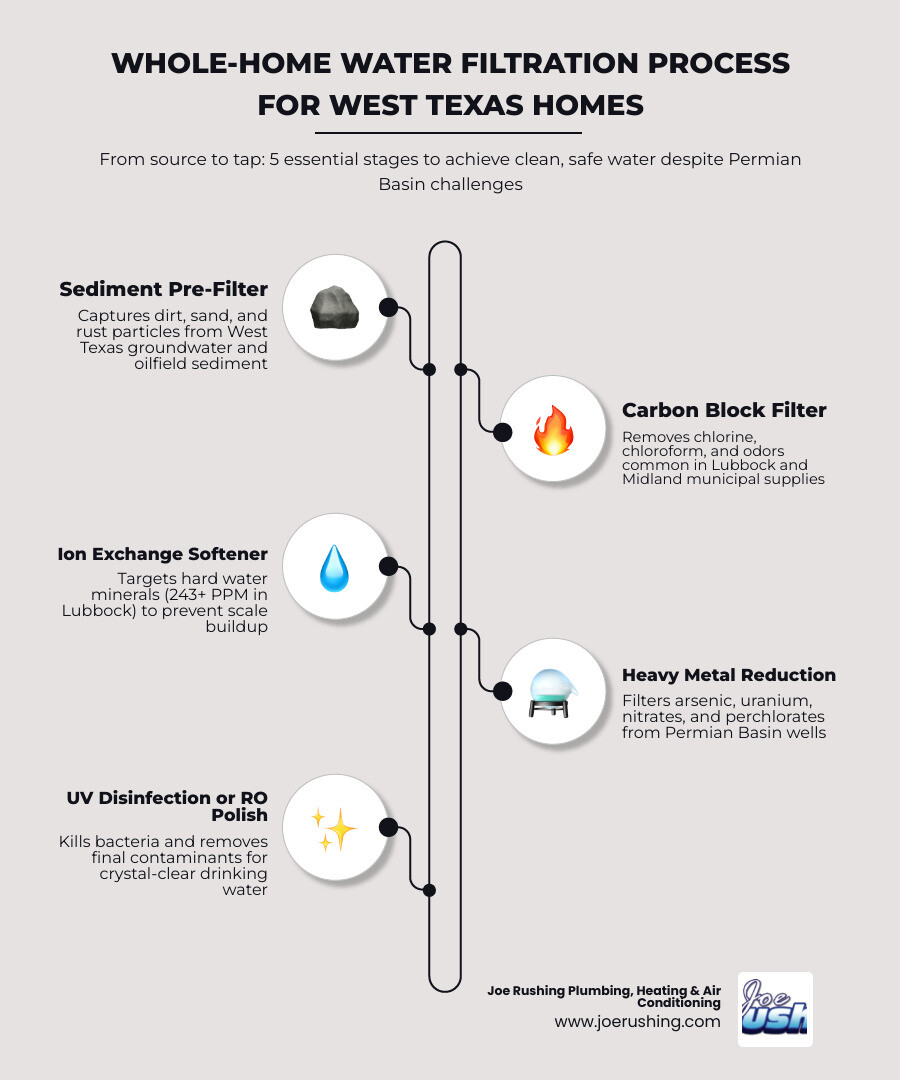
Common Water Quality Challenges in the Permian Basin

Living in West Texas means dealing with some of the most "stubborn" water in the country. When we talk about water quality here, we aren't just talking about a little bit of lime on your showerhead; we’re talking about a complex chemical cocktail shaped by our unique geology and industrial history.
The Hardness Factor
In Lubbock, water hardness averages about 243 PPM (parts per million). To put that in perspective, anything over 180 PPM is classified as "extremely hard." This hardness is caused by dissolved calcium and magnesium. While these minerals aren't toxic to drink, they act like liquid rock inside your home. They create the "stalactites and stalagmites" of scale you see on your faucets and, more importantly, the hidden buildup inside your plumbing that chokes off water pressure.
Contaminants in the Permian Basin
The challenges go deeper than just minerals. Recent data from the Midland area has revealed startling levels of various contaminants. Chloroform, often associated with liver damage risk, has been found at 3.7 times the recommended health guidelines. Even more concerning are the levels of Nitrate and Nitrite (18x), Uranium (23x), and Arsenic, which has been recorded at levels 2,717 times higher than some health benchmarks. These aren't just "flavor" issues; they are endocrine disruptors and kidney health risks that require serious water treatment solutions for west texas homes.
Oil Drilling and Local Geology
The Permian Basin is world-famous for oil, but that industry impacts our groundwater chemistry. Oil drilling can introduce perchlorates, heavy metals, and increased sediment into the local water table. Even if your home isn't right next to a rig, these substances can migrate through the aquifer. Furthermore, the warm West Texas climate can encourage the growth of bacteria and algae in water storage systems, making seasonal variations in taste and odor a common complaint for many residents.
Comprehensive Water Treatment Solutions for West Texas Homes
Because the water in Lubbock and Levelland is so complex, a "one size fits all" pitcher filter from the grocery store isn't going to cut it. We need robust, multi-stage systems designed to handle high mineral loads and specific chemical contaminants.
Reverse Osmosis (RO)
Reverse Osmosis is often considered the gold standard for water purification. It works by forcing water through a semi-permeable membrane that catches almost everything—lead, arsenic, uranium, and even the tiny molecules of fluoride and salt.
- Whole-Home RO: These systems treat every drop of water entering your house. They are the ultimate protection but require professional calibration to ensure they don't make the water too aggressive for your pipes.
- Point-of-Use RO: Usually installed under the kitchen sink, these provide "bottled water quality" for drinking and cooking without the plastic waste.
Whole-Home Filtration
Unlike a softener that just handles minerals, a whole-home filtration system targets chemicals like chlorine and VOCs (volatile organic compounds).
- Stage 1: Sediment Pre-filter: Removes sand, rust, and silt down to 5 microns.
- Stage 2: Kinetic Degradation Fluxion (KDF): Uses copper-zinc blends to neutralize chlorine and heavy metals while inhibiting bacteria growth.
- Stage 3: Activated Carbon: The "polishing" stage that removes pesticides, herbicides, and that "swimming pool" chlorine smell.
Why Your Household Needs Water Treatment Solutions for West Texas Homes
If you've ever stepped out of a shower in Lubbock feeling like your skin is two sizes too small, you've experienced the effects of hard water. The minerals strip away natural oils, leading to chronic dry skin and brittle hair.
Beyond personal comfort, your wallet takes a hit too. Dishwashers and washing machines in this region typically require repairs 2-3 times more frequently than the national average. Hard water scale builds up on heating elements, forcing your water heater to work harder and fail sooner. By installing a proper treatment system, you aren't just buying a gadget; you're protecting your plumbing and extending the life of every water-using appliance in your home.
Selecting the Best Water Treatment Solutions for West Texas Homes and Wells
For those living outside the city limits in rural areas, well water presents its own set of gremlins.
- Hydrogen Sulfide: That "rotten egg" smell isn't just unpleasant; it's a corrosive gas that can damage metal components in your home.
- Iron and Manganese: These cause those unsightly red or black stains in your tubs and toilets. Even if the water looks clear at first, once it hits the air (oxidation), the stains appear.
- Bacteria: Well owners are responsible for their own water safety. UV disinfection systems are a must-have for ensuring your family is protected from coliform and other organic contaminants.
Comparing Salt-Based Softeners and Salt-Free Filtration
One of the most common questions we hear at Joe Rushing is: "Do I need salt or not?" The answer depends on your goals and your home's specific water score.
| Feature | Salt-Based Softeners | Salt-Free Filtration/Conditioning |
|---|---|---|
| Primary Goal | Complete mineral removal | Scale prevention & chemical removal |
| Technology | Ion Exchange (swaps minerals for sodium) | Template Assisted Crystallization (TAC) |
| Maintenance | Monthly salt refills | Annual or bi-annual filter changes |
| Electricity | Required for regeneration cycles | Often non-electric options available |
| Water Waste | 20–40 gallons per cycle | Zero water waste |
| Feel | "Slippery" or "silky" feel | Natural water feel (no salt) |
Salt-Based Softeners
These are the traditional heavy hitters. They physically remove the calcium and magnesium. If you want to completely eliminate scale and get that classic "soft water" feel, this is the way to go. However, they do require you to haul heavy bags of salt and they discharge brine into the sewer system.
Salt-Free Systems
Technically "water conditioners," these systems don't remove the minerals; they change their chemical structure so they can't "stick" to your pipes or appliances. These are popular in 2026 because they are eco-friendly, require no electricity, and don't add sodium to your drinking water. They are excellent for municipal water where chlorine removal is the primary concern.
Protecting Your Plumbing and Appliances from Mineral Damage
We see it every day: a high-end tankless water heater that has completely scaled up and stopped working in less than three years. In West Texas, your plumbing is under constant attack.
When minerals build up inside your pipes, it’s like cholesterol in an artery. The opening gets smaller and smaller, reducing your water pressure and making your fixtures whistle or leak. A professional installation of a water treatment system acts as a shield. By calibrating the system to your specific water chemistry, we ensure that your water is "balanced"—not so hard that it scales, but not so soft that it becomes corrosive to copper pipes.
Frequently Asked Questions about West Texas Water
How does hard water affect my home appliances?
Hard water is an "efficiency killer." It creates a layer of insulation on heating elements in your water heater and dishwasher. This means the machine has to run longer and hotter to get the job done, which leads to burnt-out motors and cracked heating elements. In Midland and Lubbock, untreated water can cut the lifespan of a water heater by nearly 50%.
What is the difference between a water softener and a water filter?
Think of it this way: a water softener is a specialist that only cares about minerals (calcium and magnesium). A water filter is a generalist that removes chemicals, smells, and sediment. Most West Texas homes benefit most from a combination of both—a softener to protect the pipes and a carbon or RO filter to make the water safe and delicious to drink.
Is reverse osmosis necessary for city water in Midland and Lubbock?
While city water is treated to meet federal standards, many families choose RO as an "extra layer of insurance." Given the high levels of arsenic and nitrates found in regional testing, an RO system provides peace of mind that your family isn't consuming trace amounts of heavy metals or industrial byproducts that municipal plants might miss.
Conclusion
Finding the right water treatment solutions for west texas homes doesn't have to be a guessing game. Whether you are in Lubbock or Levelland, the first step is always a professional water test. You need to know exactly what is in your water before you can decide how to fix it.
At Joe Rushing Plumbing, Heating & Air Conditioning, we’ve spent decades navigating the unique groundwater challenges of the Permian Basin. We don't just sell equipment; we provide custom-tailored solutions that protect your health, your home, and your peace of mind. From non-invasive underground camera inspections to ensure your pipes are clear, to the latest in RO technology, we are here to make sure your water is as clear as a West Texas sunrise.
If you’re ready to ditch the bottled water and the dry skin, give us a call. We’ll help you find a system that fits your lifestyle and ensures your home’s plumbing stays healthy for years to come.
Need HVAC Help?
Our certified technicians are ready to help with all your heating and cooling needs.
Get Free EstimateMore Articles
View All PostsRelated Articles
Ready to Get Started?
Whether you need a repair, maintenance, or a new system installation, our expert team is here to help.