Discover the ultimate water heater buying guide for hard water areas. Choose tankless, heat pumps, or stainless steel to fight scale, save energy, and extend lifespan.
How Hard Water Affects Your Water Heater Choice
Why Your Water Heater Buying Guide for Hard Water Areas Starts With Knowing What's in Your Water
A solid water heater buying guide for hard water areas can save you thousands of dollars and years of headaches — especially if you live in West Texas, where hard water is simply a fact of life. Water in and around Lubbock and Levelland regularly exceeds 7 grains per gallon (gpg) — the threshold where water is officially considered "hard" — and in many cases pushes well past 10 gpg, where mineral damage to appliances accelerates significantly.
Here's a quick-reference snapshot to help you choose the right water heater for hard water conditions:
Best Water Heater Types for Hard Water Areas (Ranked)
- Heat pump (hybrid) water heaters — Most forgiving in hard water; highest energy efficiency; best long-term value
- Storage tank water heaters with glass lining — Reliable and widely available; manageable with regular maintenance
- Stainless steel tank water heaters — No anode rod needed; highly corrosion-resistant; great for very hard water
- Tankless water heaters — Efficient but high-maintenance in hard water; require a water softener and annual descaling
Key features to prioritize:
- Glass-lined or stainless steel tank construction
- Low-watt-density or titanium heating elements
- Self-cleaning dip tube
- Powered or magnesium anode rod
- Built-in scale detection (for tankless models)
Bottom line: In hard water areas, the type of water heater you choose — and the features it includes — matters far more than brand alone. Pairing any unit with a whole-house water softener is the single most effective way to extend its life.
Hard water doesn't just leave spots on your dishes or film on your shower glass. It quietly attacks your water heater from the inside out. Calcium and magnesium minerals dissolve into your water supply as it moves through underground rock formations, and when that water gets heated, those minerals separate out and stick to everything — your tank walls, your heating elements, your pipes. The result is a crusty, insulating layer called limescale that forces your water heater to work harder, use more energy, and wear out faster than it should.
In fact, at hardness levels of 22–23 grains per gallon — not uncommon in parts of West Texas — electric water heaters can fail in as little as three to four years. The national average lifespan is closer to twelve to fifteen years. That's a massive gap, and it's almost entirely preventable with the right equipment choices and maintenance habits.
This guide walks you through everything you need to know: what hard water actually does to your system, which water heater types hold up best, what features to look for, and how to keep your unit running longer regardless of what's coming out of your tap.
I'm Ronda Rushing Brown, a third-generation leader at Joe Rushing Plumbing, Heating & Air Conditioning and a Registered Nurse who has spent years helping Lubbock and Levelland homeowners navigate tough decisions — including putting together a reliable water heater buying guide for hard water areas that actually fits life here in West Texas. Whether you're replacing a failed unit or planning ahead, this guide gives you the straight answers you need to make a smart choice.
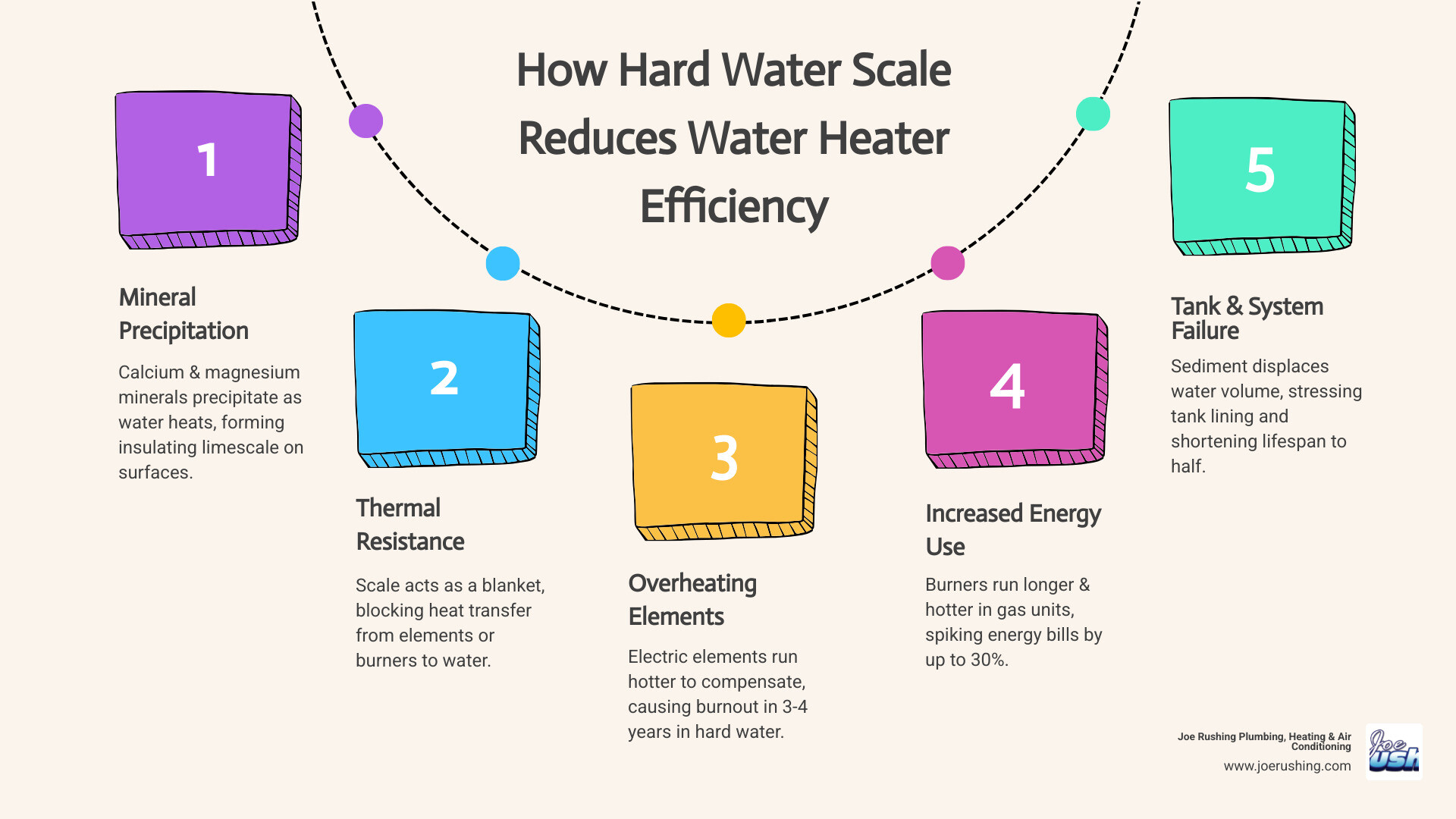
Understanding the Impact of Hard Water on Heating Systems
When we talk about hard water, we are really talking about chemistry. As water is heated, the solubility of minerals like calcium and magnesium decreases. This causes them to precipitate out of the liquid, forming a rock-hard substance known as limescale. In a water heater, this scale acts like a thermal blanket — but not the good kind.
Limescale creates significant thermal resistance. If you have an electric water heater, the scale coats the heating elements. Instead of the heat transferring directly into the water, the element has to heat the scale first. This causes the element to run much hotter than intended, leading to premature element burnout. In gas units, the scale settles at the bottom of the tank, creating an insulating layer between the burner and the water. This forces the burner to run longer and hotter, which can eventually stress and crack the tank's glass lining.
Beyond efficiency loss, scale takes up physical space. A thick layer of sediment at the bottom of a 50-gallon tank can displace several gallons of water, meaning you literally have less hot water available for your morning shower. You might also hear strange rumbling or popping noises. This happens when water gets trapped beneath the layer of scale, flashes into steam, and "bubbles" up through the sediment. If you are hearing these sounds, it's a clear sign you need Water Heater Repair & Installation Lubbock TX to address the buildup before the tank fails.
Signs of Hard Water Damage
How do you know if your current system is losing the battle against West Texas minerals? Look for these common red flags:
- White Residue: Crusty, white buildup on faucets, showerheads, or around the water heater's pressure relief valve.
- Reduced Flow: Scale can clog the hot water outlet or the heat exchanger in tankless units, leading to a noticeable drop in water pressure.
- Fluctuating Temperatures: If your water goes from hot to cold unexpectedly, scale may be interfering with the thermostat or the heating elements' ability to maintain a steady temperature.
- Popping or Rumbling Sounds: As mentioned, this is the sound of steam pockets bursting through sediment at the bottom of the tank.
- Frequent Repairs: If you find yourself calling for Water Heater Repair & Installation Wolfforth TX every year to replace burnt-out elements, your water hardness is likely the culprit.
Water Heater Buying Guide for Hard Water Areas: Choosing the Right Type
Choosing a new unit in April 2026 means looking at more than just the price tag. You need to consider how the technology interacts with our local water chemistry.
| Feature | Storage Tank (Gas/Electric) | Tankless (On-Demand) | Heat Pump (Hybrid) |
|---|---|---|---|
| Initial Cost | Lowest | High | Mid-High |
| Hard Water Tolerance | Moderate (with flushing) | Low (requires softener) | High (forgiving) |
| Lifespan in Hard Water | 8–10 years | 3–5 years (untreated) | 10–12 years |
| Maintenance Need | Flush every 6 months | Annual descaling | Annual filter/flush |
| Energy Efficiency | Standard | High | Highest (Energy Star) |
While traditional storage tanks are the most common, they are also the most susceptible to sediment accumulation. On the other hand, tankless units are extremely sensitive to scale because their heat exchangers have very narrow passages. If you choose tankless in West Texas, a water softener is essentially non-negotiable to prevent a total system failure within a few years.
For those looking for durability, stainless steel tanks are an excellent option. Unlike standard steel tanks, they don't require a sacrificial anode rod because the material itself is naturally resistant to corrosion. Non-metallic tanks, like the Rheem Marathon, use a plastic-like polybutylene tank that can never rust, though they still require element maintenance. If you're in the market for a long-term solution, we recommend looking into Water Heater Repair & Installation Levelland TX for these specialized models.
Benefits of Heat Pump Technology
Heat pump water heaters (also called hybrid units) are becoming the gold standard for efficiency and durability. Instead of generating heat directly through high-resistance elements, they pull ambient heat from the surrounding air and move it into the water.
Because they use electricity much more efficiently, Energy Star-rated heat pumps can save a family of four roughly $550 per year on energy bills — that's up to $5,600 over the unit's lifetime. From a hard water perspective, they are surprisingly forgiving. Because the heat transfer happens more gradually than the "scorching" heat of a traditional electric element, scale doesn't always bond as aggressively to the internal components. If you're looking for an upgrade in the South Plains, check out Water Heater Repair & Installation Brownfield TX for heat pump options.
Tankless Considerations for High Mineral Content
Tankless water heaters are prized for their compact design and "endless" hot water. However, in hard water areas, that convenience comes with a catch. The high heat used to instantly warm the water causes minerals to drop out of the solution rapidly inside the heat exchanger.
To combat this, look for units with:
- Scale Detection: Some modern units will alert you when it's time to descale.
- Integrated Descaling Ports: These allow a technician to easily flush the system with a cleaning solution without disconnecting the plumbing.
- Flow-Through Designs: These help minimize "dead spots" where minerals can settle.
If you are considering going tankless, talk to a pro about Water Heater Repair & Installation Shallowater TX to ensure you have the necessary pre-treatment in place.
Essential Features for Longevity in Mineral-Rich Water
When browsing our water heater buying guide for hard water areas, pay close attention to the internal specs. The "hidden" features often determine whether a unit lasts five years or fifteen.

- Vitraglas Lining: This is a professional-grade enamel lining that is fused to the internal steel tank. It provides a robust barrier against the corrosive nature of hot water.
- Hydrojet Total Performance System: This is a specialized dip tube that creates turbulence at the bottom of the tank. By keeping the water moving, it prevents sediment from settling and hardening into a "cake" at the bottom.
- Titanium Heating Elements: Standard copper elements corrode quickly in hard water. Titanium or stainless steel elements are much more resistant to mineral attack and high temperatures.
- Low Watt Density Elements: These elements have a larger surface area, meaning they don't have to get as hot to heat the water. Lower temperatures equal less scale formation.
For homeowners in the surrounding areas, finding a unit with these features is a priority. We can help you navigate these choices via Water Heater Repair & Installation Littlefield TX.
Advanced Anode Rod Technology
The anode rod is your water heater's "unsung hero." It is a sacrificial rod made of magnesium or aluminum that hangs inside the tank. Its sole job is to corrode so that your tank doesn't. In hard water, these rods work overtime and can be eaten away in just a couple of years.
- Magnesium vs. Aluminum: Magnesium rods generally provide better protection but can react with certain minerals to create a "rotten egg" smell. Aluminum-zinc rods are often used if odor is an issue.
- Powered Anode Rods: These are a game-changer for hard water areas. Instead of a metal that dissolves, a powered anode uses a small electrical current to prevent corrosion. They never need to be replaced and offer superior protection for the life of the tank.
If you haven't had your rod checked recently, it's a vital part of Water Heater Repair & Installation Plainview TX services.
Maintenance Strategies and Water Treatment Solutions
Even the best water heater won't survive West Texas water without a little help. Maintenance is the difference between a system that lasts and one that leaks.
The most important task is tank flushing. We recommend flushing your tank every six months in hard water areas. This involves connecting a hose to the drain valve at the bottom and running water until it comes out clear. This removes the "sludge" of calcium and magnesium before it hardens. You should also check your pressure relief valve annually to ensure it hasn't been "limed over" and stuck shut, which is a major safety hazard. For professional maintenance, we offer Water Heater Repair & Installation Slaton TX.
Integrating Water Softeners and Conditioners
If you want to stop the problem at the source, you need water treatment.
- Ion Exchange Softeners: These are the traditional salt-based systems. They physically remove calcium and magnesium and replace them with sodium ions. This is the most effective way to protect a tankless water heater.
- Salt-Free Conditioners: These use Template-Assisted Crystallization (TAC) to change the structure of the minerals so they don't stick to surfaces. They don't "soften" the water, but they are very effective at preventing scale.
- Magnetic/Electronic Treatment: These are non-invasive devices that use magnetic fields to keep minerals in suspension. While less powerful than ion exchange, they can help reduce scale in storage tanks.
Many manufacturers will actually void your warranty if you have extreme hard water and fail to provide treatment or regular descaling. Protecting your investment starts with Water Heater Repair & Installation Lubbock TX and a proper water analysis.
Frequently Asked Questions about Hard Water
How often should I flush my unit according to a water heater buying guide for hard water areas?
In standard conditions, once a year is fine. However, in West Texas, we recommend a 6-month flush. If your water is exceptionally hard (over 20 gpg), some manufacturers even suggest a 3-month interval. Regular flushing prevents the sediment from "fossilizing" at the bottom of the tank, which is much harder to remove later.
Can I install a tankless unit in a water heater buying guide for hard water areas?
Yes, but with a warning: you must have a water softener. Without it, the narrow heat exchanger will scale up quickly, leading to "code" errors and a loss of hot water. You will also need to perform an annual descaling (flushing with food-grade vinegar or a descaling solution) to keep the unit within warranty and running efficiently.
What is the best tank material for resisting hard water corrosion?
Stainless steel is widely considered the best for corrosion resistance, followed by high-quality glass-lined (vitreous enamel) steel. Plastic (polybutylene) tanks are also excellent because they cannot rust or corrode, though they are usually only found in specific high-end electric models.
Conclusion
Living with hard water doesn't have to mean living with constant water heater failures. By choosing a unit with the right lining, heating elements, and sediment-fighting features — and by committing to a regular maintenance schedule — you can enjoy reliable hot water for a decade or more.
At Joe Rushing Plumbing, Heating & Air Conditioning, we've seen everything West Texas water can throw at a home. Beyond just water heaters, we specialize in fixing water damage and offer advanced solutions like Perma-Liner no-dig drain repair and unique underground camera inspections. We serve Lubbock, Levelland, and the surrounding communities with the expertise needed to handle our unique regional challenges.
If you're ready to upgrade your home's hot water system or need a professional flush to save your current tank, visit our Water Heaters Service Page today. Let's make sure your next water heater is built to last!
Need HVAC Help?
Our certified technicians are ready to help with all your heating and cooling needs.
Get Free EstimateMore Articles
View All PostsRelated Articles
Ready to Get Started?
Whether you need a repair, maintenance, or a new system installation, our expert team is here to help.