Learn how ductless systems work for heating and cooling in Lubbock homes with efficient zoned comfort and reliable performance.
How Ductless Systems Work for Heating and Cooling
What Is a Ductless System and How Does It Work for Heating and Cooling?
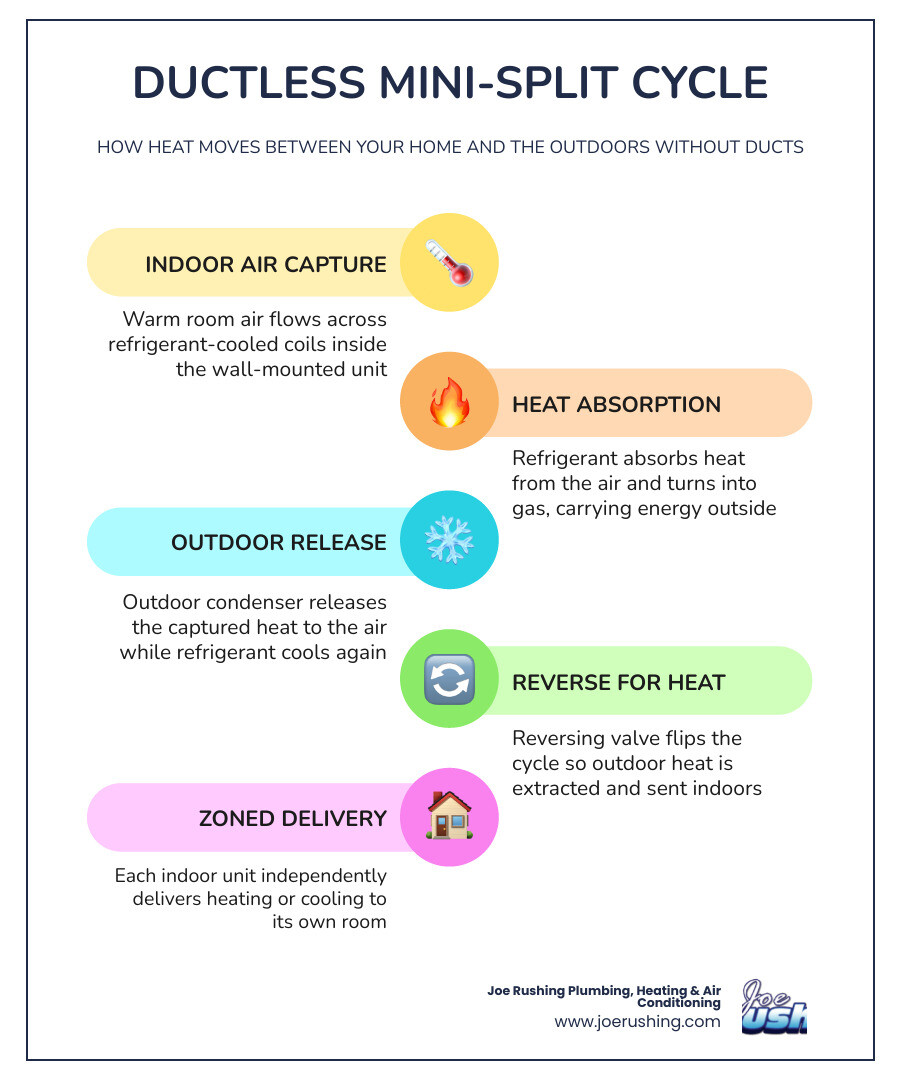
How ductless systems work for heating and cooling comes down to one simple idea: move heat, don't create it. Instead of pushing air through a network of ducts, a ductless mini-split uses refrigerant lines to transfer heat directly between an outdoor unit and one or more indoor air handlers mounted on your wall or ceiling.
Here's a quick breakdown of the core process:
- Cooling mode - The indoor unit pulls warm air from your room across a refrigerant-cooled coil. The refrigerant absorbs that heat and carries it outside, where the outdoor unit releases it. Cool air is then circulated back into the room.
- Heating mode - The system runs in reverse. The outdoor unit extracts heat energy from the outside air (even in cold weather) and transfers it indoors, where it's released to warm the space.
- Zoned control - Each indoor air handler operates independently, so you can set different temperatures in different rooms without affecting the rest of the home.
- No ducts needed - Refrigerant lines run through a small hole (about 3 inches) in an exterior wall, connecting indoor and outdoor units with no ductwork required.
For Lubbock and West Texas homeowners, this matters a lot. Summers are brutal and winters can surprise you. A system that handles both seasons efficiently — without losing energy through leaky ducts — is a practical upgrade worth understanding.
I'm Ronda Rushing Brown, a third-generation leader at Joe Rushing Plumbing, Heating & Air Conditioning, and I've spent years helping Lubbock families find smarter ways to stay comfortable year-round, including walking homeowners through exactly how ductless systems work for heating and cooling in our unique West Texas climate. In the sections below, I'll break down everything you need to know — from the refrigerant cycle to sizing, maintenance, and whether a mini-split is right for your home.
Defining the Ductless Mini-Split System

A ductless mini-split is a heating and cooling system that conditions rooms directly instead of sending air through ductwork. In plain English: no big sheet metal trunk lines in the attic, no floor vents, and no energy lost trying to push air across the house.
A typical system has these main parts:
- An outdoor condenser or heat pump
- One or more indoor air handlers
- Refrigerant lines connecting indoor and outdoor equipment
- A condensate drain line
- Electrical wiring and control cable bundled in a conduit
- A remote, wall control, or smart thermostat depending on the setup
The indoor unit is the part you see mounted high on a wall, recessed in a ceiling, or sometimes installed lower on a wall. It pulls room air in, passes it over a coil, and sends conditioned air back into the space.
The outdoor unit does the heavy lifting. It compresses refrigerant and helps release or absorb heat depending on whether the system is cooling or heating.
This is the key difference between ductless and traditional ducted HVAC:
- Ducted systems heat or cool air in one central location and distribute it through ducts
- Ductless systems treat individual rooms or zones directly at the indoor unit
That direct delivery is a big reason homeowners consider ductless systems for older homes, room additions, garages, workshops, sunrooms, and other spaces where adding ductwork would be invasive or inefficient.
If you want a broader overview of available options, visit our ductless page.
How Ductless Systems Work for Heating and Cooling
At the heart of a ductless system is heat transfer. The system does not "make cold." It moves heat from one place to another using refrigerant, coils, fans, and a compressor.
Here is the basic cooling cycle:
- The indoor unit draws warm room air across a cold evaporator coil.
- Refrigerant inside that coil absorbs heat from the air.
- Humidity also condenses out of the air, which helps the room feel more comfortable.
- The warmed refrigerant travels through the line set to the outdoor unit.
- The compressor pressurizes the refrigerant and the outdoor coil releases that heat outside.
- The refrigerant then expands, cools down again, and returns indoors to repeat the process.
That cycle runs over and over, but modern systems do it intelligently. Many ductless units use inverter-driven compressors, which can ramp up or down instead of simply turning fully on and fully off. That helps with:
- Better temperature consistency
- Lower energy use
- Less short cycling
- Quieter operation
- Improved humidity control
Traditional systems often cycle in larger bursts. Ductless systems, especially inverter models, are more like cruise control than stop-and-go traffic.
This operating style is one reason many homeowners start looking into mini-splits after dealing with hot and cold spots, rooms that never seem comfortable, or rising utility use. Our article on why homeowners are breaking up with their old HVAC digs into those comfort frustrations in more detail.
Understanding how ductless systems work for heating and cooling in winter
Heating mode is where many homeowners pause and say, "Wait, it pulls heat from cold outdoor air?" Yes. That is exactly what a heat pump does.
In heating mode, a reversing valve changes the direction of refrigerant flow. Instead of carrying heat from indoors to outdoors, the system captures heat from outside air and moves it inside.
The winter process looks like this:
- The outdoor coil absorbs heat energy from outdoor air.
- The refrigerant carries that heat to the compressor.
- The compressor increases refrigerant pressure and temperature.
- The indoor coil releases that heat into your home.
- The indoor fan distributes warm air into the room.
Even when outdoor air feels cold to us, it still contains heat energy the system can capture. That is why ductless heat pumps can provide efficient heating during much of a West Texas winter.
A few important notes:
- Standard and enhanced models vary in cold-weather performance
- Some systems keep heating effectively in very low temperatures
- In extreme cold, efficiency can drop and backup heat may still make sense in certain homes
- Proper sizing matters even more in heating mode
For Lubbock and surrounding West Texas areas, this usually makes ductless heating very practical, especially for additions, converted spaces, or rooms that never get enough warm air from a central system. Learn more on our general ductless service page for Lubbock.
How ductless systems work for heating and cooling in multi-zone setups
A single-zone mini-split has one outdoor unit connected to one indoor unit. A multi-zone system connects one outdoor unit to multiple indoor units placed in different rooms or areas.
That setup is popular when homeowners want:
- Independent room-by-room control
- Whole-home or near whole-home coverage
- Better comfort in problem areas
- Flexibility for additions or remodeled spaces
Each indoor unit acts like its own small comfort manager. One bedroom can be cooler, the home office can stay a little warmer, and the guest room does not need conditioning when no one is using it. That is zoned comfort in action.
Depending on the system design, one outdoor unit may support several indoor heads. Some multi-zone systems use branch boxes or distribution components to direct refrigerant where it is needed. The exact configuration depends on capacity, layout, and the number of rooms being served.
One thing homeowners should know: system design matters. Unit placement, room size, sun exposure, insulation, ceiling height, and airflow all affect how well a zone performs. Mini-splits are not a "stick one on the wall and hope for the best" kind of upgrade.
If you are considering one for an addition or a multi-room solution, our ductless mini-split installation and replacement service in Lubbock is a good place to start.
Why Efficiency Matters for Lubbock Homeowners
In West Texas, HVAC efficiency is not a minor detail. It affects comfort during long summer heat, winter cold snaps, and those shoulder seasons where temperatures seem to change their mind before lunch.
One reason ductless systems often perform so well is simple: no ducts. Research consistently shows that duct losses can account for more than 30% of energy used for space conditioning, especially when ducts run through unconditioned areas like attics. In homes around Lubbock, attic heat is no joke.
Ductless systems avoid that loss because they deliver conditioned air directly into the room.
Here is a quick comparison:
| System Type | Common SEER2 Range | Key Efficiency Factor |
|---|---|---|
| Ducted heat pumps | 15.2 to 25 SEER2 | Can lose energy through duct leakage |
| Ductless mini-splits | 15.2 to 35 SEER2 | No duct losses and strong zoning control |
Other useful efficiency benchmarks from current research include:
- Ductless systems are often about 20% to 30% more efficient than ducted systems
- Some ductless setups can reduce energy consumption by up to 40% compared to conventional systems
- Ductless AC systems average around 20 SEER2, while many ducted central AC systems average around 15 SEER2
Why the gap? Usually a mix of:
- No duct leakage
- Inverter compressor technology
- Variable-speed operation
- Room-by-room zoning
- Less conditioning of unused spaces
For homeowners in Lubbock, Levelland, and nearby communities, that can mean better comfort without over-conditioning the whole house just to fix one stubborn room. If your upstairs bonus room feels like a toaster in July while the rest of the house feels fine, ductless may be solving a design problem as much as an efficiency problem.
We talk more about those practical benefits in why Lubbock homeowners are splitting up with traditional AC.
That said, efficiency is not automatic. A poorly sized or poorly installed ductless system can still underperform. Bigger is not always better, and "one unit should handle it" is sometimes famous last words in home comfort planning.
Sizing and Maintaining Your System for Peak Performance
Sizing is one of the most important parts of ductless performance. If a system is too small, it runs too hard and may never fully keep up. If it is too large, it can short cycle, waste energy, and struggle with humidity control.
Capacity is typically discussed in BTUs. General room-size examples from the research include:
- 150 to 250 square feet: about 6,000 BTUs
- 250 to 300 square feet: about 7,000 BTUs
- 300 to 350 square feet: about 8,000 BTUs
- 400 to 650 square feet: about 12,000 BTUs
- 600 to 1,000 square feet: about 18,000 BTUs
- 800 to 1,300 square feet: about 24,000 BTUs
These are starting points, not final answers. We also have to account for:
- Ceiling height
- Window size and sun exposure
- Insulation quality
- Room layout
- Number of occupants
- Heat-producing appliances
- Local West Texas weather conditions
A west-facing room in Lubbock with lots of glass is a different animal than an interior bedroom with shade trees. Same square footage, very different load.
Maintenance matters just as much as sizing. A ductless system is low-maintenance, but it is not no-maintenance.
Homeowners should expect to:
- Clean or check filters about monthly, or more often with pets, dust, or smoke
- Keep indoor units free of dust buildup
- Make sure the outdoor unit stays clear of debris
- Watch for drainage issues from the condensate line
- Schedule professional maintenance annually
Professional maintenance should include checking:
- Refrigerant charge
- Coil condition
- Electrical connections
- Blower performance
- Drainage
- Overall operation in heating and cooling modes
This is especially important in West Texas, where dust can build up fast and airflow issues can quietly chip away at efficiency.
For ongoing system care, visit our ductless mini-split maintenance and tune-up page in Lubbock.
Frequently Asked Questions About Ductless HVAC
Can a ductless system heat my entire home?
Yes, it can in many homes, if it is designed correctly.
A whole-home ductless setup typically uses a multi-zone configuration with several indoor units tied to one or more outdoor units. The right answer depends on:
- Total heating and cooling load
- Home layout
- Insulation levels
- Number of rooms needing independent control
- Outdoor design temperatures in West Texas
Some homes do great with all-ductless comfort. Others use ductless as a supplement for trouble spots, additions, converted garages, or upstairs rooms. There is no one-size-fits-all answer, which is why load calculations matter.
If you are replacing an older setup or rethinking how comfort is delivered in your home, our article on ductless AC replacement in Lubbock made simple is a helpful next read.
Are ductless units quieter than traditional central air?
Usually, yes.
Indoor ductless air handlers are known for very quiet operation. Variable-speed fans and inverter compressors help avoid the loud full-blast starts common with some older systems. Outdoor units can also be quieter than many homeowners expect, with some systems operating around the sound level of a normal conversation.
That quieter performance is one of the most overlooked benefits of mini-splits. You get comfort without feeling like a jet engine is preparing for takeoff in the hallway.
What are the best rooms for a mini-split installation?
Ductless systems shine in spaces that are hard to heat or cool with standard ducted equipment.
Common good-fit locations include:
- Home additions
- Sunrooms
- Converted garages
- Workshops
- Attics
- Finished basements
- Home offices
- Guest rooms
- Older homes without existing ductwork
They are also a smart option for rooms with comfort complaints, such as spaces above garages, rooms with lots of afternoon sun, or areas at the end of long duct runs.
If an existing mini-split is not keeping up, making odd noises, leaking, or not switching modes correctly, our ductless mini-split repair service in Lubbock can help.
Conclusion
Ductless systems are popular for a reason. They heat and cool efficiently, avoid duct losses, offer zoned comfort, and fit homes or rooms where traditional ductwork is not practical. Once you understand the basics, how ductless systems work for heating and cooling is actually pretty straightforward: refrigerant moves heat, indoor units treat specific spaces, and the outdoor unit powers the cycle.
For homeowners in Lubbock, Levelland, and across West Texas, that can be a smart solution for additions, older homes, problem rooms, or even broader whole-home comfort plans.
At Joe Rushing Plumbing, Heating & Air Conditioning, we have served Lubbock since 1948. With 77 years of experience, 24/7 emergency service, licensed and insured technicians, and deep local knowledge, we help homeowners choose practical comfort solutions that work in real West Texas conditions. We are proud to be Lubbock's 2nd oldest plumbing company, and we bring that same long-standing commitment to heating and air conditioning service as well.
If you are exploring ductless options, start with our ductless services page.
Need HVAC Help?
Our certified technicians are ready to help with all your heating and cooling needs.
Get Free EstimateMore Articles
View All PostsRelated Articles
Ready to Get Started?
Whether you need a repair, maintenance, or a new system installation, our expert team is here to help.