Learn how agricultural dust clogs your HVAC system in Lubbock homes and discover practical steps to protect airflow and efficiency.
How Agricultural Dust Clogs HVAC Systems in Lubbock
Why Agricultural Dust Is One of the Biggest HVAC Threats in Lubbock, TX
How agricultural dust clogs your HVAC system is something every Lubbock homeowner near cotton fields, unpaved roads, or open farmland needs to understand. Unlike ordinary household dust, agricultural dust carries fine silica, crop chaff, mold spores, and pesticide residue — particles that stick to coils, pack into filters faster, and grind down moving parts over time. The result is reduced airflow, higher energy bills, and a system that wears out years too soon.
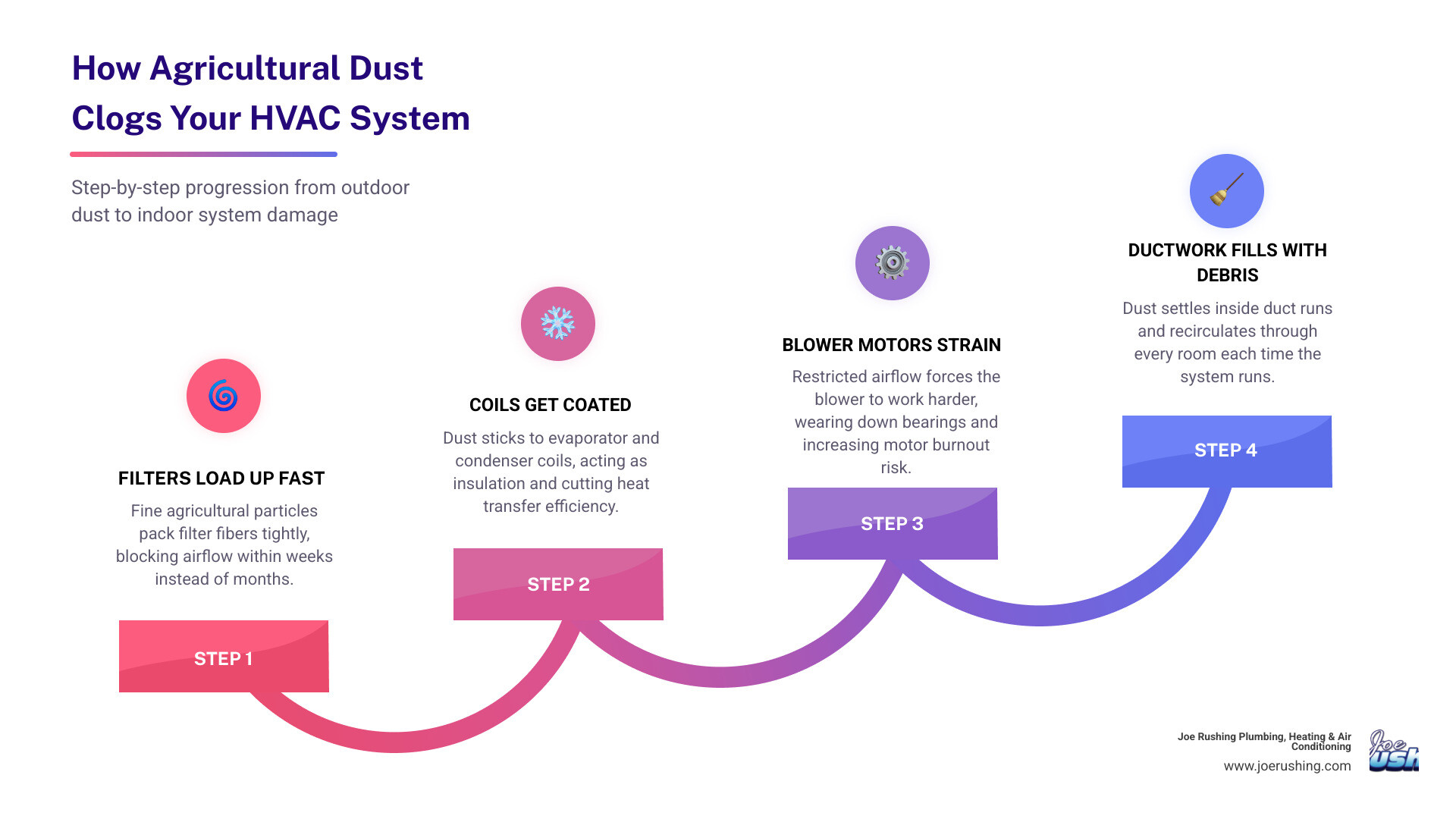
Here is a quick look at how it happens:
- Filters load up fast — Fine agricultural particles pack filter fibers tightly, blocking airflow within weeks instead of months.
- Coils get coated — Dust sticks to evaporator and condenser coils, acting as insulation and cutting heat transfer efficiency.
- Blower motors strain — Restricted airflow forces the blower to work harder, wearing down bearings and increasing the risk of motor burnout.
- Ductwork fills with debris — Dust settles inside duct runs and recirculates through every room each time the system runs.
- Leaky ducts pull in more dust — Gaps in ductwork draw in attic and crawlspace air loaded with additional particles.
- Coils can freeze — Heavy dust buildup on evaporator coils can prevent proper heat absorption, leading to ice formation and potential compressor damage.
West Texas conditions make all of this worse. Lubbock sits in the middle of one of the most active agricultural regions in the country, and dry winds, tilling seasons, and cotton harvests push enormous amounts of particulate matter into the air — and eventually into your home.
I'm Ronda Rushing Brown, a third-generation leader at Joe Rushing Plumbing, Heating & Air Conditioning, and after decades of serving Lubbock families, I've seen how agricultural dust clogs your HVAC system in ways that catch homeowners completely off guard. In this guide, I'll walk you through exactly what's happening inside your system and what you can do to protect it.
What Agricultural Dust Is and Why It Is Harder on HVAC Systems Than Normal Dust
Agricultural dust is not just "more dust." It is a rougher, finer, and more complicated mix of particles than what usually collects on a bookshelf.
In Lubbock and across West Texas, agricultural dust often includes:
- fine soil and silt
- silica and mineral fragments
- crop chaff and plant debris
- pollen
- mold spores
- pesticide or fertilizer residue
- dirt from unpaved roads
- lint-like seasonal debris from surrounding fields
That mix is harder on HVAC equipment for three main reasons:
- The particles are often smaller, so they slip deeper into filters and ductwork.
- The mineral content can be abrasive, almost like very fine sandpaper.
- Dry West Texas air creates static that helps dust cling to metal parts like coils and fan blades.
Ordinary household dust is usually made up of lint, fibers, pet dander, and skin cells. That is annoying, of course, but agricultural dust is more aggressive. It packs tighter, sticks harder, and wears components faster.

How agricultural dust clogs your hvac system faster than normal household dust
This is where the trouble starts. Fine agricultural particles can load a filter much faster than larger indoor dust. Instead of loosely collecting on the surface, they fill the tiny spaces in the filter media and choke airflow.
Some of that dust also bypasses low-quality filters, especially basic fiberglass filters. Once it gets past the filter, it can settle on:
- evaporator coils
- blower wheels
- supply ducts
- return ducts
- drain pans and condensate lines
When dust mixes with humidity or condensation around the coil, it can turn into a stuck-on film or even a mud-like layer. That is much harder to remove than loose surface dust.
Why Lubbock homes face heavier dust exposure
Lubbock homes deal with a combination that HVAC systems do not love:
- surrounding agricultural activity
- windy conditions
- long dry periods
- exposed soil during tilling and harvest
- dust from rural roads and driveways
- attic infiltration through leaks and gaps
Even homes that seem tight can still pull in dust through duct leaks, poorly sealed returns, attic penetrations, and frequent door traffic. In other words, West Texas dust is very good at finding a way in. It is basically the uninvited guest that never checks the calendar.
How Agricultural Dust Clogs HVAC Components
Once dust enters the system, it follows the airflow path and creates problems at nearly every stage.
| HVAC area | Household dust impact | Agricultural dust impact |
|---|---|---|
| Filter | Gradual loading | Rapid loading, tighter blockage |
| Evaporator coil | Light film over time | Sticky, insulating buildup that cuts heat transfer |
| Condenser coil | Outdoor dirt accumulation | Heavy windblown debris and fine silt reducing airflow |
| Ductwork | Settled dust | Deeper debris buildup and recirculation through the home |
| Blower motor and fan | Mild wear | Increased static pressure, harder strain, abrasive wear |
| Condensate system | Occasional grime | Dust sludge that can contribute to drain issues |
How agricultural dust clogs your hvac system at the filter and return side
Your return side is the front door of the HVAC system. If agricultural dust is heavy outside, the filter catches a lot of it fast.
A clogged filter does two bad things at once:
- It reduces airflow through the system.
- It increases static pressure, which forces the blower motor to work harder.
That added strain is one reason dirty systems run longer and wear out sooner. Research also shows that even a thin, almost invisible layer of dust inside ducts can reduce airflow by up to 20%.
Filter type matters here. In dusty areas like Lubbock, pleated filters usually perform better than cheap fiberglass filters because they capture finer particles more effectively. But the filter still has to be matched to the system. Going too restrictive without checking airflow can create a different problem, so filter upgrades should be chosen carefully.
What happens when dust coats coils, fans, and duct interiors
Coils are where efficiency lives or dies.
The evaporator coil inside your home absorbs heat. The condenser coil outside releases it. When agricultural dust coats either coil, heat transfer drops. The dust acts like insulation on a part that is supposed to transfer heat efficiently.
According to research referenced in the HVAC industry and the U.S. Department of Energy, even a microscopic dust layer on a coil can reduce efficiency by more than 20%. A buildup as small as 1/16 inch can cut coil efficiency by up to 21%.
That can lead to:
- longer cooling cycles
- weaker cooling
- frozen evaporator coils
- poor humidity removal
- extra compressor strain
Dust on blower wheels and fan blades also changes how air moves. The fan becomes less effective, and the system has to work harder to move the same amount of air.
Inside ductwork, settled dust narrows the effective air path. Dirty air ducts have been associated with 20% to 40% higher energy consumption, and dirty ducts can increase heating costs by 20% to 30%.
How clogged ductwork and leaks make the problem worse
Leaky ducts make a dusty problem much dustier.
If return ducts have gaps in attics or wall cavities, they can pull in dirty air from those spaces. That means your system is not just recirculating indoor air. It may also be vacuuming up attic dust and feeding it right back into the HVAC system.
This can cause:
- more dust on vents and furniture
- weaker airflow
- uneven room temperatures
- faster filter clogging
- more debris reaching coils and blower parts
When pressure is out of balance, the system may also short cycle or struggle to keep up. That is why duct sealing and duct inspection matter so much in homes near fields or windy roads.
Signs Agricultural Dust Is Already Affecting Your HVAC System
You usually will not see the whole problem directly, but your house will start giving clues.
Performance symptoms homeowners notice first
Watch for these warning signs:
- air filters turning gray or brown unusually fast
- weak airflow from vents
- rooms that feel hotter or colder than others
- AC running longer than normal
- more frequent on-and-off cycling
- thermostat setting not matching how the house feels
- noisy blower operation
- extra dust collecting on registers and furniture
- stale or dusty smell when the system turns on
If your utility use rises without a big change in weather or thermostat settings, dust restriction may be part of the reason.
Indoor air quality and health symptoms to watch
Agricultural dust is not just a mechanical problem. It can also affect what your family breathes.
Common symptoms include:
- sneezing when the HVAC starts
- coughing or throat irritation
- itchy or watery eyes
- worsened allergy symptoms
- asthma flare-ups
- stale indoor air
- musty or earthy odors
In farming areas, dust may also carry mold spores and other biological particles. That is one reason indoor air quality deserves just as much attention as HVAC performance. For families with kids, older adults, asthma, or allergies, recirculated dust can be a big deal.
How Dust Buildup Hurts Efficiency, Equipment Life, and Warranty Protection
Dust buildup is not only about comfort. It affects energy use, wear and tear, and even warranty coverage.
Why restricted airflow raises energy use and monthly strain
The easiest way to picture this is breathing through a straw stuffed with cotton. Air can still move, but it takes more effort.
That is what a dust-loaded HVAC system experiences.
Restricted airflow causes:
- higher static pressure
- longer run times
- more strain on the blower motor
- reduced cooling output
- weaker dehumidification
- more system cycling stress
Research shows dirty air ducts can increase energy consumption by 20% to 40%. Proper maintenance, including clean ducts and coils, can reduce energy use by 20% to 50%.
Even a very light coating matters. A nearly invisible layer of dust can reduce airflow by up to 20%, and a thin layer on the coil can slash efficiency by over 20%.
Can agricultural dust cause permanent damage or void warranties?
Yes, it can.
Over time, agricultural dust can contribute to:
- blower motor wear
- bearing and seal damage
- frozen evaporator coils
- compressor strain
- overheated components
- cracked heat exchanger risk in heating mode from chronic airflow restriction
Some of these issues can become permanent if buildup goes unchecked long enough.
Dust can also affect warranty claims. Manufacturer warranties generally cover defects, not damage linked to neglect. If a system fails because coils were never cleaned, filters were not replaced, or maintenance was skipped, the claim may be denied.
That is why we recommend keeping service records, especially in high-dust parts of West Texas. Documentation helps show that the system was maintained properly.
Maintenance and Filtration Strategies for Homes Near Fields in Lubbock
The good news is that dust problems are manageable if you stay ahead of them.
For homeowners dealing with Lubbock wind, farm traffic, and seasonal field dust, prevention usually works much better than waiting for airflow to collapse.
If you want to improve protection for your home and family, you can also learn more about indoor air quality services.
How often to inspect, clean, and service your system in dusty areas
In a normal environment, people often hear "change the filter every 90 days." Near agricultural activity, that advice is often too slow.
A better schedule for many Lubbock-area homes is:
- check filters every 2 weeks during harvest, drought, or windy periods
- replace many 1-inch filters about every 30 days during dusty seasons
- inspect the system seasonally
- schedule professional HVAC maintenance annually
- inspect ductwork every 2 to 3 years
- schedule duct cleaning about every 3 to 5 years, or sooner if dust buildup, allergies, or airflow problems are obvious
If you have pets, allergies, or leaky ducts, the schedule may need to be even tighter.
Which upgrades help capture dust without choking airflow
The best filtration setup is not always the "highest number possible." It is the one that captures fine particles while still allowing your system to breathe.
Helpful upgrades can include:
- pleated filters in the MERV 8 to MERV 13 range, depending on system design
- deeper media filters that offer more surface area
- properly sealed filter cabinets
- sealed return ducts
- whole-home air cleaners
- HEPA add-on solutions where the system supports them
- airflow balancing and static pressure testing
For many homes, MERV 8 to MERV 11 is a practical step up from fiberglass filters. In heavier dust or allergy situations, MERV 13 may be appropriate if the equipment can handle it without excessive restriction.
Which professional services remove agricultural dust most effectively
When agricultural dust gets deep into the system, surface cleaning is not enough.
The most effective services usually include:
- full HVAC inspection
- static pressure testing
- professional coil cleaning
- blower wheel and cabinet cleaning
- condensate drain flushing
- duct inspection
- duct sealing where leaks are found
- source-removal duct cleaning using negative pressure and agitation tools
That matters because DIY vacuuming at the vent opening only reaches a short distance into the duct. It does not clean deep runs, the air handler, the blower, or the coil where some of the biggest efficiency losses happen.
Frequently Asked Questions About How Agricultural Dust Clogs Your HVAC System
How often should homeowners in agricultural areas replace HVAC filters?
In Lubbock-area homes near fields, open lots, or unpaved roads, we recommend checking filters at least every 2 weeks during peak dust season. Many homeowners need replacement every 30 days during harvest or windy dry spells. If you have pets, allergies, or high system use, you may need changes even sooner.
When do seasonal conditions make dust problems worst in Lubbock?
Dust issues usually get worse during:
- spring winds
- tilling periods
- dry summer weather
- drought conditions
- cotton and crop harvest periods
- any major wind event or dust storm
Those are the times when outdoor particles rise sharply and filters can clog much faster than expected.
Is DIY vent vacuuming enough to remove agricultural dust?
No, not by itself.
Vacuuming visible dust from vent covers is helpful for housekeeping, but it does not remove buildup deep inside the duct system or on internal HVAC parts. Most DIY cleaning only reaches the first couple of feet. It also does not address dirty coils, blower buildup, static pressure problems, or duct leaks pulling in more dust.
For meaningful cleanup, the system usually needs professional inspection and cleaning.
Conclusion
Agricultural dust is a fact of life in Lubbock, but major HVAC damage does not have to be. When we understand how agricultural dust clogs your HVAC system, we can respond early with better filters, cleaner coils, sealed ducts, and timely maintenance.
That means:
- cleaner airflow
- better comfort
- less strain on your equipment
- healthier indoor air
- longer system life
At Joe Rushing Plumbing, Heating & Air Conditioning, we have served Lubbock families since 1948, and we know how hard West Texas dust can be on a home. If you want help protecting your system, improving airflow, or addressing indoor dust problems, visit our page for indoor air quality services.
Need HVAC Help?
Our certified technicians are ready to help with all your heating and cooling needs.
Get Free EstimateMore Articles
View All PostsRelated Articles
Ready to Get Started?
Whether you need a repair, maintenance, or a new system installation, our expert team is here to help.