Fix It or Forget It? Signs Your Home Systems are Ready for Retirement
Joe Rushing
Spot signs your systems need replacing not just fixing: age, costs, efficiency drops & red flags. Upgrade your Lubbock HVAC now!
Fix It or Forget It? Signs Your Home Systems are Ready for Retirement
How to Spot the Signs Your Systems Need Replacing Not Just Fixing
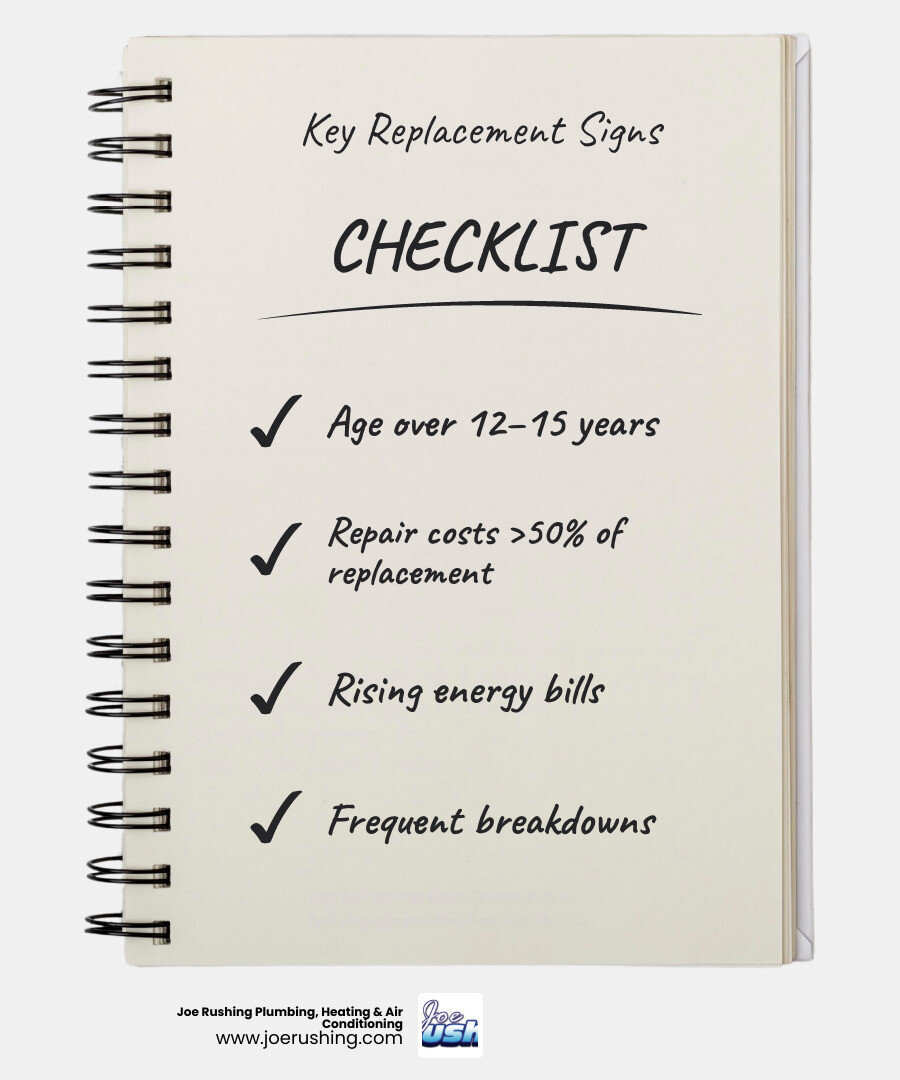
The signs your systems need replacing not just fixing are often easier to recognize than most homeowners expect. Here is a quick look at the most common ones:
- Age over 12–15 years — Performance drops significantly after this point, even with regular maintenance
- Repair costs exceeding 50% of replacement value — Known as the 50% rule, this is a reliable financial signal
- Rising energy bills without a clear cause — Aging systems lose efficiency and work harder for the same result
- Frequent breakdowns — Multiple repairs in a single year signal systemic failure, not isolated issues
- Uneven heating or cooling — Hot and cold spots throughout the home point to a system that can no longer keep up
- Strange noises or odors — Grinding, banging, or burning smells can indicate serious component failure
- R-22 refrigerant use — This coolant was phased out by the EPA in 2020, making repairs costly and difficult
- Major component failure — A failed compressor or cracked heat exchanger on an older unit rarely justifies repair
There is a point in every home system's life where patching the problem stops making sense. Most HVAC units are built to last 15 to 20 years, but performance often begins slipping well before that — typically around the 12-year mark. For homeowners in Lubbock and Levelland, where systems face intense summer heat and demanding conditions, that decline can come even sooner. The real question is not just whether your system can be fixed, but whether fixing it is actually worth it.
I am Ronda Rushing Brown, a third-generation leader at Joe Rushing Plumbing, Heating & Air Conditioning with decades of hands-on experience helping homeowners recognize the signs your systems need replacing not just fixing before small problems become costly emergencies. In the sections ahead, I will walk you through every key signal to watch for — so you can make a confident, informed decision for your home.
The Lifespan Factor: When Age Outweighs Maintenance
In home maintenance, age is more than just a number; it is a predictor of reliability. While most HVAC systems are designed with a lifespan of 15 to 20 years, the reality of living in West Texas means our units work harder than those in milder climates. The relentless heat of a Lubbock summer forces air conditioners to run for extended cycles, accelerating the wear and tear on internal components.
By the time a system hits 12 years of age, we often see a noticeable decline in performance. The motor might run a bit louder, the air coming from the vents might not feel as crisp, and the system may struggle to reach the temperature set on the thermostat. Even with meticulous annual maintenance, mechanical parts eventually reach their "fatigue point." When you are weighing the choice between a service call and a new installation, understanding When to Repair vs Replace Your HVAC or Plumbing is essential to avoiding a "money pit" scenario.
Recognizing the 15-Year Threshold
If your system is approaching or has passed the 15-year mark, you are essentially living on borrowed time. At this stage, the risk of a catastrophic failure—like a seized compressor or a rusted-out drain pan—increases exponentially.
To find out exactly where your system stands, look for the manufacturer’s data plate. This is usually a metal sticker located on the side of your outdoor condenser or the indoor furnace cabinet.

Once you find the plate, look for the "MFR DATE" or "Date of Manufacture." If the plate is faded or unreadable, the serial number often contains the year (for example, a serial number starting with "11" might indicate the unit was built in 2011). If your unit was installed back when smartphones were a new novelty, it is likely time to start planning for its retirement.
Why Older Systems Struggle in April 2026
As we move through April 2026, the technology gap between older units and modern systems has never been wider. Systems manufactured 15 years ago were built to different efficiency standards. Over time, friction, dust accumulation, and minor electrical degradations mean that an old "13 SEER" unit might only be performing at the level of an 8 or 9 SEER unit today.
Furthermore, parts for these older machines are becoming harder to source. Manufacturers eventually stop producing components for legacy models, meaning a simple fan motor replacement that should take one day could turn into a week-long wait while a part is shipped from across the country. In the middle of a Texas heatwave, that is a week nobody wants to endure.
The 50% Rule and Other Financial Signs Your Systems Need Replacing Not Just Fixing
Deciding whether to fix or forget a system often comes down to the "50% Rule." This is a simple financial benchmark used by professionals to help homeowners make logical, rather than emotional, investments.
The rule states: If the cost of a single repair (or the total cost of repairs over the last year) exceeds 50% of the cost of a brand-new system, replacement is the smarter choice.
| Factor | Repair It | Replace It |
|---|---|---|
| Repair Cost | Less than 30% of new unit cost | More than 50% of new unit cost |
| System Age | Under 10 years | Over 15 years |
| Frequency | First major issue in years | Multiple service calls in 12 months |
| Efficiency | Bills are stable | Bills increasing 10-20% annually |
Investing a significant amount of money into a system that is already near the end of its life doesn't reset the clock. It just buys you a little more time on a machine that will likely break down again soon. Choosing How to Pick the Perfect HVAC Installation Company Near Lubbock ensures that when you do decide to invest, the job is done right the first time.
How Frequent Repairs Act as Signs Your Systems Need Replacing Not Just Fixing
We often call it the "nickel and dime" effect. It starts with a $200 capacitor. Six months later, it’s a $400 contactor. Then, the blower motor goes, and you're looking at $800. Before you know it, you've spent a significant portion of what a new, warrantied system would have cost.
Frequent repairs are one of the most glaring signs your systems need replacing not just fixing. If you find yourself on a first-name basis with your repair technician, your system is trying to tell you something. Beyond the direct costs, you have to consider the "downtime cost." For a business, an hour of downtime can cost thousands. For a homeowner, it means lost sleep, uncomfortable family members, and the stress of rearranging your schedule for yet another service appointment.
Evaluating Efficiency Metrics as Signs Your Systems Need Replacing Not Just Fixing
Have you noticed your electric bill creeping up every summer, even though you haven't changed your habits? Aging systems lose their "muscle." As components wear down, the system has to run longer and work harder to achieve the same cooling effect.
By choosing to Upgrade Your Lubbock Home with a High-Efficiency AC Replacement, you can often reduce your energy consumption by 20% to 40%. Modern systems utilize SEER2 (Seasonal Energy Efficiency Ratio) ratings that far outpace the units of a decade ago. In many cases, the monthly savings on your utility bill can actually help offset the monthly investment in a new system.
Performance Red Flags: Comfort, Efficiency, and Air Quality
Sometimes the signs aren't found on a bill or a data plate; they are felt in the air. Your HVAC system is responsible for more than just temperature; it manages humidity, filtration, and air distribution. When it starts failing at these secondary tasks, it is a sign of systemic exhaustion.
Short Cycling and Inconsistent Temperatures
Does your AC turn on, run for three minutes, and then shut off, only to turn back on again moments later? This is called "short cycling." It is incredibly hard on the equipment—much like stop-and-go traffic is hard on a car engine. Short cycling can be caused by an oversized unit, a failing thermostat, or a dying compressor.
Similarly, if your living room is an ice box while your master bedroom feels like a sauna, your system may no longer have the "push" required to move air through the ductwork effectively. While sometimes these are duct issues, often they are signs your systems need replacing not just fixing because the blower or the system's capacity has degraded. For homes with stubborn comfort issues, many Lubbock Homeowners Are Splitting Up with Traditional AC in favor of more flexible, modern solutions.
Strange Noises and Safety Hazards
Your home should be a sanctuary, not a source of strange noises. While no system is silent, certain sounds are red flags:
- Grinding or Screeching: Often indicates failing bearings in the motor or a damaged compressor.
- Banging or Clunking: Could mean a part has come loose inside the housing.
- Hissing: Usually a sign of a refrigerant leak.
Odors are equally important. A "burning" smell could be electrical components overheating, which poses a fire risk. In gas furnaces, persistent odors or yellow burner flames can indicate a cracked heat exchanger—a serious safety hazard that can leak carbon monoxide into your home. If your system is old and develops a cracked heat exchanger, replacement is almost always the only safe and logical path.
Critical Component Failures and Outdated Technology
There are certain repairs that we consider "deal-breakers." If your system is over 10 years old and experiences a major component failure, the cost of the part plus the labor and the required refrigerant often makes the repair a poor investment.
If you are looking for a simpler way to handle these failures, Ductless AC Replacement in Lubbock Made Simple offers an alternative that bypasses many of the headaches associated with old, failing central air units.
The R-22 Refrigerant Dilemma
If your air conditioner was manufactured before 2010, there is a high probability it uses R-22 refrigerant (often called Freon). The EPA officially banned the production and import of R-22 in 2020 because of its ozone-depleting properties.
Why does this matter for your repair? Because the supply of R-22 is now extremely limited. If your old system develops a leak, "recharging" it with R-22 can cost a small fortune—sometimes hundreds of dollars per pound. Spending that much money just to fill a leaking, old system is rarely a good move. Modern systems use R-410A or the newer A2L refrigerants, which are better for the environment and much more affordable to service.
Major Component Breakdown
When a "heart" component fails, the system is usually ready for retirement. This includes:
- The Compressor: The most expensive part of your AC. If it dies on an out-of-warranty unit, replacement is usually the best path.
- The Blower Motor: Essential for airflow; replacing this on an old unit is often just the beginning of more repairs.
- The Evaporator Coil: If this is rusted or leaking, it often means the rest of the system is in similar condition.
Frequently Asked Questions about System Replacement
Are there situations where repairing an older system still makes sense?
Yes, there are a few exceptions. If your system is 12 years old but has a perfect maintenance history and the current issue is a minor, inexpensive fix (like a blown fuse or a clogged drain line), a repair is perfectly reasonable. Additionally, if you are planning to move out of the home in the next few months, you might opt for a repair to keep the system running for the sale. However, keep in mind that a brand-new system with a transferable warranty can actually increase your home's resale value and appeal to buyers.
What questions should I ask a professional during an evaluation?
When we visit your home for an evaluation, we encourage you to be curious! Ask your technician:
- "Based on the current wear, how much usable life is realistically left in this unit?"
- "Will my existing ductwork support a newer, high-efficiency system?"
- "Are there local rebates or energy incentives available for this model?"
- "Can you show me the temperature difference (delta-T) the system is currently achieving?"
When is the ideal time to replace a system to avoid emergencies?
The worst time to replace your AC is on a 105-degree Saturday in July when every HVAC company in West Texas is booked solid. The ideal times are the "shoulder seasons"—spring (March/April) and fall (October/November). During these windows, scheduling is much more flexible, and you can take the time to choose the right system without the pressure of a sweltering house. Replacing your system proactively ensures you stay comfortable all year long.
Conclusion
Recognizing the signs your systems need replacing not just fixing is the first step toward a more comfortable, energy-efficient home. Whether it’s the age of the unit, the rising cost of utility bills, or the "50% rule" signaling that repairs are no longer a sound investment, taking action early saves you from the stress of an emergency breakdown.
At Joe Rushing Plumbing, Heating & Air Conditioning, we have been serving our neighbors in Lubbock and Levelland for generations. We pride ourselves on offering more than just a quick fix. From our unique underground camera inspections that find plumbing issues without tearing up your yard to our Perma-Liner no-dig drain repairs, we focus on high-tech, non-invasive solutions for your home.
If your HVAC or plumbing systems are showing their age, don't wait for a total failure. Let our team provide a comprehensive evaluation to help you decide if it’s time to "fix it or forget it." Schedule your professional system evaluation today and experience the peace of mind that comes with a reliable, high-efficiency home.
Need HVAC Help?
Our certified technicians are ready to help with all your heating and cooling needs.
Get Free EstimateMore Articles
View All PostsRelated Articles
Ready to Get Started?
Whether you need a repair, maintenance, or a new system installation, our expert team is here to help.