Discover if gas vs electric water heater which is better for your home. Compare efficiency, costs, recovery rates & expert Lubbock installation tips.
Electric vs Gas Water Heaters Compared
Which Is Better: Gas vs Electric Water Heater?
Gas vs electric water heater which is better depends on your home's existing setup, your household's hot water demand, and your local utility rates — but here's a quick breakdown to help you decide fast:
- Choose gas if you have an existing gas line, a large household, or need fast hot water recovery after back-to-back showers
- Choose electric if your home lacks gas infrastructure, you have lower hot water demand, or you want simpler installation and less maintenance
- Consider a heat pump (hybrid electric) if long-term energy savings are your top priority and you have the right space for it
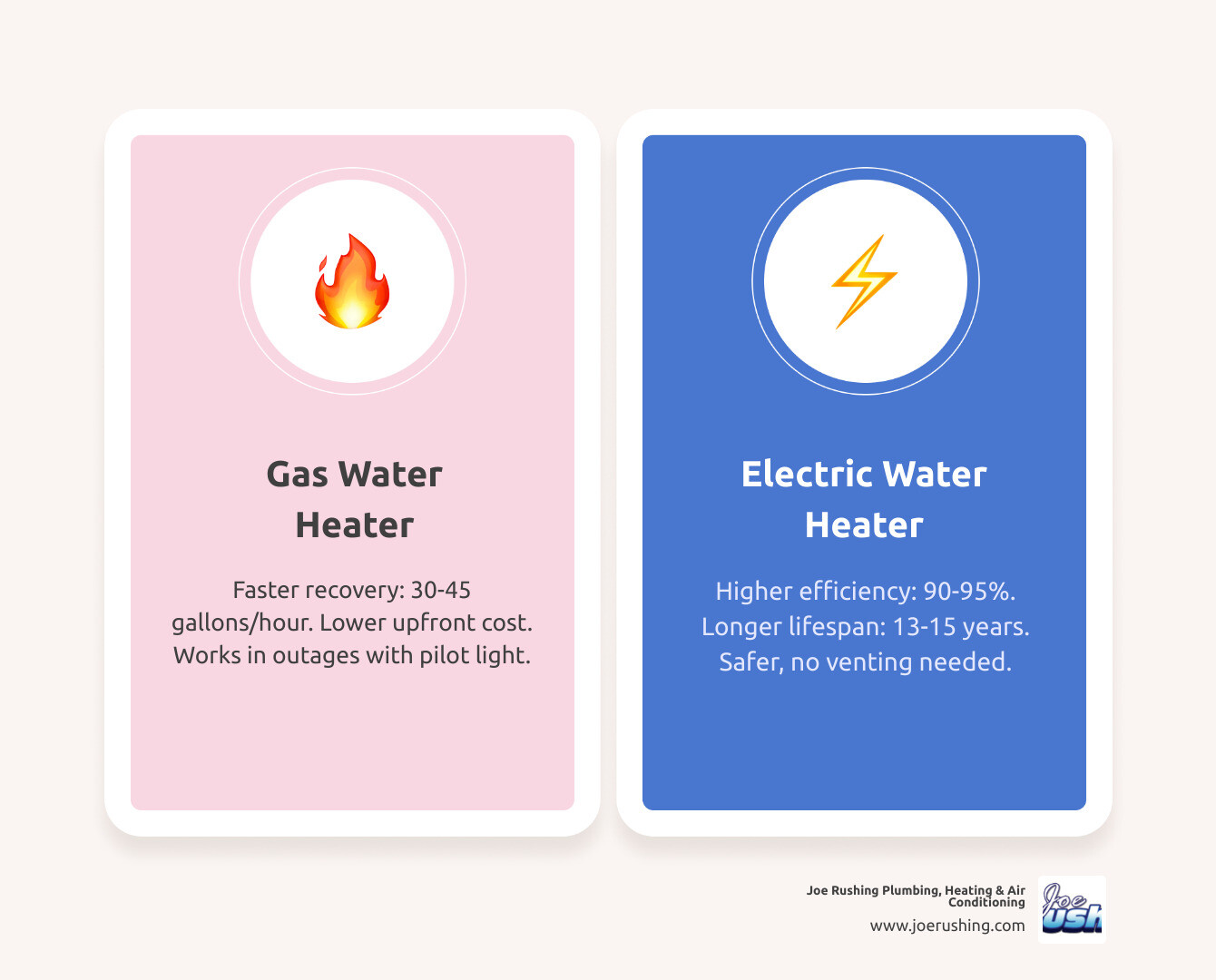
Neither type is universally better. Gas heaters heat water faster — recovering 30 to 45 gallons per hour compared to electric's 14 to 20 gallons per hour. But electric units are more energy-efficient in how they convert power to heat (90–95% vs. 60–70% for gas), last a few years longer on average, and carry fewer safety risks. Your best choice comes down to what your home already has and how much hot water your family actually uses.
I'm Ronda Rushing Brown, a third-generation leader at one of the region's longest-running plumbing, heating, and air conditioning companies, and I've helped countless Lubbock and Levelland homeowners work through exactly this decision — the gas vs electric water heater which is better question comes up constantly, and the right answer is always personal. Let's walk through everything you need to make a confident choice.
Core Differences in Operation and Infrastructure
When we talk about gas vs electric water heater which is better, we have to start with the "guts" of the machine. Even though they both sit in your garage or utility closet and deliver hot water to your taps, they go about it in completely different ways.
Gas Water Heaters: The Fire Under the Tank
A gas water heater is essentially a giant tea kettle. It uses a burner assembly at the bottom of the tank to ignite natural gas or propane. This flame heats the bottom of the tank and the flue pipe that runs through the center. Because there is actual fire involved, these units require a venting system to carry combustion byproducts—like carbon monoxide—safely out of your home.
In many West Texas homes, we see these units connected to existing natural gas lines. If you are building a new home or renovating, ensuring you have the right gas line capacity is crucial. Our team often handles Gas Line Services in Lubbock, TX to ensure these units have the fuel they need to operate safely and efficiently.
Electric Water Heaters: The Resistance Method
Electric water heaters don't use flames. Instead, they use electrical resistance. Inside the tank, you’ll find two metal loops called heating elements. When you turn on the hot water, electricity flows through these elements, they get incredibly hot, and they transfer that heat directly to the water.
Infrastructure-wise, electric units are "cleaner" because they don't need vents or gas pipes. However, they do require a heavy-duty electrical setup. Most residential models need a dedicated 240-volt, 30-amp circuit. If your electrical panel is already full, installing an electric heater might require a panel upgrade.

Gas vs electric water heater which is better for your household?
Choosing between these two often comes down to the "math of the morning shower." If you have four teenagers all trying to get ready for school at 7:00 AM, your needs are very different from a retired couple in Levelland.
To help you visualize the trade-offs, we’ve put together this comparison based on standard 50-gallon tank models as of April 2026:
| Feature | Gas Water Heaters | Electric Water Heaters |
|---|---|---|
| Recovery Rate | 30–45 Gallons Per Hour | 14–20 Gallons Per Hour |
| Energy Efficiency | 60–70% (Standard) | 90–95% |
| Average Lifespan | 8–12 Years | 10–15 Years |
| Upfront Cost | Generally Higher | Generally Lower |
| Monthly Bill | Typically Lower (Fuel Cost) | Typically Higher (Utility Rates) |
Recovery Speed and Peak Usage
The "recovery rate" is the amount of water a heater can raise by 90 degrees Fahrenheit in one hour. This is where gas shines. Because a gas flame is much hotter than an electric element, it can replenish the hot water in the tank nearly twice as fast. If you run out of hot water, a gas unit will have you back in the shower much sooner.
If you are currently experiencing "cold shower syndrome," it might be time for a professional look at your system. We provide comprehensive Water Heater Repair & Installation in Lubbock, TX to help families find the right balance between tank size and fuel type.
Deciding if a gas vs electric water heater which is better for high-demand homes
In our experience across West Texas, large households almost always prefer gas. When you have multiple bathrooms, a dishwasher, and a washing machine all competing for hot water, the fast recovery of a gas burner is a lifesaver.
Think about your peak usage. Does your family take back-to-back showers? Do you run the laundry while someone is bathing the kids? If so, the "wait time" for an electric heater to catch up can become a major point of frustration. For our neighbors in the surrounding areas, we often recommend gas for these high-demand scenarios. We offer specialized Water Heater Repair & Installation in Wolfforth, TX to ensure your high-demand home stays comfortable.
Determining if a gas vs electric water heater which is better for long-term efficiency
Efficiency is a tricky word in the plumbing world. If you look at the Uniform Energy Factor (UEF), electric heaters win every time. They convert nearly 100% of the electricity they consume into heat. Gas heaters lose a significant amount of energy (about 30-40%) just through the venting process—heat literally goes up the chimney.
However, "efficiency" on paper doesn't always equal a lower bill. In many parts of Texas, natural gas is significantly cheaper than electricity per unit of energy. So, even though the gas unit is "less efficient" at converting fuel, it might still be cheaper to operate month-to-month.
If you are looking for the absolute peak of efficiency, look for the Energy Star rating. High-efficiency gas models can reach up to 80% efficiency, while hybrid electric models can blow both standard types out of the water. We help homeowners navigate these ratings with Water Heater Repair & Installation in Plainview, TX.
Energy Efficiency and Environmental Impact
In April 2026, we are seeing a massive shift toward "greener" home solutions. If your goal is to reduce your carbon footprint, the gas vs electric water heater which is better debate takes on a new dimension.
The Rise of Heat Pump (Hybrid) Technology
The "gold standard" for eco-friendly water heating right now is the Heat Pump Water Heater (HPWH). Instead of creating heat through resistance or combustion, it works like a refrigerator in reverse. It pulls heat from the surrounding ambient air and dumps it into the tank.
- Efficiency: These are 2 to 3 times more efficient than standard electric units.
- Dehumidification: As a bonus, they dehumidify the space they are in—great for some Texas basements or utility rooms.
- Space Needs: They do require about 1,000 cubic feet of air space to "breathe" properly.
While they have a higher upfront cost, the long-term energy savings are massive. Real-world data shows that a hybrid unit might use only 20 kWh per month compared to 60 kWh for a standard electric resistance model. For those looking for the most sustainable Plumbing Services, this is often the top recommendation.
Environmental Trade-offs
Gas heaters produce direct greenhouse gas emissions through combustion. Electric heaters produce zero emissions at your home, but their "greenness" depends on how your local grid generates power. If your electricity comes from West Texas wind farms, your electric heater is incredibly clean. If it comes from coal, the story changes slightly.
Maintenance, Longevity, and Safety Considerations
No matter which side of the gas vs electric water heater which is better fence you land on, both require a little love to last.
The Battle Against Sediment
West Texas is known for many things, but "soft water" isn't usually one of them. Mineral buildup (sediment) is the number one killer of water heaters in Lubbock and Levelland.
- In Gas Units: Sediment settles at the bottom, creating a barrier between the flame and the water. This causes the tank to overheat and eventually crack.
- In Electric Units: Sediment can bury the lower heating element, causing it to burn out prematurely.
We recommend an annual sediment flushing to keep your unit running. Additionally, the anode rod (a sacrificial rod that prevents tank corrosion) should be checked every 2–3 years.
Safety Factors
Safety is a major consideration for many families.
- Gas Safety: The primary risks are gas leaks and carbon monoxide (CO). Modern units have "Flammable Vapor Ignition Resistant" (FVIR) technology and sealed combustion, but you still need working CO detectors in your home.
- Electric Safety: The risks here are purely electrical—short circuits or dry-firing (turning on the power when the tank is empty).
For peace of mind and professional maintenance, we provide Water Heater Repair & Installation in Slaton, TX to ensure your system is vented correctly and operating within safe parameters.
Frequently Asked Questions
Do gas water heaters work during power outages?
This is a classic "it depends." Older gas water heaters with a standing pilot light (a tiny flame that stays lit all the time) will work perfectly during a power outage because they don't need electricity to operate the gas valve.
However, many modern high-efficiency gas heaters use electronic ignition or power-venting fans. These units do require electricity to start the burner or blow exhaust out of the vent. If the power goes out in Levelland, these modern gas units will sit idle unless you have a battery backup. Electric water heaters, of course, will not heat any new water until the power returns, though the water already in the tank will stay warm for a few hours. We help local residents choose the right backup options with Water Heater Repair & Installation in Levelland, TX.
What are the challenges of switching fuel types?
Switching from gas to electric (or vice versa) is rarely a "plug and play" situation.
- Gas to Electric: You have to cap the gas line, seal the old vent, and—most importantly—run a new 240-volt circuit from your electrical panel to the water heater closet.
- Electric to Gas: This is usually more complex. You have to run a new gas line and cut a hole in your roof or wall for the new venting system.
Because of these infrastructure hurdles, we usually suggest sticking with the fuel type your home was built for unless you are doing a major renovation. If you are considering a switch, our experts in Gas Line Services in Wolfforth, TX can evaluate your home's structure to see if it's feasible.
Are tankless water heaters a viable alternative?
Absolutely. Tankless heaters (available in both gas and electric) heat water on demand rather than storing it.
- Pros: They provide "endless" hot water and take up very little space. They also have a lifespan of 20+ years.
- Cons: Gas tankless units require very large gas lines (often 3/4 inch) and specialized venting. Electric tankless units require a massive amount of electrical power—sometimes needing 3 or 4 dedicated breakers.
In West Texas, gas tankless is often a great fit for large families, while electric tankless is usually better suited for small "point-of-use" applications like a guest sink. We can help you size these systems correctly through our Water Heater Repair & Installation in Shallowater, TX services.
Conclusion
At the end of the day, the gas vs electric water heater which is better debate doesn't have a single winner—it only has a winner for your specific home. If you value fast recovery and lower monthly fuel costs, gas is your champion. If you prefer a lower upfront cost, simpler maintenance, and a longer-lasting unit, electric is the way to go.
At Joe Rushing Plumbing, Heating & Air Conditioning, we’ve been serving the Lubbock and Levelland communities for decades. We don't just swap out tanks; we look at the whole picture. Whether it's using our unique underground camera inspections to ensure your plumbing can handle a new high-flow system or utilizing Perma-Liner no-dig drain repair to fix issues without destroying your yard, we bring high-tech solutions to every job.
As we move through April 2026, home standards are higher than ever. Don't settle for lukewarm showers or sky-high utility bills. Whether you need a quick repair, a routine flush, or a brand-new installation, we are here to help you make the best choice for your family.
Ready to upgrade your home's comfort? Check out our full range of water heater services and let's get your hot water back on track!
Need HVAC Help?
Our certified technicians are ready to help with all your heating and cooling needs.
Get Free EstimateMore Articles
View All PostsRelated Articles
Ready to Get Started?
Whether you need a repair, maintenance, or a new system installation, our expert team is here to help.